Hinterecker Thomas, Leroy Caroline, Zhao Mintao, Butz Martin V, Bülthoff Heinrich H, Meilinger Tobias
Max-Planck-Institute for Biological Cybernetics, Spemannstr. 38, D-72076, Tübingen, Germany.
Eberhard-Karls University, Tübingen, Germany.
Mem Cognit. 2018 Jan;46(1):158-171. doi: 10.3758/s13421-017-0753-9.
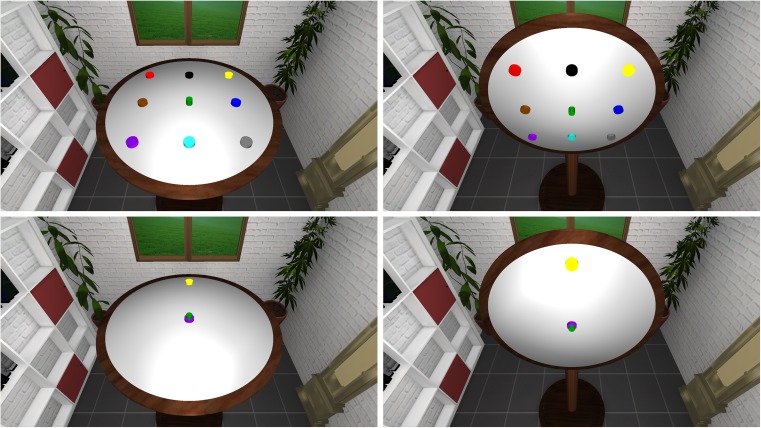
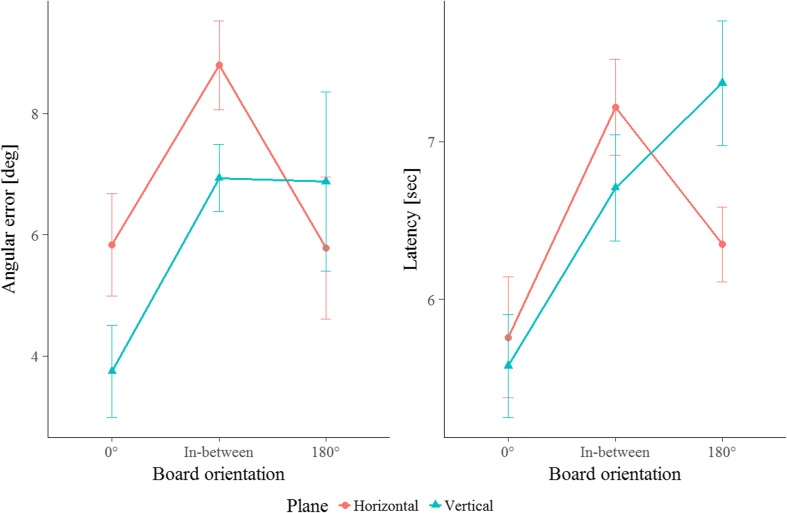
Previous behavioral and neurophysiological research has shown better memory for horizontal than for vertical locations. In these studies, participants navigated toward these locations. In the present study we investigated whether the orientation of the spatial plane per se was responsible for this difference. We thus had participants learn locations visually from a single perspective and retrieve them from multiple viewpoints. In three experiments, participants studied colored tags on a horizontally or vertically oriented board within a virtual room and recalled these locations with different layout orientations (Exp. 1) or from different room-based perspectives (Exps. 2 and 3). All experiments revealed evidence for equal recall performance in horizontal and vertical memory. In addition, the patterns for recall from different test orientations were rather similar. Consequently, our results suggest that memory is qualitatively similar for both vertical and horizontal two-dimensional locations, given that these locations are learned from a single viewpoint. Thus, prior differences in spatial memory may have originated from the structure of the space or the fact that participants navigated through it. Additionally, the strong performance advantages for perspective shifts (Exps. 2 and 3) relative to layout rotations (Exp. 1) suggest that configurational judgments are not only based on memory of the relations between target objects, but also encompass the relations between target objects and the surrounding room-for example, in the form of a memorized view.
以往的行为和神经生理学研究表明,对水平位置的记忆比对垂直位置的记忆更好。在这些研究中,参与者朝着这些位置导航。在本研究中,我们调查了空间平面本身的方向是否是造成这种差异的原因。因此,我们让参与者从单一视角视觉学习位置,并从多个视角检索这些位置。在三个实验中,参与者研究了虚拟房间内水平或垂直方向板上的彩色标签,并以不同的布局方向(实验1)或从不同的基于房间的视角(实验2和3)回忆这些位置。所有实验都揭示了水平和垂直记忆中回忆表现相当的证据。此外,不同测试方向的回忆模式相当相似。因此,我们的结果表明,对于垂直和水平二维位置,只要这些位置是从单一视角学习的,记忆在质量上是相似的。因此,先前空间记忆的差异可能源于空间结构或参与者在其中导航的事实。此外,相对于布局旋转(实验1),视角转换(实验2和3)具有很强的表现优势,这表明构型判断不仅基于对目标对象之间关系的记忆,还包括目标对象与周围房间之间的关系——例如,以记忆视图的形式。