Max Planck Institute for Biological Cybernetics, Tübingen, Germany ; Research Center for Advanced Science and Technology, the University of Tokyo, Tokyo, Japan.
PLoS One. 2013 Sep 3;8(9):e74177. doi: 10.1371/journal.pone.0074177. eCollection 2013.
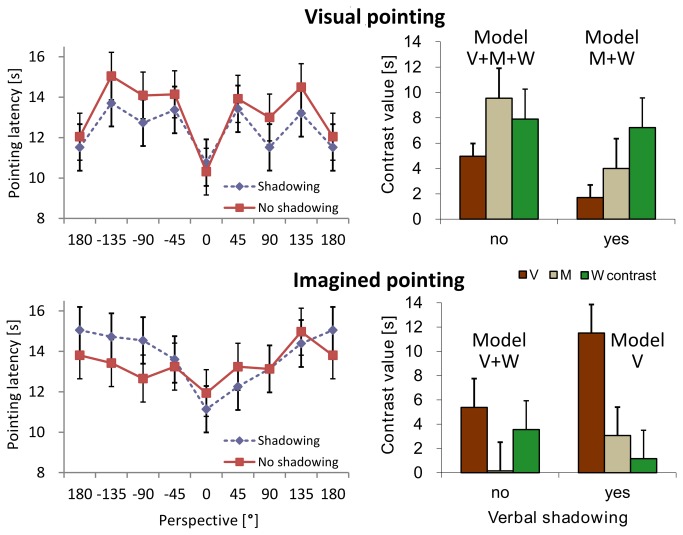
Spatial memory is thought to be organized along experienced views and allocentric reference axes. Memory access from different perspectives typically yields V-patterns for egocentric encoding (monotonic decline in performance along with the angular deviation from the experienced perspectives) and W-patterns for axes encoding (better performance along parallel and orthogonal perspectives than along oblique perspectives). We showed that learning an object array with a verbal secondary task reduced W-patterns compared with learning without verbal shadowing. This suggests that axes encoding happened in a verbal format; for example, by rows and columns. Alternatively, general cognitive load from the secondary task prevented memorizing relative to a spatial axis. Independent of encoding, pointing with a surrounding room visible yielded stronger W-patterns compared with pointing with no room visible. This suggests that the visible room geometry interfered with the memorized room geometry. With verbal shadowing and without visual interference only V-patterns remained; otherwise, V- and W-patterns were combined. Verbal encoding and visual interference explain when W-patterns can be expected alongside V-patterns and thus can help in resolving different performance patterns in a wide range of experiments.
空间记忆被认为是沿着经验视图和以自我为中心的参照轴组织的。从不同视角进行记忆访问通常会产生自我中心编码的 V 型模式(随着与经验视角的角度偏差而单调下降)和轴编码的 W 型模式(与斜视角相比,平行和正交视角的性能更好)。我们表明,与没有口头阴影的学习相比,使用口头次要任务学习物体数组会减少 W 型模式。这表明轴编码是以口头格式发生的;例如,通过行和列。或者,来自次要任务的一般认知负荷会阻止相对于空间轴进行记忆。无论是否进行编码,在可见的周围房间中进行指向操作都会产生比在没有房间可见时更强的 W 型模式。这表明可见的房间几何形状干扰了记忆中的房间几何形状。只有在进行口头阴影且没有视觉干扰的情况下,才会保留 V 型模式;否则,V 型和 W 型模式会结合在一起。口头编码和视觉干扰解释了为什么可以预期 W 型模式与 V 型模式一起出现,因此有助于解决广泛实验中的不同性能模式。