Saunders Megan I, Bode Michael, Atkinson Scott, Klein Carissa J, Metaxas Anna, Beher Jutta, Beger Maria, Mills Morena, Giakoumi Sylvaine, Tulloch Vivitskaia, Possingham Hugh P
Centre for Biodiversity and Conservation Science, The University of Queensland, St. Lucia, Australia.
Australian Research Council (ARC) Centre of Excellence in Environmental Decisions, University of Queensland, St. Lucia, Australia.
PLoS Biol. 2017 Sep 6;15(9):e2001886. doi: 10.1371/journal.pbio.2001886. eCollection 2017 Sep.
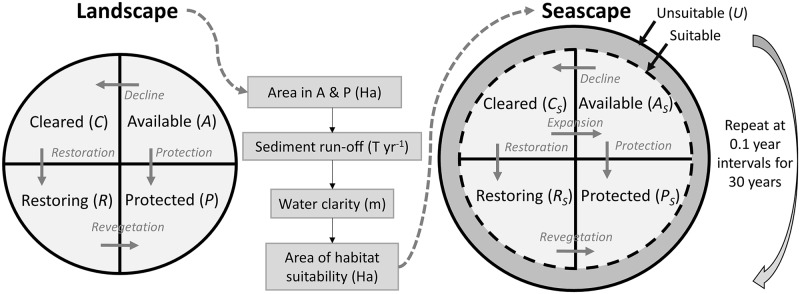
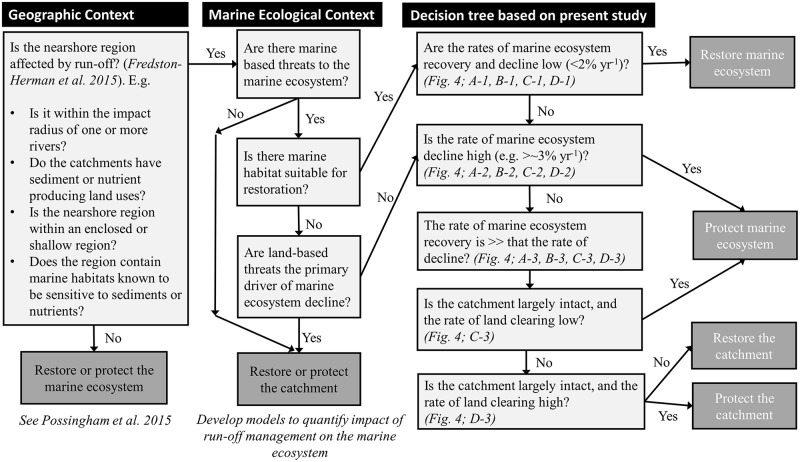
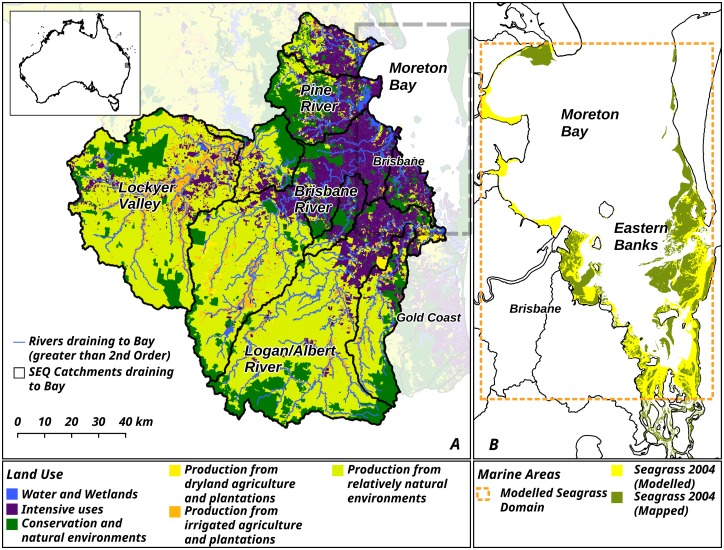
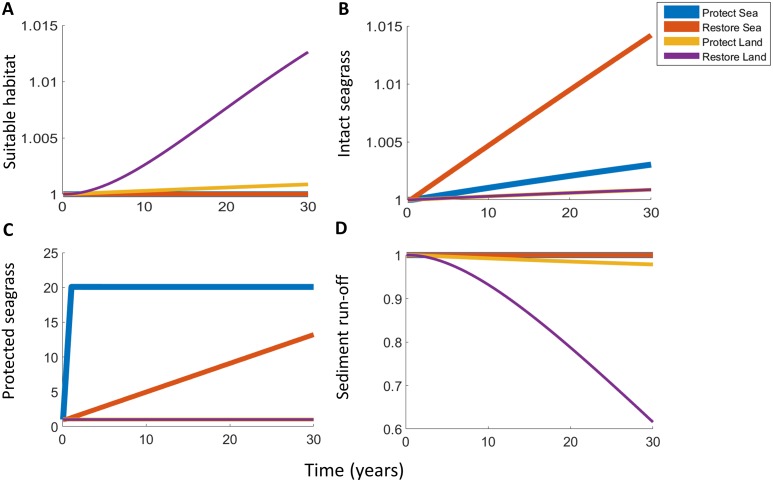
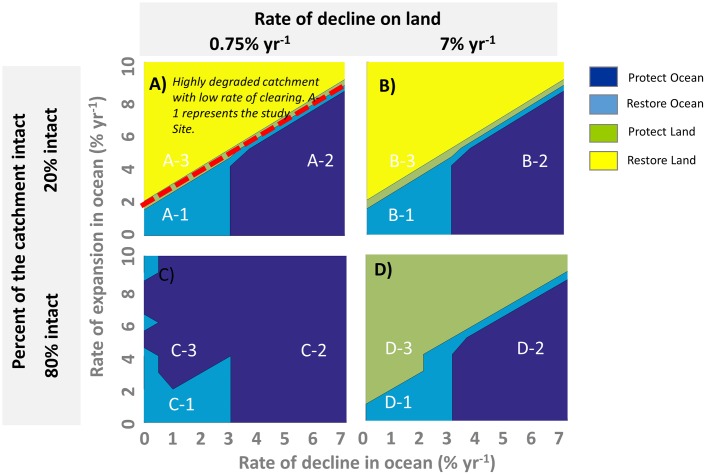
Coastal marine ecosystems can be managed by actions undertaken both on the land and in the ocean. Quantifying and comparing the costs and benefits of actions in both realms is therefore necessary for efficient management. Here, we quantify the link between terrestrial sediment runoff and a downstream coastal marine ecosystem and contrast the cost-effectiveness of marine- and land-based conservation actions. We use a dynamic land- and sea-scape model to determine whether limited funds should be directed to 1 of 4 alternative conservation actions-protection on land, protection in the ocean, restoration on land, or restoration in the ocean-to maximise the extent of light-dependent marine benthic habitats across decadal timescales. We apply the model to a case study for a seagrass meadow in Australia. We find that marine restoration is the most cost-effective action over decadal timescales in this system, based on a conservative estimate of the rate at which seagrass can expand into a new habitat. The optimal decision will vary in different social-ecological contexts, but some basic information can guide optimal investments to counteract land- and ocean-based stressors: (1) marine restoration should be prioritised if the rates of marine ecosystem decline and expansion are similar and low; (2) marine protection should take precedence if the rate of marine ecosystem decline is high or if the adjacent catchment is relatively intact and has a low rate of vegetation decline; (3) land-based actions are optimal when the ratio of marine ecosystem expansion to decline is greater than 1:1.4, with terrestrial restoration typically the most cost-effective action; and (4) land protection should be prioritised if the catchment is relatively intact but the rate of vegetation decline is high. These rules of thumb illustrate how cost-effective conservation outcomes for connected land-ocean systems can proceed without complex modelling.
沿海海洋生态系统可通过陆地和海洋采取的行动来管理。因此,为了进行有效管理,有必要对这两个领域行动的成本和效益进行量化和比较。在这里,我们量化陆地沉积物径流与下游沿海海洋生态系统之间的联系,并对比海洋和陆地保护行动的成本效益。我们使用一个动态的陆地和海洋景观模型来确定有限的资金是否应投向四种替代性保护行动之一——陆地保护、海洋保护、陆地恢复或海洋恢复,以便在十年时间尺度上最大限度地扩大依赖光照的海洋底栖生境范围。我们将该模型应用于澳大利亚一个海草草甸的案例研究。基于对海草向新栖息地扩张速度的保守估计,我们发现在该系统的十年时间尺度上,海洋恢复是最具成本效益的行动。最优决策在不同的社会生态背景下会有所不同,但一些基本信息可以指导最优投资,以应对基于陆地和海洋的压力源:(1)如果海洋生态系统的衰退和扩张速度相似且较低,应优先考虑海洋恢复;(2)如果海洋生态系统的衰退速度较高,或者相邻集水区相对完整且植被衰退速度较低,则应优先进行海洋保护;(3)当海洋生态系统扩张与衰退的比率大于1:1.4时,基于陆地的行动是最优的,其中陆地恢复通常是最具成本效益的行动;(4)如果集水区相对完整但植被衰退速度较高,则应优先进行陆地保护。这些经验法则说明了在不进行复杂建模的情况下,如何实现陆地 - 海洋相连系统的具有成本效益的保护成果。