Caini Saverio, Alonso Wladimir J, Séblain Clotilde El-Guerche, Schellevis François, Paget John
Netherlands Institute for Health Services Research (NIVEL), Utrecht, The Netherlands.
Origem Scientifica, São Paulo, Brasil.
Euro Surveill. 2017 Aug 31;22(35). doi: 10.2807/1560-7917.ES.2017.22.35.30606.
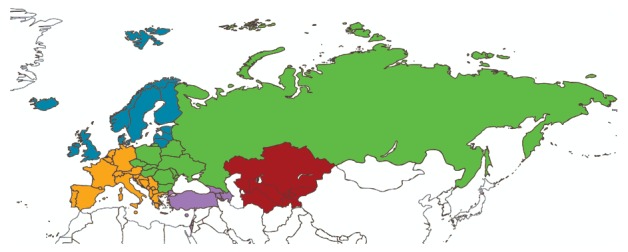
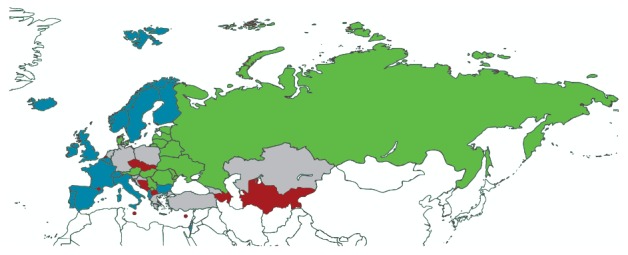
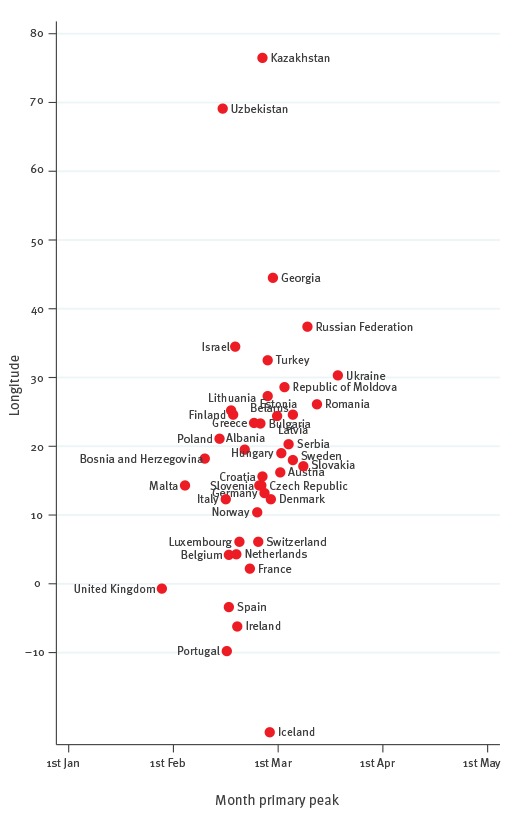
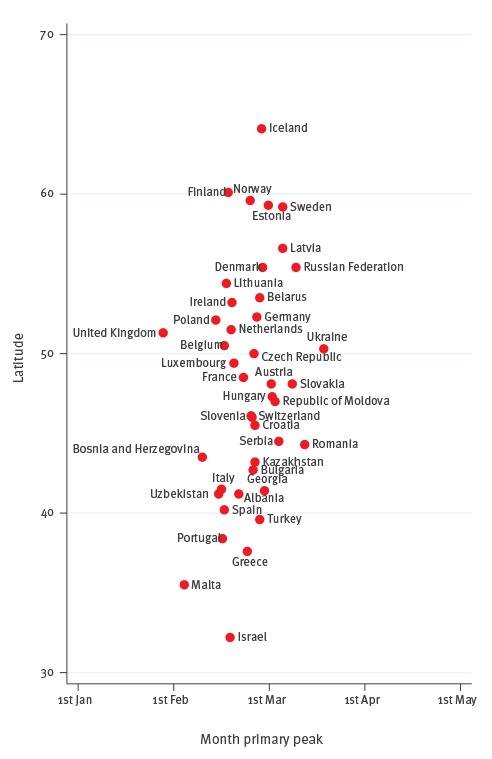
We aimed to assess the epidemiology and spatiotemporal patterns of influenza in the World Health Organization (WHO) European Region and evaluate the validity of partitioning the Region into five influenza transmission zones (ITZs) as proposed by the WHO. We used the FluNet database and included over 650,000 influenza cases from 2000 to 2015. We analysed the data by country and season (from July to the following June). We calculated the median proportion of cases caused by each virus type in a season, compared the timing of the primary peak between countries and used a range of cluster analysis methods to assess the degree of overlap between the WHO-defined and data-driven ITZs. Influenza A and B caused, respectively, a median of 83% and 17% cases in a season. There was a significant west-to-east and non-significant (p = 0.10) south-to-north gradient in the timing of influenza activity. Typically, influenza peaked in February and March; influenza A earlier than influenza B. Most countries in the WHO European Region would fit into two ITZs: 'Western Europe' and 'Eastern Europe'; countries bordering Asia may be better placed into extra-European ITZs. Our findings have implications for the presentation of surveillance data and prevention and control measures in this large WHO Region.
我们旨在评估世界卫生组织(WHO)欧洲区域流感的流行病学特征及时空模式,并评估将该区域划分为WHO提议的五个流感传播区(ITZ)的有效性。我们使用了流感监测网络(FluNet)数据库,纳入了2000年至2015年期间超过65万例流感病例。我们按国家和季节(从7月至次年6月)对数据进行了分析。我们计算了每个季节中由每种病毒类型引起的病例的中位数比例,比较了各国主要流行高峰的时间,并使用了一系列聚类分析方法来评估WHO定义的ITZ与数据驱动的ITZ之间的重叠程度。甲型流感和乙型流感在一个季节中分别导致了中位数为83%和17%的病例。流感活动时间存在显著的自西向东梯度,而自南向北梯度不显著(p = 0.10)。通常,流感在2月和3月达到高峰;甲型流感比乙型流感更早达到高峰。WHO欧洲区域的大多数国家可归为两个ITZ:“西欧”和“东欧”;与亚洲接壤的国家可能更适合归入欧洲以外的ITZ。我们的研究结果对这个WHO大区域的监测数据呈现以及预防和控制措施具有启示意义。