Parino Francesco, Gustani-Buss Emanuele, Bedford Trevor, Suchard Marc A, Trovão Nídia S, Rambaut Andrew, Colizza Vittoria, Poletto Chiara, Lemey Philippe
Sorbonne Université, INSERM, Institut Pierre Louis d'Epidemiologie et de Santé Publique (IPLESP), Paris, France.
Department of Microbiology, Immunology and Transplantation, Rega Institute, KU Leuven - University of Leuven, Leuven 3000, Belgium.
PNAS Nexus. 2024 Dec 17;4(1):pgae561. doi: 10.1093/pnasnexus/pgae561. eCollection 2025 Jan.
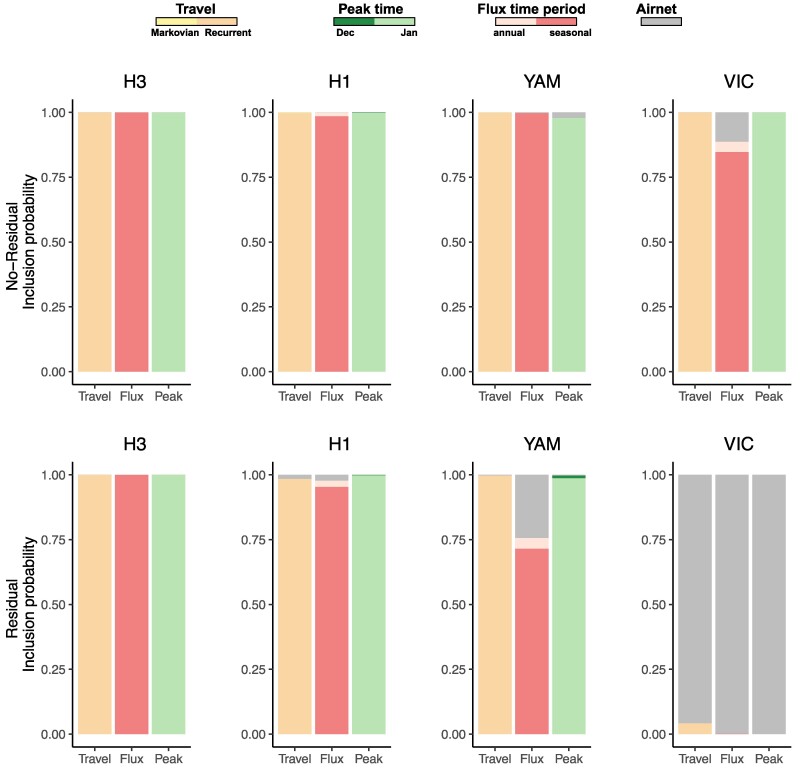
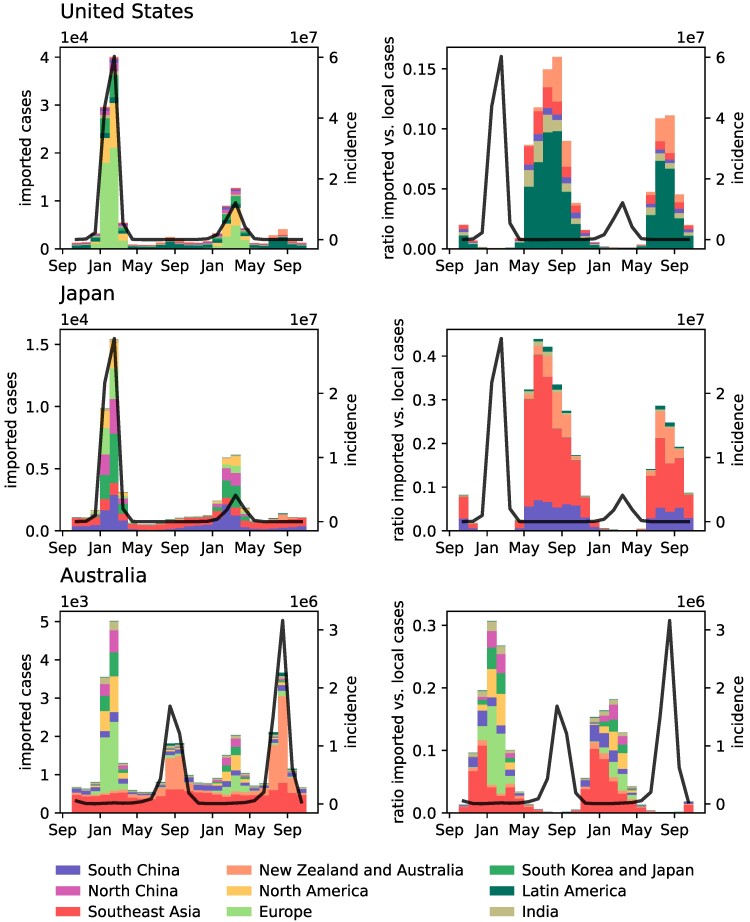
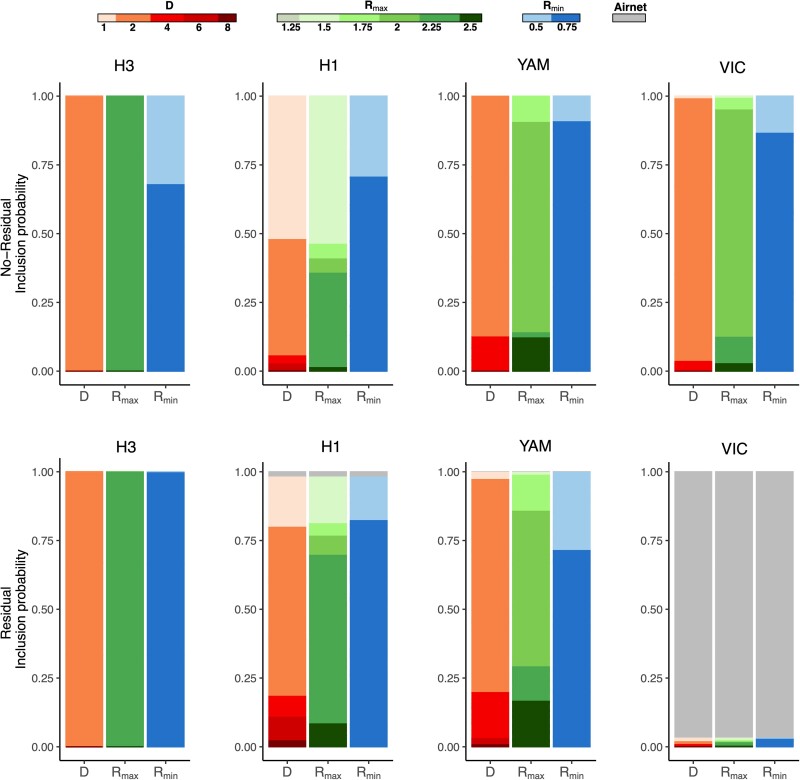
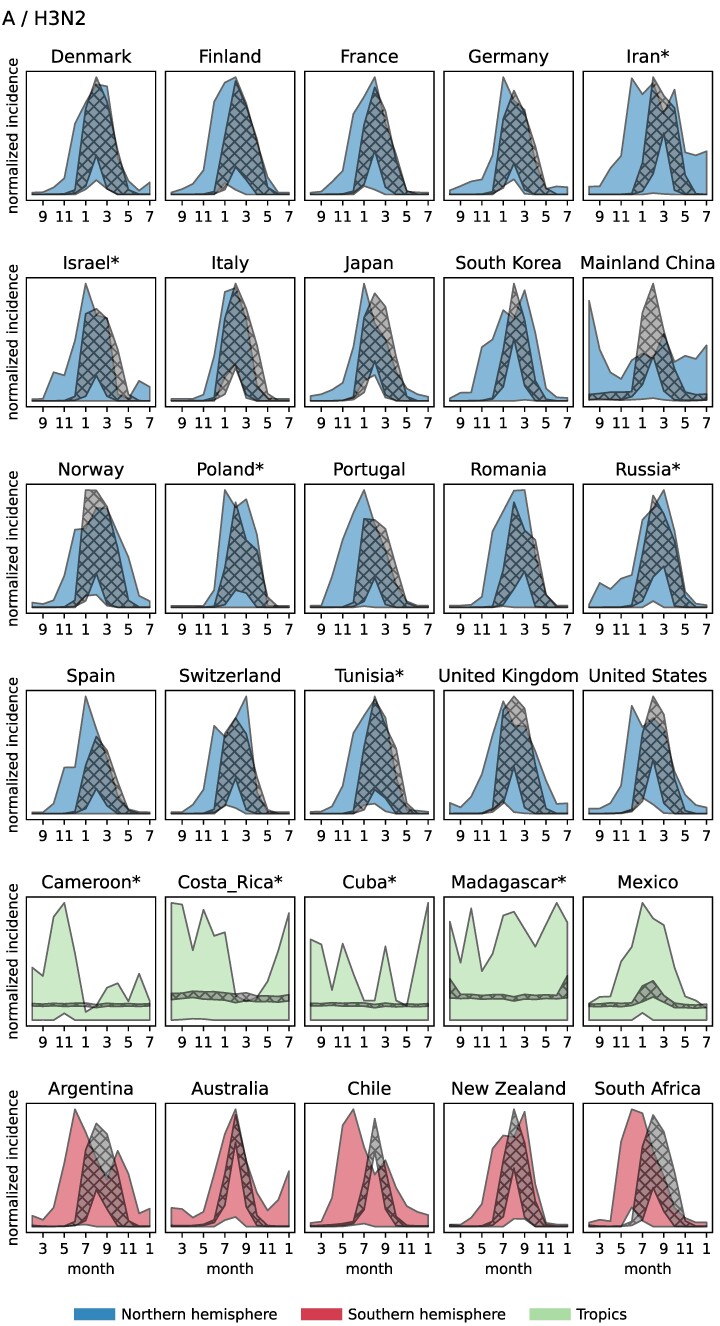
Global seasonal influenza circulation involves a complex interplay between local (seasonality, demography, host immunity) and global factors (international mobility) shaping recurrent epidemic patterns. No studies so far have reconciled the two spatial levels, evaluating the coupling between national epidemics, considering heterogeneous coverage of epidemiological, and virological data, integrating different data sources. We propose a novel-combined approach based on a dynamical model of global influenza spread (GLEAM), integrating high-resolution demographic, and mobility data, and a generalized linear model of phylogeographic diffusion that accounts for time-varying migration rates. Seasonal migration fluxes across countries simulated with GLEAM are tested as phylogeographic predictors to provide model validation and calibration based on genetic data. Seasonal fluxes obtained with a specific transmissibility peak time and recurrent travel outperformed the raw air-transportation predictor, previously considered as optimal indicator of global influenza migration. Influenza A subtypes supported autumn-winter reproductive number as high as 2.25 and an average immunity duration of 2 years. Similar dynamics were preferred by influenza B lineages, with a lower autumn-winter reproductive number. Comparing simulated epidemic profiles against FluNet data offered comparatively limited resolution power. The multiscale approach enables model selection yielding a novel computational framework for describing global influenza dynamics at different scales-local transmission and national epidemics vs. international coupling through mobility and imported cases. Our findings have important implications to improve preparedness against seasonal influenza epidemics. The approach can be generalized to other epidemic contexts, such as emerging disease outbreaks to improve the flexibility and predictive power of modeling.
全球季节性流感传播涉及局部因素(季节性、人口统计学、宿主免疫力)和全球因素(国际流动性)之间的复杂相互作用,这些因素共同塑造了反复出现的流行模式。到目前为止,尚无研究协调这两个空间层面,评估国家疫情之间的耦合情况,考虑流行病学和病毒学数据的异质性覆盖,整合不同的数据来源。我们提出了一种新的组合方法,该方法基于全球流感传播动态模型(GLEAM),整合高分辨率人口统计学和流动性数据,以及一个考虑随时间变化的迁移率的系统发育地理扩散广义线性模型。用GLEAM模拟的各国季节性迁移通量作为系统发育地理预测因子进行测试,以基于遗传数据提供模型验证和校准。在特定传播高峰时间和反复旅行情况下获得的季节性通量优于以前被视为全球流感迁移最佳指标的原始航空运输预测因子。甲型流感亚型在秋冬季节的再生数高达2.25,平均免疫持续时间为2年。乙型流感谱系也有类似的动态变化,但其秋冬季节的再生数较低。将模拟的疫情概况与FluNet数据进行比较,分辨率相对有限。这种多尺度方法能够进行模型选择,从而产生一个新的计算框架,用于描述不同尺度上的全球流感动态——局部传播和国家疫情与通过流动性和输入病例的国际耦合。我们的研究结果对提高季节性流感疫情防范能力具有重要意义。该方法可推广到其他疫情情况,如新发疾病爆发,以提高建模的灵活性和预测能力。