Lauterbur Research Center for Biomedical Imaging, Shenzhen Institutes of Advanced Technology, Chinese Academy of Sciences, Shenzhen, 518055, China.
Sci Rep. 2017 Sep 6;7(1):10747. doi: 10.1038/s41598-017-11222-z.
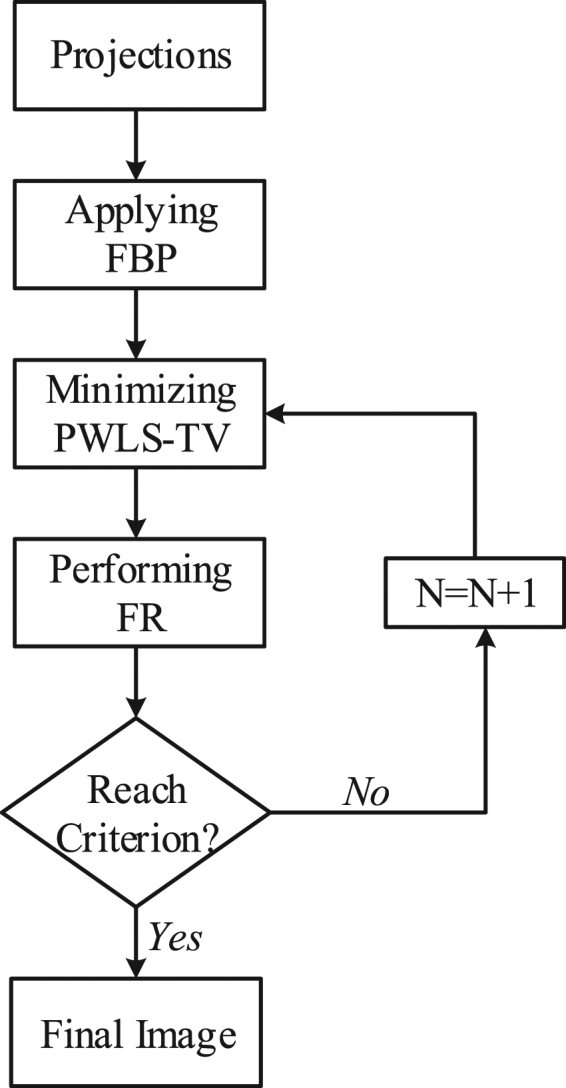
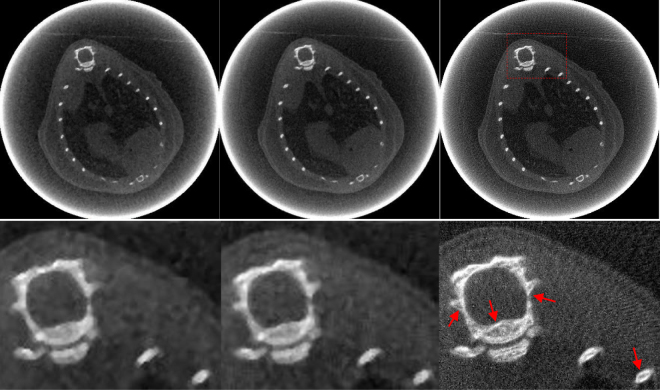
Because radiation is harmful to patients, it is important to reduce X-ray exposure in the clinic. For CT, reconstructions from sparse views or limited angle tomography are being used more frequently for low dose imaging. However, insufficient sampling data causes severe streak artifacts in images reconstructed using conventional methods. To solve this issue, various methods have recently been developed. In this paper, we improve a statistical iterative algorithm based on the minimization of the image total variation (TV) for sparse or limited projection views during CT image reconstruction. Considering the statistical nature of the projection data, the TV is performed under a penalized weighted least-squares (PWLS-TV) criterion. During implementation of the proposed method, the image reconstructed using the filtered back-projection (FBP) method is used as the initial value of the first iteration. Next, the feature refinement (FR) step is performed after each PWLS-TV iteration to extract the fine features lost in the TV minimization, which we refer to as 'PWLS-TV-FR'.
由于辐射对患者有害,因此在临床实践中减少 X 射线照射非常重要。对于 CT,稀疏视图或有限角度断层摄影术的重建正越来越多地用于低剂量成像。然而,由于采样数据不足,使用传统方法重建的图像会产生严重的条纹伪影。为了解决这个问题,最近开发了各种方法。在本文中,我们改进了一种基于最小化图像全变差(TV)的统计迭代算法,用于 CT 图像重建中的稀疏或有限投影视图。考虑到投影数据的统计特性,在惩罚加权最小二乘(PWLS-TV)准则下进行 TV 处理。在实现所提出的方法时,使用滤波反投影(FBP)方法重建的图像作为第一迭代的初始值。接下来,在每次 PWLS-TV 迭代后执行特征细化(FR)步骤,以提取在 TV 最小化过程中丢失的精细特征,我们称之为“PWLS-TV-FR”。