Mai Naikeng, Zhong Xiaomei, Chen Ben, Peng Qi, Wu Zhangying, Zhang Weiru, Ouyang Cong, Ning Yuping
Department of Neurology, Southern Medical UniversityGuangdong, China.
Department of Neurology, The Affiliated Brain Hospital of Guangzhou Medical University (Guangzhou Huiai Hospital)Guangdong, China.
Front Aging Neurosci. 2017 Aug 23;9:279. doi: 10.3389/fnagi.2017.00279. eCollection 2017.
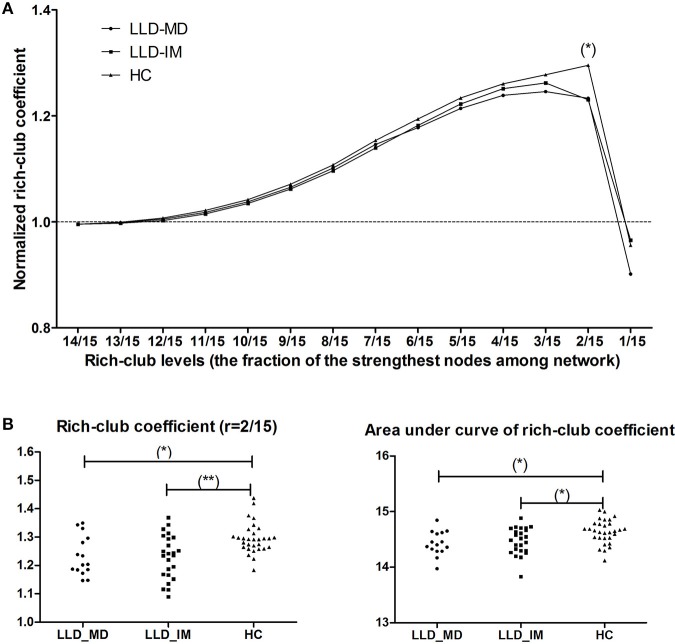
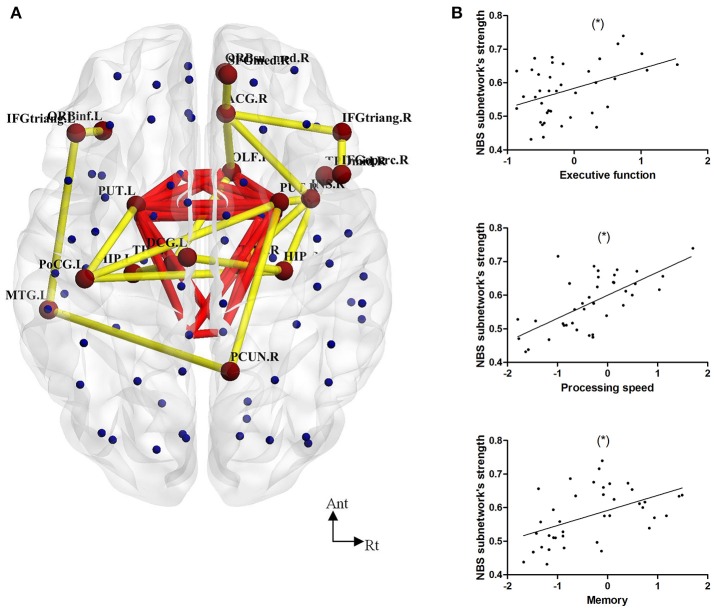
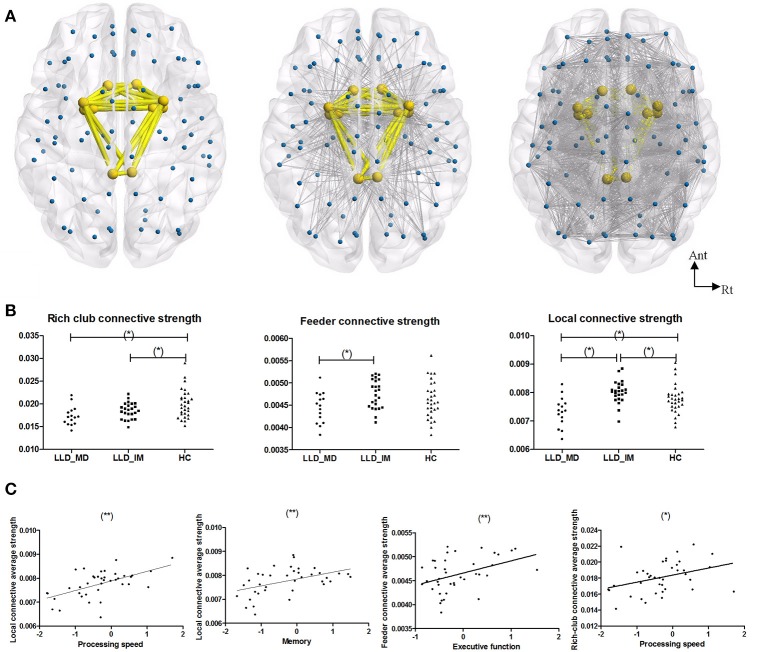
Patients with late-life depression (LLD) have a higher incident of developing dementia, especially individuals with memory deficits. However, little is known about the white matter characteristics of LLD with memory deficits (LLD-MD) in the human connectome, especially for the rich-club coefficient, which is an indicator that describes the organization pattern of hub in the network. To address this question, diffusion tensor imaging of 69 participants [15 LLD-MD patients; 24 patients with LLD with intact memory (LLD-IM); and 30 healthy controls (HC)] was applied to construct a brain network for each individual. A full-scale battery of neuropsychological tests were used for grouping, and evaluating executive function, processing speed and memory. Rich-club analysis and global network properties were utilized to describe the topological features in each group. Network-based statistics (NBS) were calculated to identify the impaired subnetwork in the LLD-MD group relative to that in the LLD-IM group. We found that compared with HC participants, patients with LLD (LLD-MD and LLD-IM) had relatively impaired rich-club organizations and rich-club connectivity. In addition, LLD-MD group exhibited lower feeder and local connective average strength than LLD-IM group. Furthermore, global network properties, such as the shortest path length, connective strength, efficiency and fault tolerant efficiency, were significantly decreased in the LLD-MD group relative to those in the LLD-IM and HC groups. According to NBS analysis, a subnetwork, including right cognitive control network (CCN) and corticostriatal circuits, were disrupted in LLD-MD patients. In conclusion, the disease effects of LLD were prevalent in rich-club organization. Feeder and local connections, especially in the subnetwork including right CCN and corticostriatal circuits, were further impaired in those with memory deficits. Global network properties were disrupted in LLD-MD patients relative to those in LLD-IM patients.
老年期抑郁症(LLD)患者患痴呆症的几率更高,尤其是有记忆缺陷的个体。然而,关于人类连接组中伴有记忆缺陷的老年期抑郁症(LLD-MD)的白质特征,人们知之甚少,尤其是关于富俱乐部系数,它是描述网络中枢纽组织模式的一个指标。为了解决这个问题,对69名参与者[15名LLD-MD患者;24名记忆完好的LLD患者(LLD-IM);以及30名健康对照者(HC)]进行了扩散张量成像,以构建每个人的脑网络。使用一整套全面的神经心理学测试进行分组,并评估执行功能、处理速度和记忆力。利用富俱乐部分析和全局网络属性来描述每组的拓扑特征。计算基于网络的统计量(NBS),以识别LLD-MD组相对于LLD-IM组受损的子网络。我们发现,与HC参与者相比,LLD患者(LLD-MD和LLD-IM)的富俱乐部组织和富俱乐部连通性相对受损。此外,LLD-MD组的馈线和局部连接平均强度低于LLD-IM组。此外,相对于LLD-IM组和HC组,LLD-MD组的全局网络属性,如最短路径长度、连接强度、效率和容错效率,显著降低。根据NBS分析,LLD-MD患者的一个子网络,包括右侧认知控制网络(CCN)和皮质纹状体回路,受到了破坏。总之,LLD的疾病影响在富俱乐部组织中普遍存在。馈线和局部连接,尤其是在包括右侧CCN和皮质纹状体回路的子网络中,在有记忆缺陷的患者中进一步受损。相对于LLD-IM患者,LLD-MD患者的全局网络属性受到破坏。