Aoun Nathalie, Tauleigne Laetitia, Lonjon Fabien, Deslandes Laurent, Vailleau Fabienne, Roux Fabrice, Berthomé Richard
LIPM, Centre National de la Recherche Scientifique, Institut National de la Recherche Agronomique, INPT, Université de ToulouseCastanet-Tolosan, France.
Front Plant Sci. 2017 Aug 22;8:1387. doi: 10.3389/fpls.2017.01387. eCollection 2017.
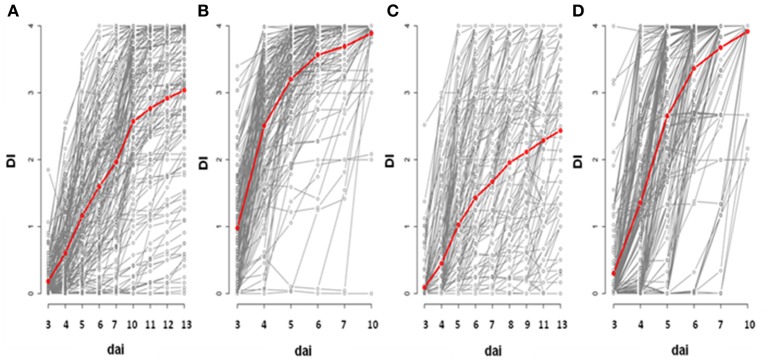
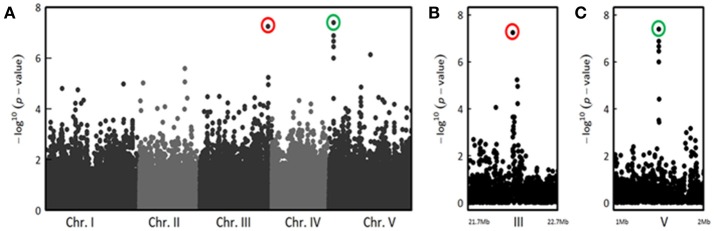
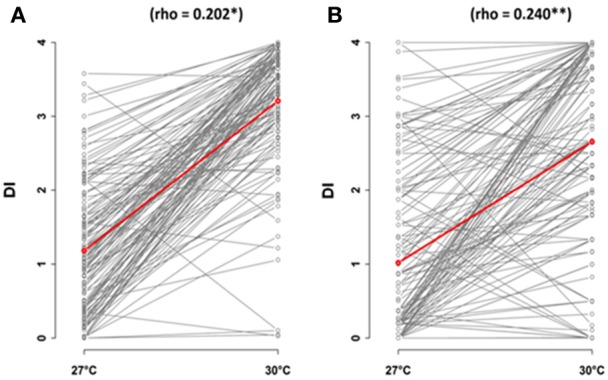
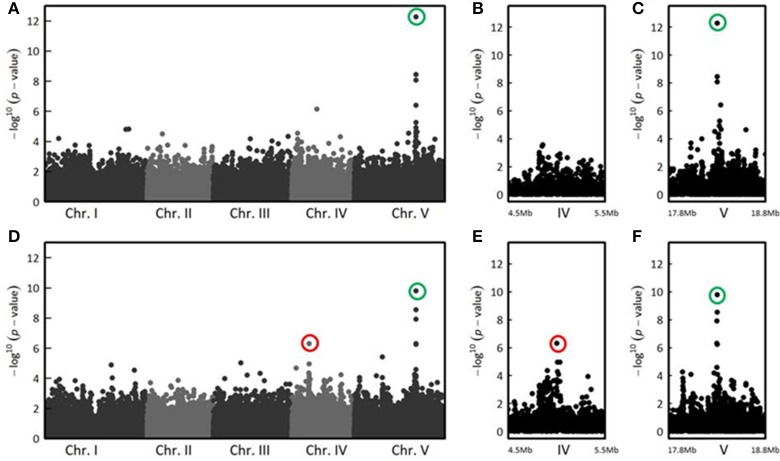
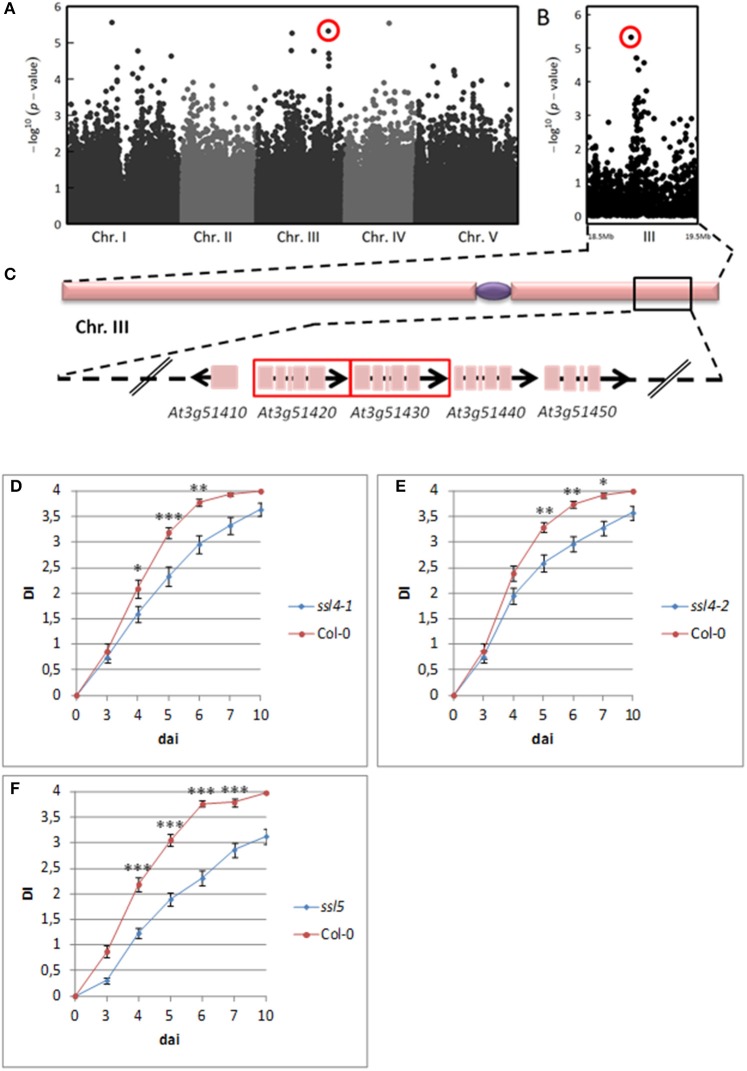
In the context of climate warming, plants will be facing an increased risk of epidemics as well as the emergence of new highly aggressive pathogen species. Although a permanent increase of temperature strongly affects plant immunity, the underlying molecular mechanisms involved are still poorly characterized. In this study, we aimed to uncover the genetic bases of resistance mechanisms that are efficient at elevated temperature to the species complex (RSSC), one of the most harmful phytobacteria causing bacterial wilt. To start the identification of quantitative trait loci (QTLs) associated with natural variation of response to , we adopted a genome wide association (GWA) mapping approach using 176 worldwide natural accessions of inoculated with the GMI1000 strain. Following two different procedures of root-inoculation (root apparatus cut vs. uncut), plants were grown either at 27 or 30°C, with the latter temperature mimicking a permanent increase in temperature. At 27°C, the locus was the main QTL of resistance detected regardless of the method of inoculation used. This highlights the power of GWA mapping to identify functionally important loci for resistance to the GMI1000 strain. At 30°C, although most of the accessions developed wilting symptoms, we identified several QTLs that were specific to the inoculation method used. We focused on a QTL region associated with response to the GMI1000 strain in the early stages of infection and, by adopting a reverse genetic approach, we functionally validated the involvement of a strictosidine synthase-like 4 (SSL4) protein that shares structural similarities with animal proteins known to play a role in animal immunity.
在气候变暖的背景下,植物将面临流行病风险增加以及新的高侵袭性病原体物种出现的情况。尽管温度持续升高会强烈影响植物免疫力,但其中涉及的潜在分子机制仍未得到充分表征。在本研究中,我们旨在揭示在高温下对茄科劳尔氏菌复合种(RSSC)有效的抗性机制的遗传基础,茄科劳尔氏菌复合种是导致青枯病的最有害植物细菌之一。为了开始鉴定与对RSSC反应的自然变异相关的数量性状基因座(QTL),我们采用了全基因组关联(GWA)定位方法,使用176份接种了GMI1000菌株的来自世界各地的天然材料。采用两种不同的根部接种程序(切断根部器具与未切断)后,植物分别在27℃或30℃下生长,后者温度模拟温度的持续升高。在27℃时,无论使用何种接种方法,RRS1位点都是检测到的主要抗性QTL。这突出了GWA定位在鉴定对GMI1000菌株抗性的功能重要基因座方面的能力。在30℃时,尽管大多数材料出现了萎蔫症状,但我们鉴定出了几个特定于所用接种方法的QTL。我们聚焦于一个与感染早期对GMI1000菌株反应相关的QTL区域,并通过采用反向遗传学方法,从功能上验证了一种与已知在动物免疫中起作用的动物蛋白具有结构相似性的类strictosidine合酶4(SSL4)蛋白的参与。