Holovachov Oleksandr, Haenel Quiterie, Bourlat Sarah J, Jondelius Ulf
Department of Zoology, Swedish Museum of Natural History, Stockholm, Sweden.
Zoological Institute, University of Basel, Basel, Switzerland.
R Soc Open Sci. 2017 Aug 16;4(8):170315. doi: 10.1098/rsos.170315. eCollection 2017 Aug.
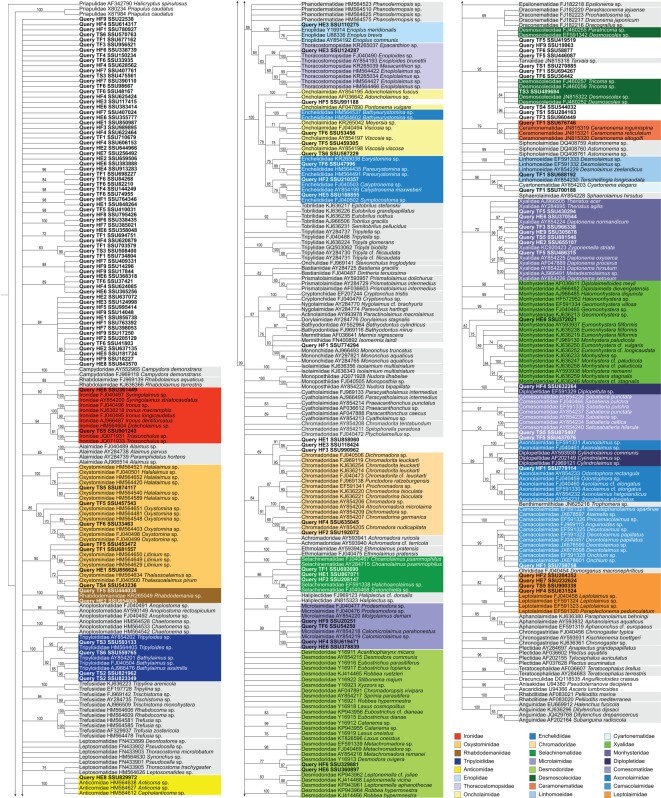
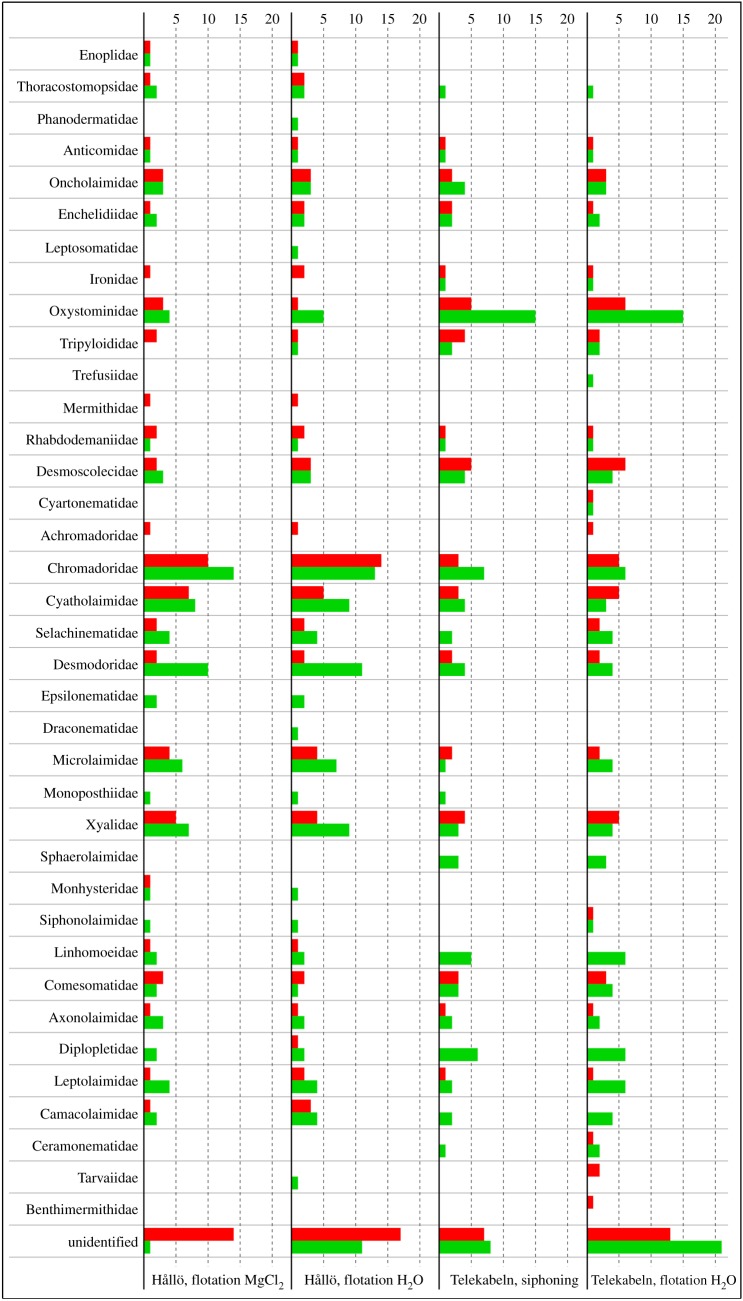
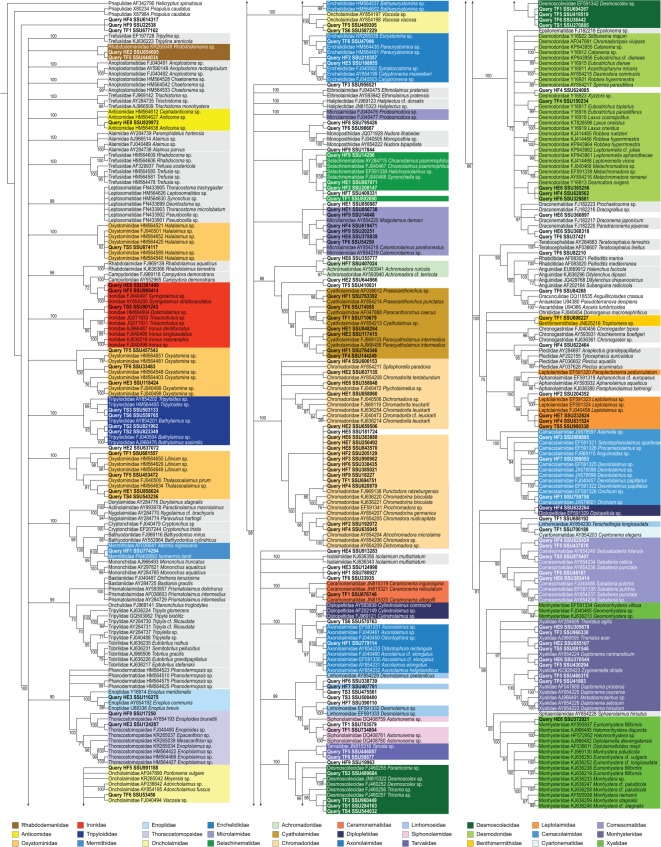
Precision and reliability of barcode-based biodiversity assessment can be affected at several steps during acquisition and analysis of data. Identification of operational taxonomic units (OTUs) is one of the crucial steps in the process and can be accomplished using several different approaches, namely, alignment-based, probabilistic, tree-based and phylogeny-based. The number of identified sequences in the reference databases affects the precision of identification. This paper compares the identification of marine nematode OTUs using alignment-based, tree-based and phylogeny-based approaches. Because the nematode reference dataset is limited in its taxonomic scope, OTUs can only be assigned to higher taxonomic categories, families. The phylogeny-based approach using the evolutionary placement algorithm provided the largest number of positively assigned OTUs and was least affected by erroneous sequences and limitations of reference data, compared to alignment-based and tree-based approaches.
基于条形码的生物多样性评估的精度和可靠性在数据采集和分析的几个步骤中可能会受到影响。操作分类单元(OTU)的识别是该过程中的关键步骤之一,可以使用几种不同的方法来完成,即基于比对、概率、基于树和基于系统发育的方法。参考数据库中已识别序列的数量会影响识别的精度。本文比较了使用基于比对、基于树和基于系统发育的方法对海洋线虫OTU的识别。由于线虫参考数据集在分类学范围上有限,OTU只能被分配到更高的分类类别,即科。与基于比对和基于树的方法相比,使用进化放置算法的基于系统发育的方法提供了最多的正向分配OTU,并且受错误序列和参考数据限制的影响最小。