Ampaire Lucas, Muhindo Abraham, Orikiriza Patrick, Mwanga-Amumpaire Juliet, Bebell Lisa, Boum Yap
Department of Medical Laboratory Sciences, Mbarara University of Science and Technology, Mbarara, Uganda.
Epicentre Mbarara Research Centre, Mbarara, Uganda.
Afr J Lab Med. 2016 Sep 15;5(1):432. doi: 10.4102/ajlm.v5i1.432. eCollection 2016.
Knowledge of local and regional antimicrobial resistance (AMR) is important for clinical decision making. However, surveillance capacity for AMR is lacking throughout East Africa, and current AMR data are sparse. We sought to address this gap by summarising all available high-quality data on AMR in the East Africa region.
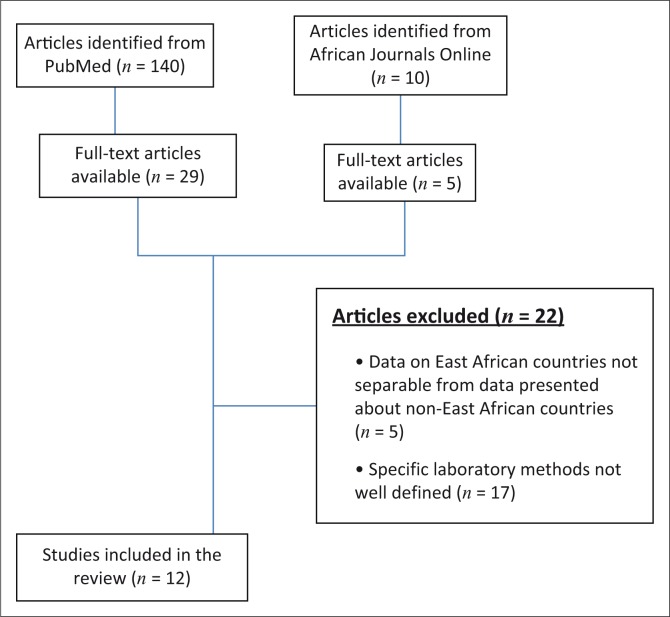
We searched the PubMed database and African Journals Online archives in April and May 2015 using the search term 'antimicrobial resistance AND sub-Saharan Africa' to find articles published from 2005 onwards. Only full-text articles in English were included.
We included 12 published articles in our analysis. Most articles were on bloodstream infections, hospital-based and cross-sectional in design; a majority described either community- or hospital-acquired infections. High levels of AMR to commonly-used antibiotics were reported, including 50% - 100% resistance to ampicillin and cotrimoxazole infections, emerging resistance to gentamicin (20% - 47%) and relatively high levels of resistance to ceftriaxone (46% - 69%) among Gram-negative infections. Much of the resistance was reported to be in species and Among Gram-positive infections, extensive resistance was reported to ampicillin (100%), gentamicin and ceftriaxone (50% - 100%), with methicillin-resistant prevalence ranging from 2.6% - 4.0%.
Overall, bacterial resistance was reported among commonly-used antibiotics (ampicillin, gentamicin and ceftriaxone), raising concern that these antibiotics may no longer be useful for treating moderate or severe bacterial infections in East Africa. Thus, empirical treatment of bacterial infections needs to be reconsidered and guided by local assessment of AMR. Improvements in the limited amount of quality data and lack of harmonisation in assessing the burden of AMR are also needed.
了解当地及区域的抗菌药物耐药性(AMR)对于临床决策至关重要。然而,东非地区缺乏AMR监测能力,且当前的AMR数据稀少。我们试图通过总结东非地区所有可用的高质量AMR数据来填补这一空白。
我们于2015年4月和5月在PubMed数据库及非洲期刊在线存档中进行检索,使用检索词“抗菌药物耐药性与撒哈拉以南非洲”,以查找2005年起发表的文章。仅纳入英文全文文章。
我们的分析纳入了12篇已发表文章。大多数文章涉及血流感染,设计为基于医院的横断面研究;大多数描述的是社区获得性或医院获得性感染。报告显示,对常用抗生素的AMR水平较高,包括对氨苄西林和复方新诺明感染有50% - 100%的耐药性,庆大霉素出现新的耐药性(20% - 47%),革兰氏阴性菌感染中对头孢曲松的耐药水平相对较高(46% - 69%)。许多耐药情况据报道存在于[具体物种1]和[具体物种2]中。在革兰氏阳性菌感染中,据报道对氨苄西林(100%)、庆大霉素和头孢曲松(50% - 100%)存在广泛耐药,耐甲氧西林[具体细菌名称]的患病率在2.6% - 4.0%之间。
总体而言,常用抗生素(氨苄西林、庆大霉素和头孢曲松)中报告存在细菌耐药性,这引发了人们对这些抗生素可能不再适用于治疗东非地区中度或重度细菌感染的担忧。因此,需要重新考虑细菌感染的经验性治疗,并以当地对AMR的评估为指导。还需要改善有限的高质量数据量以及评估AMR负担方面缺乏协调性的问题。