Department of Pharmacy, Pharmacology and Toxicology, School of Veterinary Medicine and Sciences, University of Ngaoundéré, Ngaoundéré, Cameroon.
One Health Innovative Solutions (OHIS) Research Unit, Ngaoundéré, Cameroon.
BMC Vet Res. 2024 Jul 10;20(1):307. doi: 10.1186/s12917-024-04158-w.
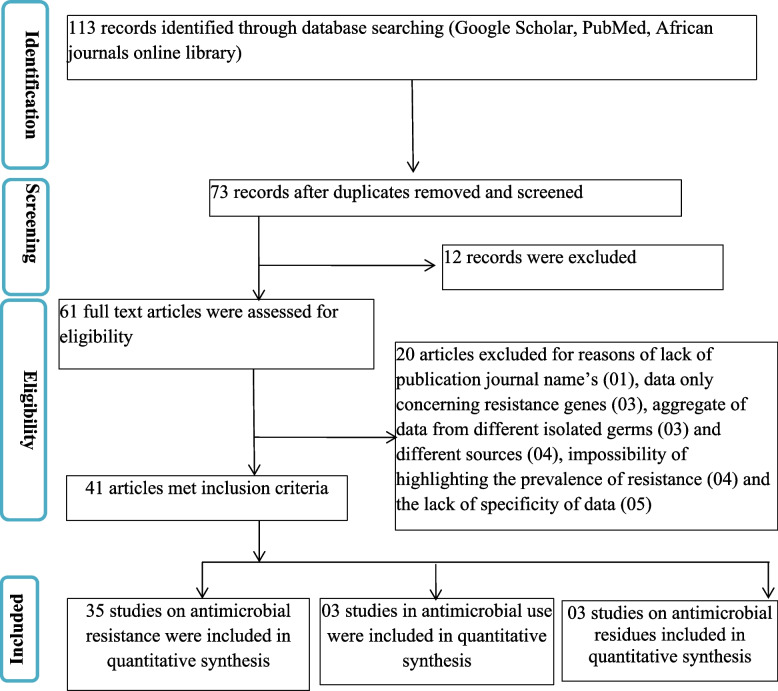
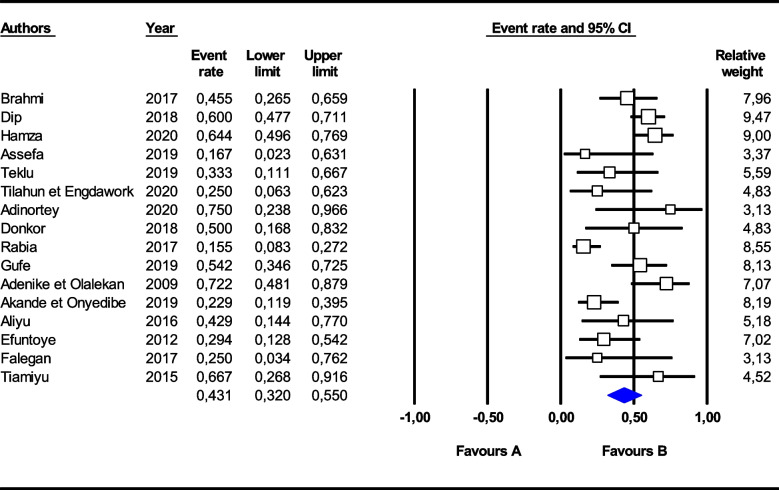
In low- and middle-income countries, data on antimicrobial use (AMU) and antimicrobial resistance (AMR) in aquaculture are scarce. Therefore, summarizing documented data on AMU, antimicrobial residue (AR), and AMR in aquaculture in Africa is key to understanding the risk to public health. Google Scholar, PubMed, African Journals online, and Medline were searched for articles published in English and French following the PRISMA guidelines. A structured search string was used with strict inclusion and exclusion criteria to retrieve and screen the articles. The pooled prevalence and 95% confidence intervals were calculated for each pathogen-antimicrobial pair using random effects models. Among the 113 full-text articles reviewed, 41 met the eligibility criteria. The majority of the articles reported AMR (35; 85.4%), while a few were on AMU (3; 7.3%) and AR (3; 7.3%) in fish. The articles originated from West Africa (23; 56.1%), North Africa (8; 19.7%), and East Africa (7; 17.1%). Concerning the antimicrobial agents used in fish farming, tetracycline was the most common antimicrobial class used, which justified the high prevalence of residues (up to 56.7%) observed in fish. For AMR, a total of 69 antimicrobial agents were tested against 24 types of bacteria isolated. Bacteria were resistant to all classes of antimicrobial agents and exhibited high levels of multidrug resistance. Escherichia coli, Salmonella spp., and Staphylococcus spp. were reported in 16, 10, and 8 studies, respectively, with multidrug resistance rates of 43.1% [95% CI (32.0-55.0)], 40.3% [95% CI (24.1-58.1)] and 31.3% [95% CI (17.5-49.4)], respectively. This review highlights the high multidrug resistance rate of bacteria from aquaculture to commonly used antimicrobial agents, such as tetracycline, ampicillin, cotrimoxazole, gentamicin, and amoxicillin, in Africa. These findings also highlighted the lack of data on AMU and residue in the aquaculture sector, and additional efforts should be made to fill these gaps and mitigate the burden of AMR on public health in Africa.
在中低收入国家,水产养殖中抗菌药物使用 (AMU) 和抗菌药物耐药性 (AMR) 的数据十分匮乏。因此,总结非洲水产养殖中已记录的 AMU、抗菌药物残留 (AR) 和 AMR 数据,对于了解其对公共卫生的风险至关重要。本研究按照 PRISMA 指南,在 Google Scholar、PubMed、African Journals online 和 Medline 上检索了以英文和法文发表的文章。使用严格的纳入和排除标准,通过结构化检索字符串检索和筛选文章。使用随机效应模型计算了每对病原体-抗菌药物的汇总流行率和 95%置信区间。在审查的 113 篇全文文章中,有 41 篇符合入选标准。大多数文章报告了 AMR (35; 85.4%),少数文章报告了 AMU (3; 7.3%) 和 AR (3; 7.3%)。文章来源于西非 (23; 56.1%)、北非 (8; 19.7%) 和东非 (7; 17.1%)。关于水产养殖中使用的抗菌药物,四环素是最常用的抗菌药物类别,这也解释了在鱼类中观察到的高残留率 (高达 56.7%)。在 AMR 方面,总共测试了 69 种抗菌药物对 24 种分离的细菌。细菌对抗生素所有类别均有耐药性,表现出高水平的多药耐药性。在 16、10 和 8 项研究中分别报告了大肠杆菌、沙门氏菌和葡萄球菌,其多药耐药率分别为 43.1%[95%CI(32.0-55.0)]、40.3%[95%CI(24.1-58.1)]和 31.3%[95%CI(17.5-49.4)]。本综述强调了非洲水产养殖中细菌对抗生素的高耐药率,这些抗生素包括四环素、氨苄西林、复方新诺明、庆大霉素和阿莫西林等。这些发现还强调了水产养殖部门缺乏 AMU 和残留数据,应进一步努力填补这些空白,减轻非洲公共卫生领域 AMR 的负担。