Khaparde Sunil, Raizada Neeraj, Nair Sreenivas Achuthan, Denkinger Claudia, Sachdeva Kuldeep Singh, Paramasivan Chinnambedu Nainarappan, Salhotra Virender Singh, Vassall Anna, Hoog Anja Van't
Central TB Division, Government of India, New Delhi, India.
Foundation for Innovative New Diagnostics, New Delhi, India.
PLoS One. 2017 Sep 7;12(9):e0184270. doi: 10.1371/journal.pone.0184270. eCollection 2017.
India is considering the scale-up of the Xpert MTB/RIF assay for detection of tuberculosis (TB) and rifampicin resistance. We conducted an economic analysis to estimate the costs of different strategies of Xpert implementation in India.
Using a decision analytical model, we compared four diagnostic strategies for TB patients: (i) sputum smear microscopy (SSM) only; (ii) Xpert as a replacement for the rapid diagnostic test currently used for SSM-positive patients at risk of drug resistance (i.e. line probe assay (LPA)); (iii) Upfront Xpert testing for patients at risk of drug resistance; and (iv) Xpert as a replacement for SSM for all patients.
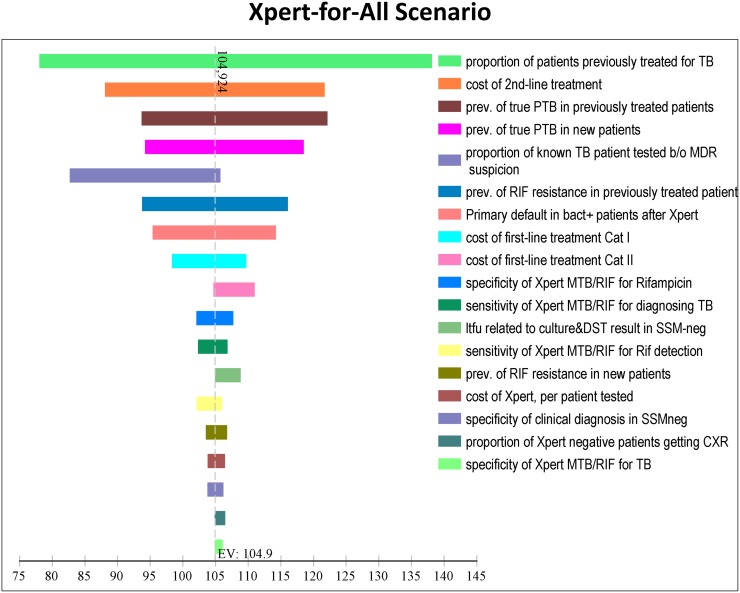
The total costs associated with diagnosis for 100,000 presumptive TB cases were: (i) US$ 619,042 for SSM-only; (ii) US$ 575,377 in the LPA replacement scenario; (iii) US$ 720,523 in the SSM replacement scenario; and (iv) US$ 1,639,643 in the Xpert-for-all scenario. Total cohort costs, including treatment costs, increased by 46% from the SSM-only to the Xpert-for-all strategy, largely due to the costs associated with second-line treatment of a higher number of rifampicin-resistant patients due to increased drug-resistant TB (DR-TB) case detection. The diagnostic costs for an estimated 7.64 million presumptive TB patients would comprise (i) 19%, (ii) 17%, (iii) 22% and (iv) 50% of the annual TB control budget. Mean total costs, expressed per DR-TB case initiated on treatment, were lowest in the Xpert-for-all scenario (US$ 11,099).
The Xpert-for-all strategy would result in the greatest increase of TB and DR-TB case detection, but would also have the highest associated costs. The strategy of using Xpert only for patients at risk for DR-TB would be more affordable, but would miss DR-TB cases and the cost per true DR-TB case detected would be higher compared to the Xpert-for-all strategy. As such expanded Xpert strategy would require significant increased TB control budget to ensure that increased case detection is followed by appropriate care.
印度正在考虑扩大使用Xpert MTB/RIF检测法来检测结核病(TB)和利福平耐药性。我们进行了一项经济分析,以估算在印度实施Xpert的不同策略的成本。
我们使用决策分析模型,比较了针对结核病患者的四种诊断策略:(i)仅痰涂片显微镜检查(SSM);(ii)将Xpert作为目前用于有耐药风险的SSM阳性患者的快速诊断测试(即线性探针测定法(LPA))的替代方法;(iii)对有耐药风险的患者进行直接Xpert检测;(iv)将Xpert作为所有患者的SSM替代方法。
100,000例疑似结核病病例的诊断相关总成本为:(i)仅SSM为619,042美元;(ii)LPA替代方案中为575,377美元;(iii)SSM替代方案中为720,523美元;(iv)全用Xpert方案中为1,639,643美元。包括治疗成本在内的总队列成本,从仅SSM策略到全用Xpert策略增加了46%,这主要是由于耐多药结核病(DR-TB)病例检测增加,导致更多利福平耐药患者接受二线治疗的相关成本增加。估计764万例疑似结核病患者的诊断成本将占年度结核病控制预算的(i)19%、(ii)17%、(iii)22%和(iv)50%。按开始治疗的每例DR-TB病例计算的平均总成本,在全用Xpert方案中最低(11,099美元)。
全用Xpert策略将使结核病和DR-TB病例检测增加最多,但相关成本也最高。仅对有DR-TB风险的患者使用Xpert的策略成本更低,但会遗漏DR-TB病例,并且与全用Xpert策略相比,检测到的每例真正DR-TB病例的成本会更高。因此,扩大Xpert策略将需要大幅增加结核病控制预算,以确保在病例检测增加后能提供适当的治疗。