Guo Xiangyu, Xu Junnan, Ying E, Yu Zhifu, Sun Tao
Department of Internal Medicine 1, Cancer Hospital of China Medical University, Liaoning Cancer Hospital & Institute, Key Laboratory of Liaoning Breast Cancer Research, Shenyang, P. R. China.
Department of Epidemiology, Cancer Hospital of China Medical University, Liaoning Cancer Hospital & Institute, Shenyang, P. R. China.
Oncotarget. 2017 Feb 2;8(31):50774-50781. doi: 10.18632/oncotarget.15037. eCollection 2017 Aug 1.
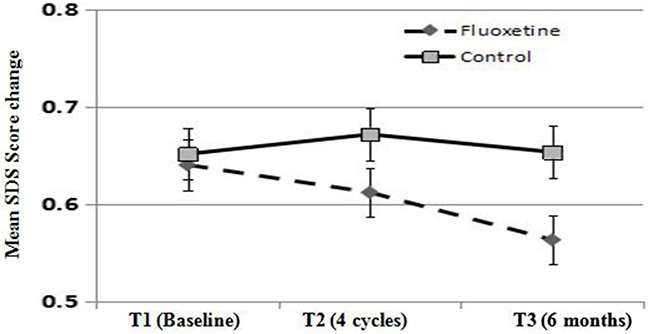
Individual differences in depressive symptoms correlate with morbidity and outcomes in breast cancer patients. We evaluated the effect of hormone receptor (HR) status on depressive symptoms in 176 women with metastatic breast cancer at diagnosis. To assess depression, the women completed Self-Rating Depression Scale (SDS) questionnaires at baseline examination (T1), after 4 chemotherapy cycles (T2) and after 6 months (T3). At baseline examination, 45/176 (25.6%) patients were found to be at high or medium risk for depression (SDS score ≥0.6). Among these, depression was both prevalent in HR-positive patients and in HR-negative patients (64.4% versus 51.4%, = 0.001). In multivariate model, HR positivity and higher depression risk were associated with poorer overall survival (25.0 months versus 32.0 months, < 0.05). Patients at high/medium risk of depression were treated with the antidepressant agent fluoxetine (N = 23) or no drug (N = 22). SDS scores in patients treated with fluoxetine were lower after 4 chemotherapy cycles and after 6 months than in the control group (mean scores: T2, 0.61 versus 0.67, = 0.001; T3, 0.56 versus 0.65, < 0.001). No difference on SDS scores was found between patients with positive or negative HR status during fluoxetine treatment. These findings suggest hormone receptor status is associated with depressive symptoms in patients with metastatic breast cancer. Fluoxetine relieves depressive symptoms in these patients, regardless of hormone receptor status.
乳腺癌患者抑郁症状的个体差异与发病率及预后相关。我们评估了激素受体(HR)状态对176例转移性乳腺癌女性患者诊断时抑郁症状的影响。为评估抑郁情况,这些女性在基线检查(T1)、4个化疗周期后(T2)以及6个月后(T3)完成了自评抑郁量表(SDS)问卷。在基线检查时,45/176(25.6%)患者被发现处于抑郁高风险或中度风险(SDS评分≥0.6)。其中,HR阳性患者和HR阴性患者中抑郁均较为普遍(64.4%对51.4%;P = 0.001)。在多变量模型中,HR阳性和较高的抑郁风险与较差的总生存期相关(25.0个月对32.0个月;P < 0.05)。抑郁高风险/中度风险患者接受抗抑郁药氟西汀治疗(N = 23)或未用药(N = 22)。接受氟西汀治疗的患者在4个化疗周期后和6个月后的SDS评分低于对照组(平均评分:T2,0.61对0.67;P = 0.001;T3,0.56对0.65;P < 0.001)。在氟西汀治疗期间,HR阳性或阴性患者的SDS评分未发现差异。这些发现表明激素受体状态与转移性乳腺癌患者的抑郁症状相关。氟西汀可缓解这些患者的抑郁症状,无论其激素受体状态如何。