Kang Sukjae Joshua, Kim Siyong, Lee Jaehyun, Kwak Chuljung, Lee Kyungmin, Zhuo Min, Kaang Bong-Kiun
Department of Biological Sciences, College of Natural Sciences, Seoul National University, Seoul 08826, Korea.
Interdisciplinary Program in Neuroscience, College of Natural Sciences, Seoul National University, Seoul 08826, Korea.
Korean J Physiol Pharmacol. 2017 Sep;21(5):487-493. doi: 10.4196/kjpp.2017.21.5.487. Epub 2017 Aug 22.
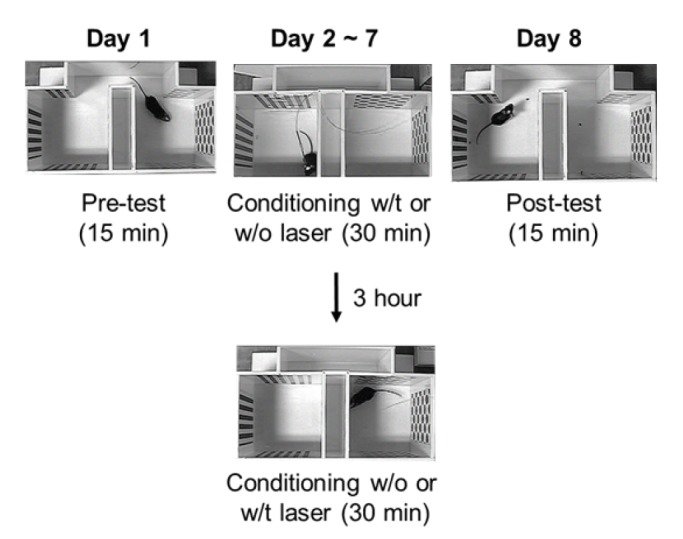
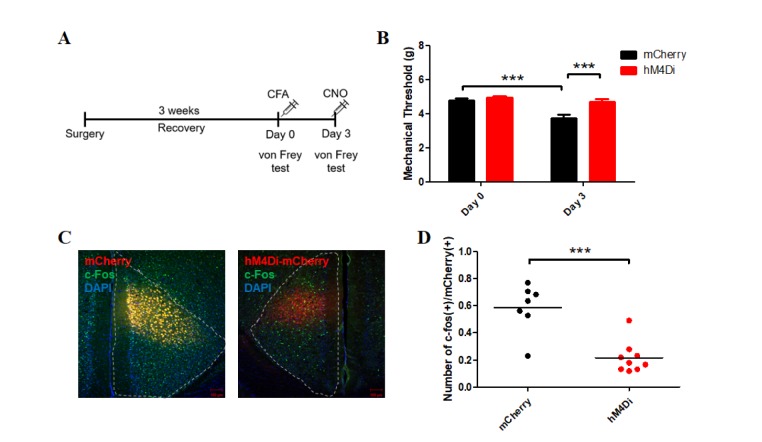
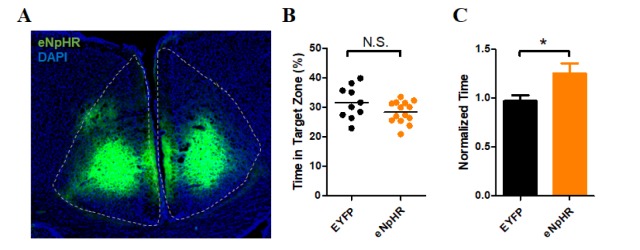
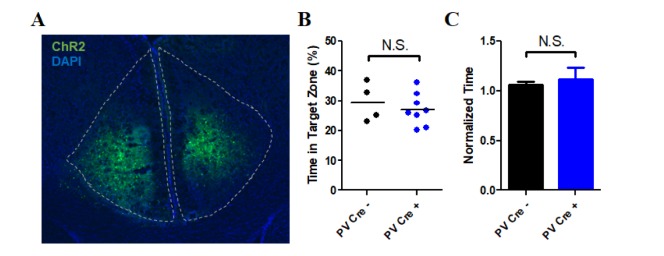
The anterior cingulate cortex (ACC) is known for its role in perception of nociceptive signals and the associated emotional responses. Recent optogenetic studies, involving modulation of neuronal activity in the ACC, show that the ACC can modulate mechanical hyperalgesia. In the present study, we used optogenetic techniques to selectively modulate excitatory pyramidal neurons and inhibitory interneurons in the ACC in a model of chronic inflammatory pain to assess their motivational effect in the conditioned place preference (CPP) test. Selective inhibition of pyramidal neurons induced preference during the CPP test, while activation of parvalbumin (PV)-specific neurons did not. Moreover, chemogenetic inhibition of the excitatory pyramidal neurons alleviated mechanical hyperalgesia, consistent with our previous result. Our results provide evidence for the analgesic effect of inhibition of ACC excitatory pyramidal neurons and a prospective treatment for chronic pain.
前扣带回皮质(ACC)因其在伤害性信号感知及相关情绪反应中的作用而闻名。最近的光遗传学研究涉及ACC中神经元活动的调节,结果表明ACC可调节机械性痛觉过敏。在本研究中,我们运用光遗传学技术,在慢性炎症性疼痛模型中选择性调节ACC中的兴奋性锥体神经元和抑制性中间神经元,以评估它们在条件性位置偏爱(CPP)试验中的动机效应。在CPP试验期间,选择性抑制锥体神经元会诱发偏爱,而激活小白蛋白(PV)特异性神经元则不会。此外,对兴奋性锥体神经元的化学遗传学抑制减轻了机械性痛觉过敏,这与我们之前的结果一致。我们的结果为抑制ACC兴奋性锥体神经元的镇痛作用提供了证据,并为慢性疼痛提供了一种前瞻性治疗方法。