Duggappa Devika Rani, Lokesh Mps, Dixit Aanchal, Paul Rinita, Raghavendra Rao R S, Prabha P
Department of Anaesthesia, Bangalore Medical College and Research Institute, Bengaluru, Karnataka, India.
Indian J Anaesth. 2017 Aug;61(8):649-654. doi: 10.4103/ija.IJA_429_16.
Perfusion index (PI) is a new parameter tried for predicting hypotension during spinal anaesthesia for the lower segment caesarean section (LSCS). This study aimed at investigating the correlation between baseline perfusion index and incidence of hypotension following SAB in LSCS.
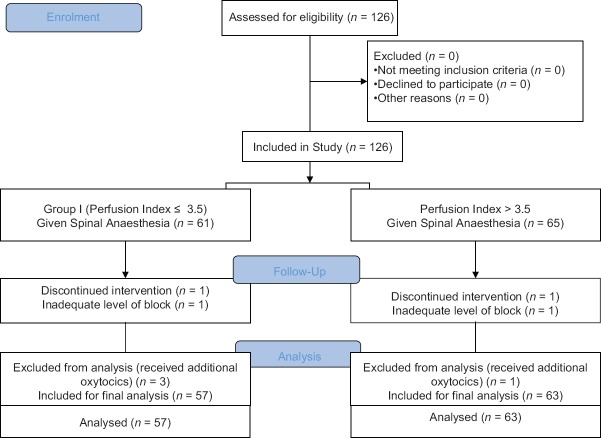
In this prospective observational study, 126 parturients were divided into two groups on the basis of baseline PI. Group I included parturients with PI of ≤3.5 and Group II, parturients with PI values >3.5. Spinal anaesthesia was performed with 10 mg of injection bupivacaine 0.5% (hyperbaric) at L3-L4 or L2-L3 interspace. Hypotension was defined as mean arterial pressure <65 mmHg. Statistical analysis was performed using Chi-square test, independent sample -test and Mann-Whitney U-test. Regression analysis with Spearman's rank correlation coefficient was done to assess the correlation between baseline PI and hypotension. Receiver operating characteristic (ROC) curve was plotted for PI and occurrence of hypotension.
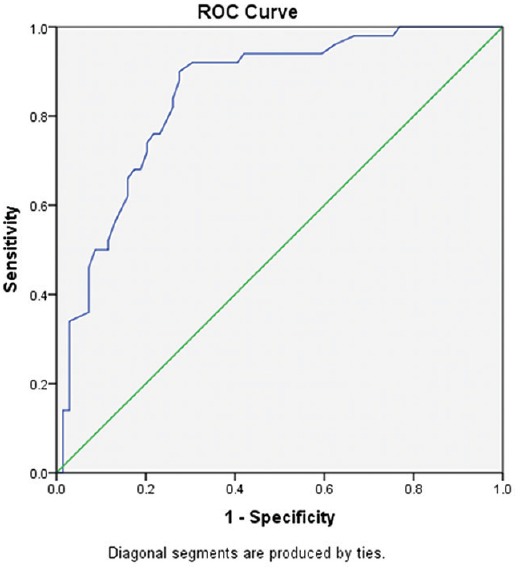
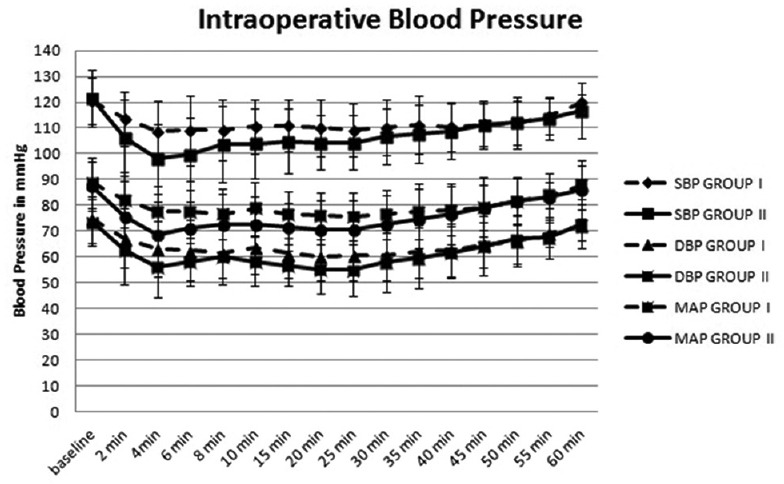
The incidence of hypotension in Group I was 10.5% compared to 71.42% in Group II ( < 0.001). There was significant correlation between baseline PI >3.5 and number of episodes of hypotension (0.416, < 0.001) and total dose of ephedrine (0.567, < 0.001). The sensitivity and specificity of baseline PI of 3.5 to predict hypotension was 69.84% and 89.29%, respectively. The area under the ROC curve for PI to predict hypotension was 0.848.
Baseline perfusion index >3.5 is associated with a higher incidence of hypotension following spinal anesthesia in elective LSCS.
灌注指数(PI)是一种用于预测下段剖宫产术(LSCS)脊髓麻醉期间低血压的新参数。本研究旨在探讨LSCS脊髓蛛网膜下腔阻滞(SAB)后基线灌注指数与低血压发生率之间的相关性。
在这项前瞻性观察研究中,126名产妇根据基线PI分为两组。第一组包括PI≤3.5的产妇,第二组包括PI值>3.5的产妇。在L3-L4或L2-L3间隙使用10mg 0.5%布比卡因注射液(重比重)进行脊髓麻醉。低血压定义为平均动脉压<65mmHg。采用卡方检验、独立样本t检验和曼-惠特尼U检验进行统计分析。采用Spearman等级相关系数进行回归分析,以评估基线PI与低血压之间的相关性。绘制PI与低血压发生情况的受试者工作特征(ROC)曲线。
第一组低血压发生率为10.5%,而第二组为71.42%(P<0.001)。基线PI>3.5与低血压发作次数(r=0.416,P<0.001)和麻黄碱总剂量(r=0.567,P<0.001)之间存在显著相关性。基线PI为3.5预测低血压的敏感性和特异性分别为69.84%和89.29%。PI预测低血压的ROC曲线下面积为0.848。
在择期LSCS中,基线灌注指数>3.5与脊髓麻醉后低血压发生率较高相关。