Grey Charlotte N B, Schmieder-Gaite Tina, Jiang Shiyu, Nascimento Christina, Poortinga Wouter
Welsh School of Architecture, Cardiff University, Cardiff, UK.
School of Social Sciences, Cardiff University, Cardiff, UK.
Indoor Built Environ. 2017 Aug;26(7):902-913. doi: 10.1177/1420326X17703450. Epub 2017 Apr 12.
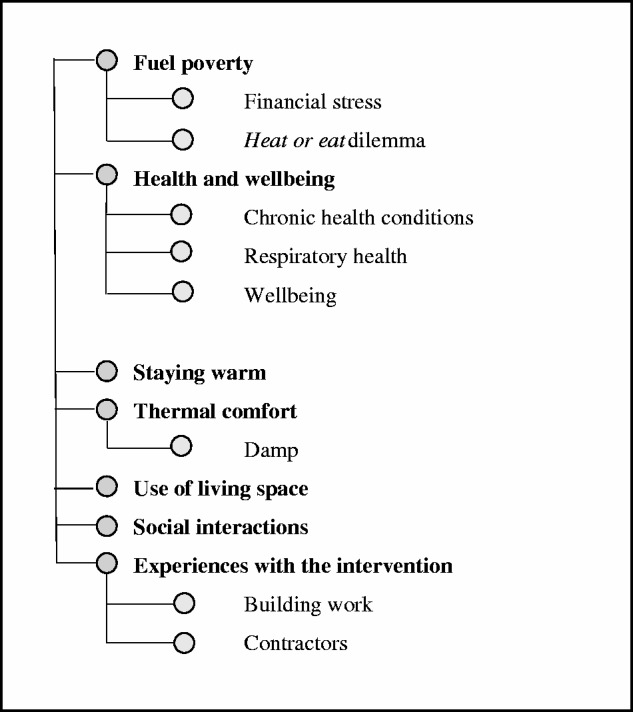
Cold homes and fuel poverty have been identified as factors in health and social inequalities that could be alleviated through energy efficiency interventions. Research on fuel poverty and the health impacts of affordable warmth initiatives have to date primarily been conducted using quantitative and statistical methods, limiting the way how fuel poverty is understood. This study took a longitudinal focus group approach that allowed exploration of lived experiences of fuel poverty before and after an energy efficiency intervention. Focus group discussions were held with residents from three low-income communities before (n = 28) and after (n = 22) they received energy efficiency measures funded through a government-led scheme. The results show that improving the energy efficiency of homes at risk of fuel poverty has a profound impact on wellbeing and quality of life, financial stress, thermal comfort, social interactions and indoor space use. However, the process of receiving the intervention was experienced by some as stressful. There is a need for better community engagement and communication to improve the benefits delivered by fuel poverty programmes, as well as further qualitative exploration to better understand the wider impacts of fuel poverty and policy-led intervention schemes.
寒冷的住房和燃料贫困已被确认为健康和社会不平等的因素,可通过能源效率干预措施加以缓解。迄今为止,关于燃料贫困和可负担取暖倡议对健康影响的研究主要采用定量和统计方法,这限制了人们对燃料贫困的理解方式。本研究采用纵向焦点小组方法,探讨了能源效率干预前后燃料贫困的生活经历。在三个低收入社区的居民接受政府主导计划资助的能源效率措施之前(n = 28)和之后(n = 22),分别进行了焦点小组讨论。结果表明,提高有燃料贫困风险家庭的能源效率对幸福感、生活质量、财务压力、热舒适度、社交互动和室内空间使用有深远影响。然而,一些人认为接受干预的过程压力很大。需要更好地促进社区参与和沟通,以提高燃料贫困计划带来的益处,同时需要进一步进行定性探索,以更好地理解燃料贫困和政策主导干预计划的更广泛影响。