Mizumoto Ayaka, Ohashi Shinya, Hirohashi Kenshiro, Amanuma Yusuke, Matsuda Tomonari, Muto Manabu
Department of Therapeutic Oncology, Graduate School of Medicine, Kyoto University, Kyoto 606-8507, Japan.
Department of Gastroenterology and Hepatology, Graduate School of Medicine, Kyoto University, Kyoto 606-8507, Japan.
Int J Mol Sci. 2017 Sep 10;18(9):1943. doi: 10.3390/ijms18091943.
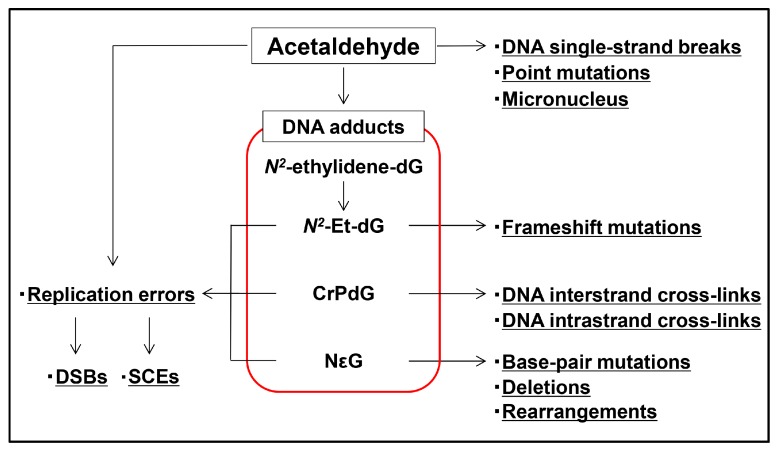
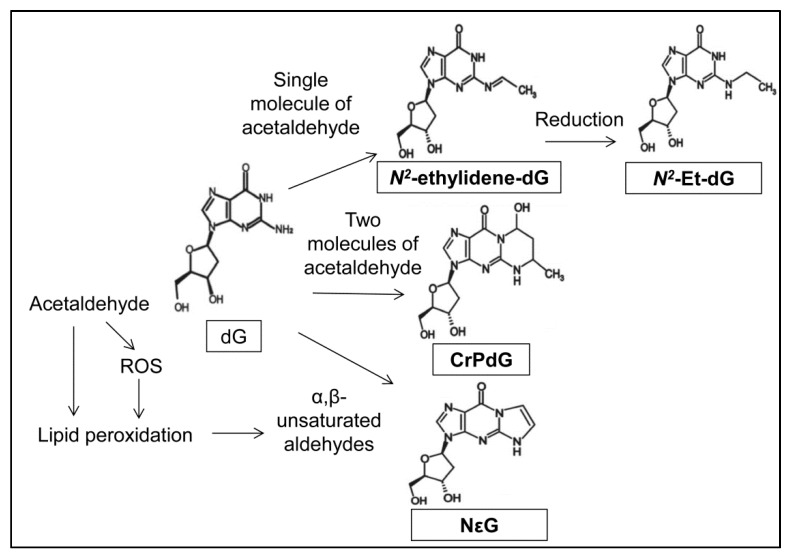
Acetaldehyde is a highly reactive compound that causes various forms of damage to DNA, including DNA adducts, single- and/or double-strand breaks (DSBs), point mutations, sister chromatid exchanges (SCEs), and DNA-DNA cross-links. Among these, DNA adducts such as -ethylidene-2'-deoxyguanosine, -ethyl-2'-deoxyguanosine, -propano-2'-deoxyguanosine, and -etheno-2'-deoxyguanosine are central to acetaldehyde-mediated DNA damage because they are associated with the induction of DNA mutations, DNA-DNA cross-links, DSBs, and SCEs. Acetaldehyde is produced endogenously by alcohol metabolism and is catalyzed by aldehyde dehydrogenase 2 (ALDH2). Alcohol consumption increases blood and salivary acetaldehyde levels, especially in individuals with polymorphisms, which are highly associated with the risk of squamous cell carcinomas in the upper aerodigestive tract. Based on extensive epidemiological evidence, the International Agency for Research on Cancer defined acetaldehyde associated with the consumption of alcoholic beverages as a "group 1 carcinogen" (definite carcinogen) for the esophagus and/or head and neck. In this article, we review recent advances from studies of acetaldehyde-mediated carcinogenesis in the squamous epithelium, focusing especially on acetaldehyde-mediated DNA adducts. We also give attention to research on acetaldehyde-mediated DNA repair pathways such as the Fanconi anemia pathway and refer to our studies on the prevention of acetaldehyde-mediated DNA damage.
乙醛是一种高反应性化合物,会对DNA造成多种形式的损伤,包括DNA加合物、单链和/或双链断裂(DSB)、点突变、姐妹染色单体交换(SCE)以及DNA-DNA交联。其中,诸如 - 亚乙基 - 2'-脱氧鸟苷、 - 乙基 - 2'-脱氧鸟苷、 - 丙基 - 2'-脱氧鸟苷和 - 乙烯基 - 2'-脱氧鸟苷等DNA加合物是乙醛介导的DNA损伤的核心,因为它们与DNA突变、DNA-DNA交联、DSB和SCE的诱导有关。乙醛由酒精代谢内源性产生,并由乙醛脱氢酶2(ALDH2)催化。饮酒会增加血液和唾液中的乙醛水平,尤其是在具有多态性的个体中,这与上呼吸道消化道鳞状细胞癌的风险高度相关。基于广泛的流行病学证据,国际癌症研究机构将与酒精饮料消费相关的乙醛定义为食管和/或头颈部的“1类致癌物”(明确致癌物)。在本文中,我们综述了鳞状上皮中乙醛介导的致癌作用研究的最新进展,特别关注乙醛介导的DNA加合物。我们还关注乙醛介导的DNA修复途径的研究,如范可尼贫血途径,并参考我们关于预防乙醛介导的DNA损伤的研究。