Kuznetsova Maria A, Chaban Inna A, Sheval Eugene V
Belozersky Institute of Physico-Chemical Biology, Lomonosov Moscow State University, 119992, Moscow, Russia.
All-Russian Research Institute of Agricultural Biotechnology, Timiryazevskaja 42, 127550, Moscow, Russia.
BMC Plant Biol. 2017 Sep 12;17(1):153. doi: 10.1186/s12870-017-1102-7.
Most data concerning chromosome organization have been acquired from studies of a small number of model organisms, the majority of which are mammals. In plants with large genomes, the chromosomes are significantly larger than the animal chromosomes that have been studied to date, and it is possible that chromosome condensation in such plants was modified during evolution. Here, we analyzed chromosome condensation and decondensation processes in order to find structural mechanisms that allowed for an increase in chromosome size.
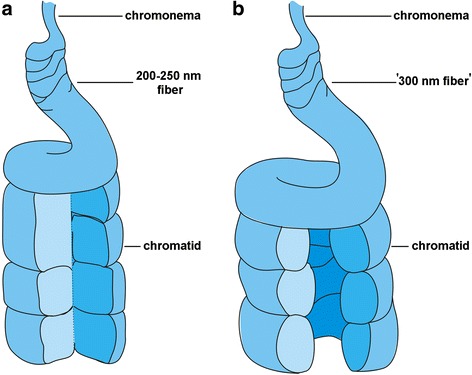
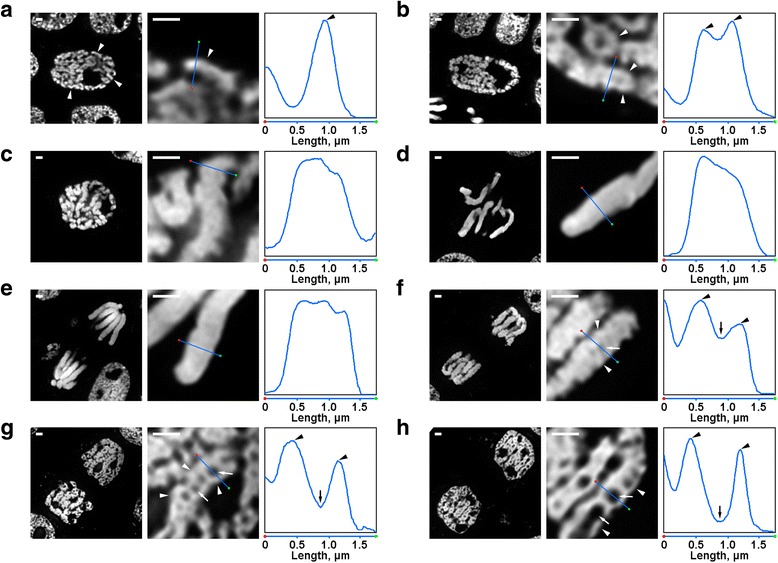
We found that anaphase and telophase chromosomes of plants with large chromosomes (average 2C DNA content exceeded 0.8 pg per chromosome) contained chromatin-free cavities in their axial regions in contrast to well-characterized animal chromosomes, which have high chromatin density in the axial regions. Similar to animal chromosomes, two intermediates of chromatin folding were visible inside condensing (during prophase) and decondensing (during telophase) chromosomes of Nigella damascena: approximately 150 nm chromonemata and approximately 300 nm fibers. The spatial folding of the latter fibers occurs in a fundamentally different way than in animal chromosomes, which leads to the formation of chromosomes with axial chromatin-free cavities.
Different compaction topology, but not the number of compaction levels, allowed for the evolution of increased chromosome size in plants.
大多数关于染色体组织的数据来自对少数模式生物的研究,其中大多数是哺乳动物。在具有大基因组的植物中,染色体明显大于迄今为止所研究的动物染色体,并且在进化过程中,此类植物的染色体浓缩可能发生了改变。在此,我们分析了染色体浓缩和解浓缩过程,以寻找能使染色体大小增加的结构机制。
我们发现,具有大染色体(每条染色体平均2C DNA含量超过0.8 pg)的植物在后期和末期的染色体,其轴向区域含有无染色质的空洞,这与特征明确的动物染色体不同,动物染色体的轴向区域具有高染色质密度。与动物染色体类似,在黑种草有丝分裂前期浓缩和末期解浓缩的染色体内部可见两种染色质折叠中间体:约150 nm的染色线和约300 nm的纤维。后者纤维的空间折叠方式与动物染色体截然不同,这导致形成具有轴向无染色质空洞的染色体。
不同的压缩拓扑结构,而非压缩水平的数量,使得植物染色体大小在进化过程中得以增加。