El Alaoui Samir, Hedman-Lagerlöf Erik, Ljótsson Brjánn, Lindefors Nils
Department of Clinical Neuroscience, Division of Psychiatry, Karolinska Institutet, Stockholm, Sweden.
Department of Clinical Neuroscience, Osher Center for Integrative Medicine, Karolinska Institutet, Stockholm, Sweden.
BMJ Open. 2017 Sep 11;7(9):e017053. doi: 10.1136/bmjopen-2017-017053.
Social anxiety disorder (SAD) can be effectively treated with internet-delivered cognitive behavioural therapy (ICBT), but studies on long-term cost minimisation from a healthcare provider perspective in comparison to an evidence-based control treatment of therapeutic equivalence are lacking. The objective of the study was to determine whether ICBT reduces healthcare costs and use of healthcare resources compared with cognitive behavioural group therapy (CBGT).
A cost-minimisation study alongside a randomised controlled trial where participants (n=126) with SAD were randomised to ICBT or to CBGT. Costs measured from a healthcare provider perspective were estimated using time-driven activity-based costing alongside health status over 4 years from baseline measured with EQ-5D.
A psychiatric outpatient clinic in Stockholm, Sweden.
Participants were 126 individuals with SAD.
Changes in EQ-5D and costs.
Participants received either CBGT or ICBT for a duration of 15 weeks.
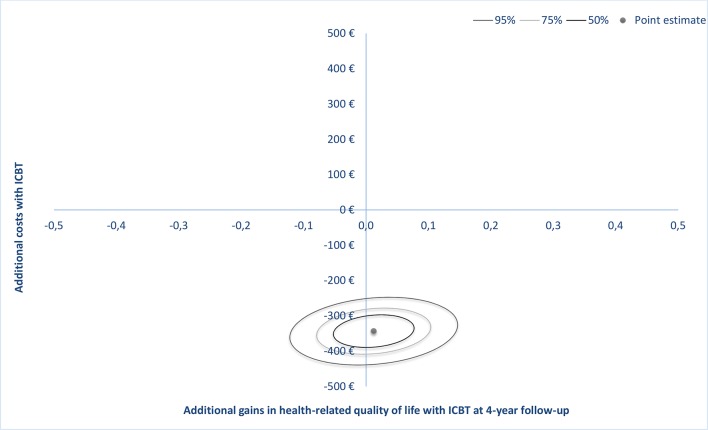
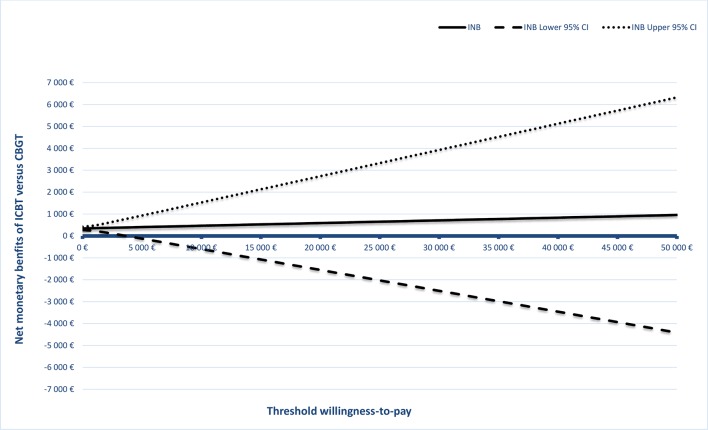
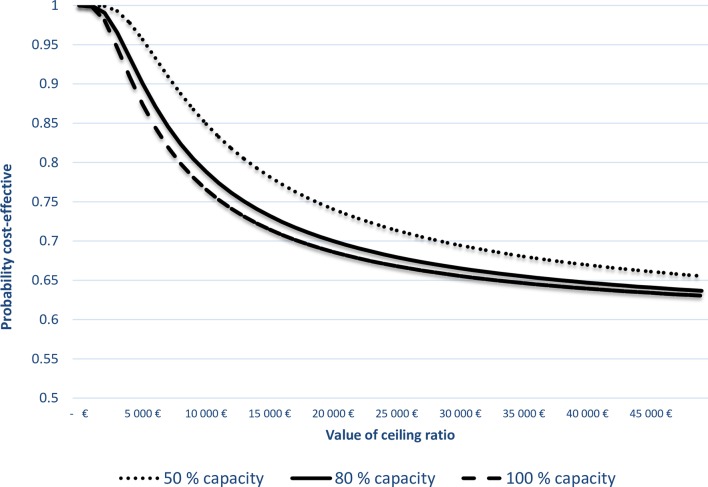
ICBT minimised healthcare costs and demonstrated health improvements within the non-inferiority margin. Assuming a practical work capacity for personnel varying between 100%, 80% and 50% of theoretical full capacity, the cost for ICBT varied in the range between 400€, 463€ and 654 €, while the cost for CBGT varied between 699€, 806€ and 1134€. Within-group effect size was -0.36 (95% CI -0.70 to -0.01) for ICBT and -0.25 (95% CI -0.60 to 0.10) for CBGT. Mean use of effective psychologist time in ICBT was 189.60 (SD=53.77) minutes compared with 499.78 (SD=30.91) in the CBGT group.
In treatment of SAD, ICBT is equally effective but is associated with more efficient staff utilisation and less costs compared with CBGT. From a healthcare provider perspective, ICBT is an advantageous treatment option.
社交焦虑障碍(SAD)可通过互联网提供的认知行为疗法(ICBT)得到有效治疗,但从医疗服务提供者的角度来看,与具有治疗等效性的循证对照治疗相比,缺乏关于长期成本最小化的研究。本研究的目的是确定与认知行为团体疗法(CBGT)相比,ICBT是否能降低医疗成本和医疗资源的使用。
一项成本最小化研究,同时进行一项随机对照试验,将126名患有SAD的参与者随机分为ICBT组或CBGT组。从医疗服务提供者的角度测量的成本,采用时间驱动作业成本法进行估算,并结合使用EQ-5D从基线开始测量的4年健康状况。
瑞典斯德哥尔摩的一家精神科门诊诊所。
126名患有SAD的个体。
EQ-5D的变化和成本。
参与者接受为期15周的CBGT或ICBT。
ICBT使医疗成本最小化,并在非劣效边际内显示出健康改善。假设人员的实际工作能力在理论满负荷能力的100%、80%和50%之间变化,ICBT的成本在400欧元、463欧元和654欧元之间,而CBGT的成本在699欧元、806欧元和1134欧元之间。ICBT组内效应量为-0.36(95%CI -0.70至-0.01),CBGT组为-0.25(95%CI -0.60至0.10)。ICBT中有效心理医生时间的平均使用量为189.60(SD=53.77)分钟,而CBGT组为499.78(SD=30.91)分钟。
在SAD的治疗中,与CBGT相比,ICBT同样有效,但与更高效的人员利用和更低的成本相关。从医疗服务提供者的角度来看,ICBT是一种有利的治疗选择。