Darling Sarah, Fielding Andrew B, Sabat-Pośpiech Dorota, Prior Ian A, Coulson Judy M
Cellular and Molecular Physiology, Institute of Translational Medicine, University of Liverpool, Liverpool L69 3BX, U.K.
Biochem Soc Trans. 2017 Oct 15;45(5):1125-1136. doi: 10.1042/BST20170087. Epub 2017 Sep 12.
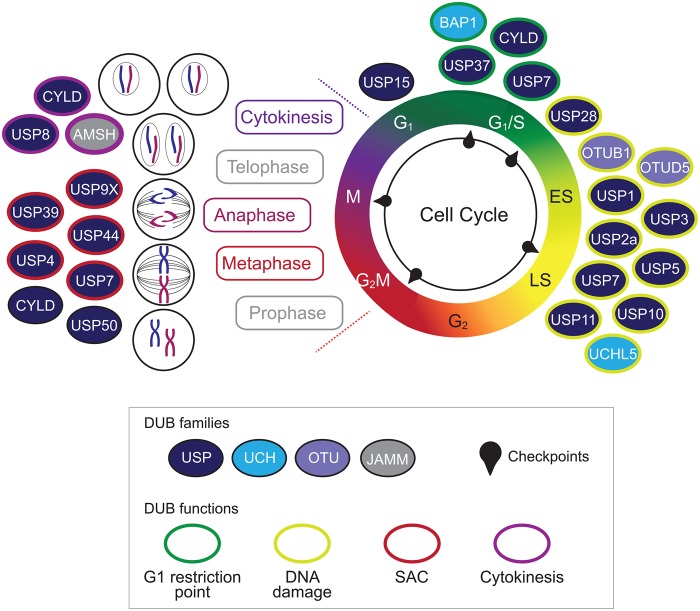
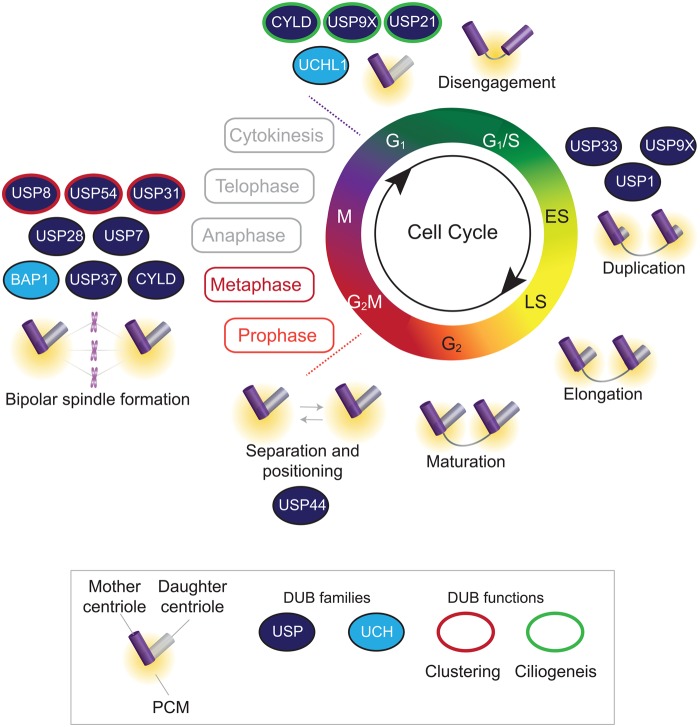
Post-translational modification of proteins by ubiquitylation is increasingly recognised as a highly complex code that contributes to the regulation of diverse cellular processes. In humans, a family of almost 100 deubiquitylase enzymes (DUBs) are assigned to six subfamilies and many of these DUBs can remove ubiquitin from proteins to reverse signals. Roles for individual DUBs have been delineated within specific cellular processes, including many that are dysregulated in diseases, particularly cancer. As potentially druggable enzymes, disease-associated DUBs are of increasing interest as pharmaceutical targets. The biology, structure and regulation of DUBs have been extensively reviewed elsewhere, so here we focus specifically on roles of DUBs in regulating cell cycle processes in mammalian cells. Over a quarter of all DUBs, representing four different families, have been shown to play roles either in the unidirectional progression of the cell cycle through specific checkpoints, or in the DNA damage response and repair pathways. We catalogue these roles and discuss specific examples. Centrosomes are the major microtubule nucleating centres within a cell and play a key role in forming the bipolar mitotic spindle required to accurately divide genetic material between daughter cells during cell division. To enable this mitotic role, centrosomes undergo a complex replication cycle that is intimately linked to the cell division cycle. Here, we also catalogue and discuss DUBs that have been linked to centrosome replication or function, including centrosome clustering, a mitotic survival strategy unique to cancer cells with supernumerary centrosomes.
蛋白质的泛素化修饰作为一种高度复杂的编码方式,越来越被认为在多种细胞过程的调控中发挥作用。在人类中,近100种去泛素化酶(DUB)组成的家族被分为六个亚家族,其中许多DUB能够从蛋白质上去除泛素以逆转信号。单个DUB在特定细胞过程中的作用已被阐明,包括许多在疾病(尤其是癌症)中失调的过程。作为潜在的可药物化酶,与疾病相关的DUB作为药物靶点越来越受到关注。DUB的生物学、结构和调控在其他地方已有广泛综述,因此在这里我们特别关注DUB在调节哺乳动物细胞周期过程中的作用。已表明超过四分之一的所有DUB(代表四个不同家族)在细胞周期通过特定检查点的单向进程中,或在DNA损伤应答和修复途径中发挥作用。我们梳理了这些作用并讨论了具体例子。中心体是细胞内主要的微管成核中心,在细胞分裂期间形成双极有丝分裂纺锤体以准确地在子细胞之间分配遗传物质方面发挥关键作用。为实现这种有丝分裂作用,中心体经历一个与细胞分裂周期密切相关的复杂复制周期。在这里,我们还梳理并讨论了与中心体复制或功能相关的DUB,包括中心体聚集,这是具有多个中心体的癌细胞特有的一种有丝分裂存活策略。