Medical Psychological Center, the Second Xiangya Hospital, Central South University, Changsha, P.R. China.
Medical Psychological Institute of Central South University, Changsha, P.R. China.
Sci Rep. 2017 Sep 12;7(1):11349. doi: 10.1038/s41598-017-11775-z.
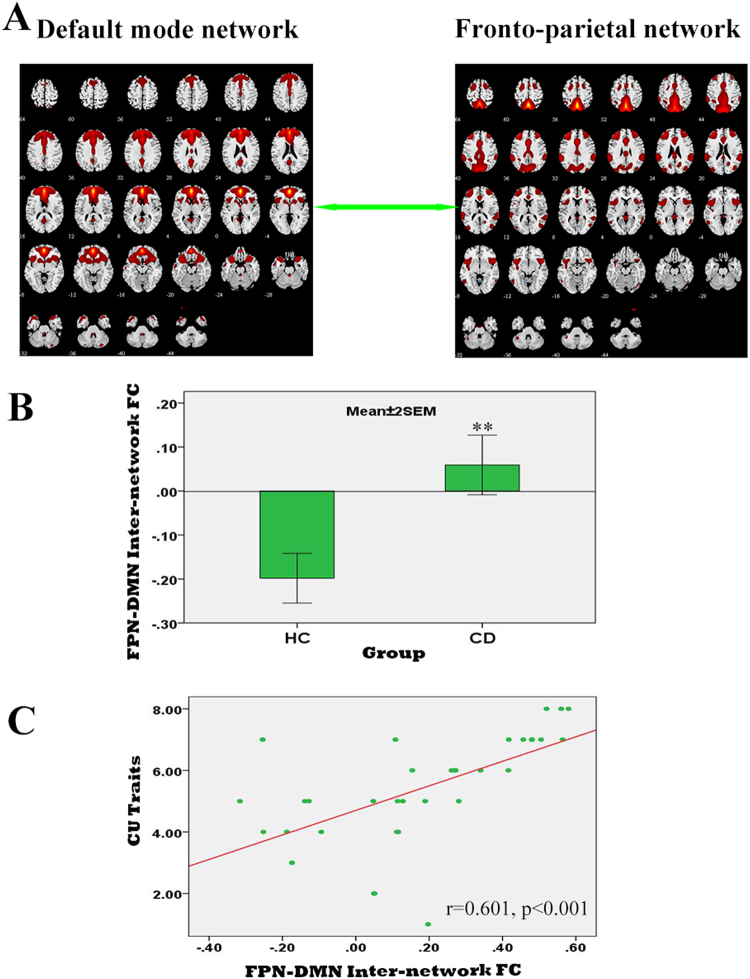
Psychopathic traits of conduct disorder (CD) have a core callous-unemotional (CU) component and an impulsive-antisocial component. Previous task-driven fMRI studies have suggested that psychopathic traits are associated with dysfunction of several brain areas involved in different cognitive functions (e.g., empathy, reward, and response inhibition etc.), but the relationship between psychopathic traits and intrinsic brain functional architecture has not yet been explored in CD. Using a holistic brain-wide functional connectivity analysis, this study delineated the alterations in brain functional networks in patients with conduct disorder. Compared with matched healthy controls, we found decreased anti-synchronization between the fronto-parietal network (FPN) and default mode network (DMN), and increased intra-network synchronization within the frontothalamic-basal ganglia, right frontoparietal, and temporal/limbic/visual networks in CD patients. Correlation analysis showed that the weakened FPN-DMN interaction was associated with CU traits, while the heightened intra-network functional connectivity was related to impulsivity traits in CD patients. Our findings suggest that decoupling of cognitive control (FPN) with social understanding of others (DMN) is associated with the CU traits, and hyper-functions of the reward and motor inhibition systems elevate impulsiveness in CD.
品行障碍(CD)的精神病态特征具有核心的无情(CU)和冲动反社会成分。先前的任务驱动 fMRI 研究表明,精神病态特征与几个涉及不同认知功能(例如同理心、奖励和反应抑制等)的大脑区域的功能障碍有关,但 CD 中尚未探讨精神病态特征与内在大脑功能结构之间的关系。使用全脑功能连接分析,本研究描绘了品行障碍患者大脑功能网络的变化。与匹配的健康对照组相比,我们发现 CD 患者的额顶网络(FPN)和默认模式网络(DMN)之间的反同步性降低,而额丘脑-基底神经节、右额顶和颞叶/边缘/视觉网络内的网络内同步性增加。相关性分析表明,FPN-DMN 相互作用的减弱与 CU 特征有关,而 CD 患者的网络内功能连接的增强与冲动特征有关。我们的研究结果表明,认知控制(FPN)与对他人的社会理解(DMN)的解耦与 CU 特征有关,而奖励和运动抑制系统的过度功能会增加 CD 中的冲动性。