Kauff Mathias, Asbrock Frank, Wagner Ulrich, Pettigrew Thomas F, Hewstone Miles, Schäfer Sarina J, Christ Oliver
Institute of Psychology, FernUniversität in HagenHagen, Germany.
Department of Psychology, Technische Universität ChemnitzChemnitz, Germany.
Front Psychol. 2017 Aug 29;8:1449. doi: 10.3389/fpsyg.2017.01449. eCollection 2017.
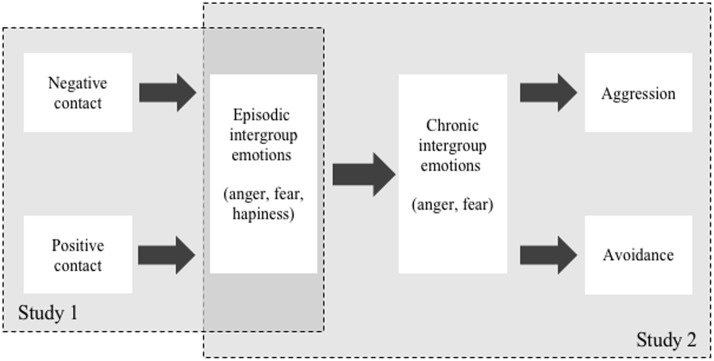
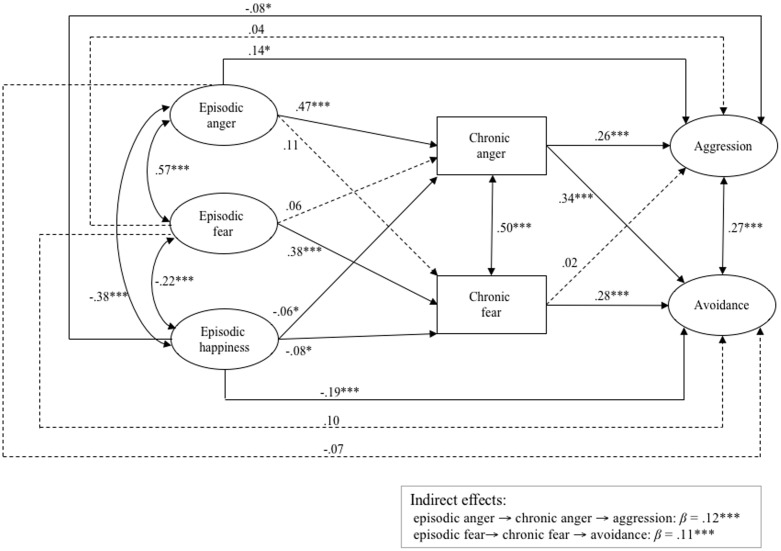
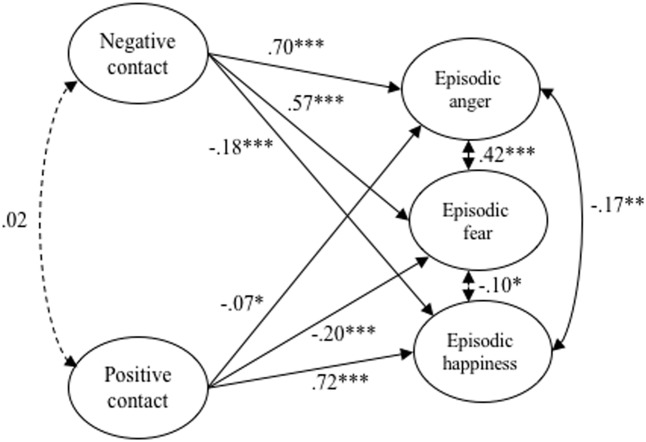
Based on two cross-sectional probability samples (Study 1: = 1,382, Study 2: = 1,587), we studied the interplay between positive and negative intergroup contact, different types of intergroup emotions (i.e., episodic intergroup emotions encountered during contact and more general chronic intergroup emotions), and outgroup behavior in the context of intergroup relations between non-immigrant Germans and foreigners living in Germany. In Study 1, we showed that positive and negative contact are related to specific episodic intergroup emotions (i.e., anger, fear and happiness). Results of Study 2 indicate an indirect effect of episodic intergroup emotions encountered during contact experiences on specific behavioral tendencies directed at outgroup members via more chronic situation-independent intergroup emotions. As expected, anger predicted approaching (discriminatory) behavioral tendencies (i.e., aggression) while fear predicted avoidance. The results extend the existing literature on intergroup contact and emotions by addressing positive and negative contact simultaneously and differentiating between situation-specific episodic and chronic intergroup emotions in predicting discriminatory behavioral tendencies.
基于两个横断面概率样本(研究1:n = 1382,研究2:n = 1587),我们研究了非移民德国人与居住在德国的外国人之间群体间关系背景下积极和消极群体间接触、不同类型的群体间情绪(即接触过程中遇到的偶发性群体间情绪和更普遍的长期性群体间情绪)以及外群体行为之间的相互作用。在研究1中,我们表明积极和消极接触与特定的偶发性群体间情绪(即愤怒、恐惧和快乐)有关。研究2的结果表明,接触经历中遇到的偶发性群体间情绪通过更长期性的、与情境无关的群体间情绪对针对外群体成员的特定行为倾向产生间接影响。正如预期的那样,愤怒预示着接近(歧视性)行为倾向(即攻击),而恐惧预示着回避。这些结果通过同时探讨积极和消极接触,并在预测歧视性行为倾向时区分特定情境的偶发性和长期性群体间情绪,扩展了关于群体间接触和情绪的现有文献。