AstraZeneca, 1 MedImmune Way, Gaithersburg, MD, 20878, USA.
Bristol-Myers Squibb, New Brunswick, NJ, USA.
Cardiovasc Diabetol. 2017 Sep 13;16(1):113. doi: 10.1186/s12933-017-0595-6.
In the Saxagliptin Assessment of Vascular Outcomes Recorded in Patients with Diabetes Mellitus (SAVOR) trial in patients with type 2 diabetes mellitus (T2D) at high risk of cardiovascular (CV) disease, saxagliptin did not increase the risk for major CV adverse events. However, there was an unexpected imbalance in events of hospitalization for heart failure (hHF), one of six components of the secondary CV composite endpoint, with a greater number of events observed with saxagliptin. Here, we examined findings from nonclinical safety and clinical pharmacology studies of saxagliptin with the aim of identifying any potential signals of myocardial injury.
In vitro and in vivo (rat, dog, monkey) safety pharmacology and toxicology studies evaluating the potential effects of saxagliptin and its major active metabolite, 5-hydroxy saxagliptin, on the CV system are reviewed. In addition, results from saxagliptin clinical studies are discussed: one randomized, 2-period, double-blind, placebo-controlled single-ascending-dose study (up to 100 mg); one randomized, double-blind, placebo-controlled, sequential, multiple-ascending-high-dose study (up to 400 mg/day for 14 days); and one randomized, double-blind, 4-period, 4-treatment, cross-over thorough QTc study (up to 40 mg/day for 4 days) in healthy volunteers; as well as one randomized, placebo-controlled, sequential multiple-ascending-dose study in patients with T2D (up to 50 mg/day for 14 days).
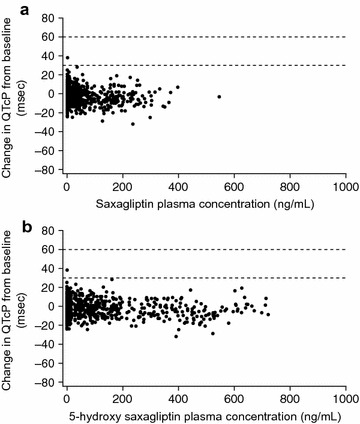
Neither saxagliptin nor 5-hydroxy saxagliptin affected ligand binding to receptors and ion channels (e.g. potassium channels) or action potential duration in in vitro studies. In animal toxicology studies, no changes in the cardiac conduction system, blood pressure, heart rate, contractility, heart weight, or heart histopathology were observed. In healthy participants and patients with T2D, there were no findings suggestive of myocyte injury or fluid overload. Serum chemistry abnormalities indicative of cardiac injury, nonspecific muscle damage, or fluid homeostasis changes were infrequent and balanced across treatment groups. There were no QTc changes associated with saxagliptin. No treatment-emergent adverse events suggestive of heart failure or myocardial damage were reported.
The saxagliptin nonclinical and clinical pharmacology programs did not identify evidence of myocardial injury and/or CV harm that may have predicted or may explain the unexpected imbalance in the rate of hHF observed in SAVOR.
在 2 型糖尿病(T2D)高危心血管疾病(CV)患者中进行的沙格列汀评估血管结局记录在糖尿病患者(SAVOR)试验中,沙格列汀并未增加主要 CV 不良事件的风险。然而,在六个次要 CV 复合终点之一的心力衰竭(HF)住院事件中出现了意外的不平衡,接受沙格列汀治疗的患者中观察到的事件更多。在这里,我们检查了沙格列汀的非临床安全性和临床药理学研究结果,目的是确定任何潜在的心肌损伤信号。
回顾评估沙格列汀及其主要活性代谢物 5-羟基沙格列汀对心血管系统潜在影响的体外和体内(大鼠、狗、猴子)安全性药理学和毒理学研究。此外,还讨论了沙格列汀临床研究的结果:一项随机、2 期、双盲、安慰剂对照的单次递增剂量研究(高达 100mg);一项随机、双盲、安慰剂对照、序贯、多次递增高剂量研究(高达 400mg/天,持续 14 天);一项在健康志愿者中进行的随机、双盲、4 期、4 种治疗、交叉全面 QT c 研究(高达 40mg/天,持续 4 天);以及一项在 T2D 患者中进行的随机、安慰剂对照、序贯多次递增剂量研究(高达 50mg/天,持续 14 天)。
在体外研究中,沙格列汀和 5-羟基沙格列汀均不影响配体与受体和离子通道(如钾通道)的结合或动作电位持续时间。在动物毒理学研究中,未观察到心脏传导系统、血压、心率、收缩力、心脏重量或心脏组织病理学的变化。在健康参与者和 T2D 患者中,没有发现提示心肌损伤或液体超负荷的迹象。提示心肌损伤、非特异性肌肉损伤或液体动态平衡变化的血清化学异常很少见,且在治疗组之间平衡。沙格列汀没有引起 QT c 改变。没有报告与心力衰竭或心肌损伤相关的治疗后出现的不良事件。
沙格列汀的非临床和临床药理学计划没有发现心肌损伤和/或心血管损害的证据,这些证据可能预测或解释了 SAVOR 中观察到的心力衰竭住院率的意外不平衡。