Yoshikawa Miho, Zhang Ming, Toyota Koki
Geological Survey of Japan, National Institute of Advanced Industrial Science and Technology (AIST).
Graduate School of Bio-Applications and Systems Engineering, Tokyo University of Agriculture and Technology.
Microbes Environ. 2017 Sep 27;32(3):188-200. doi: 10.1264/jsme2.ME16188. Epub 2017 Sep 12.
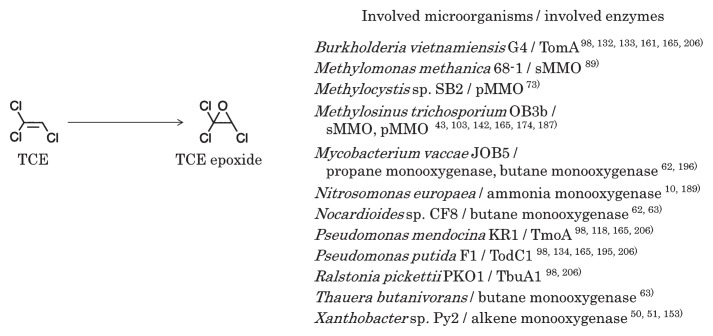
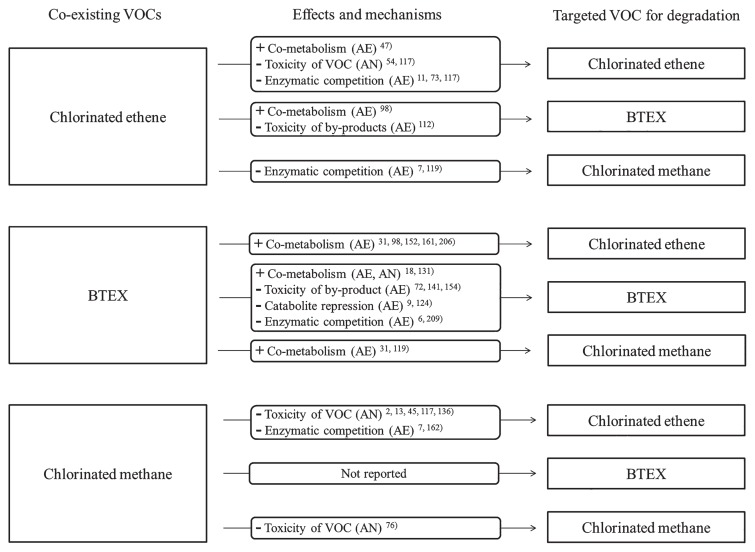
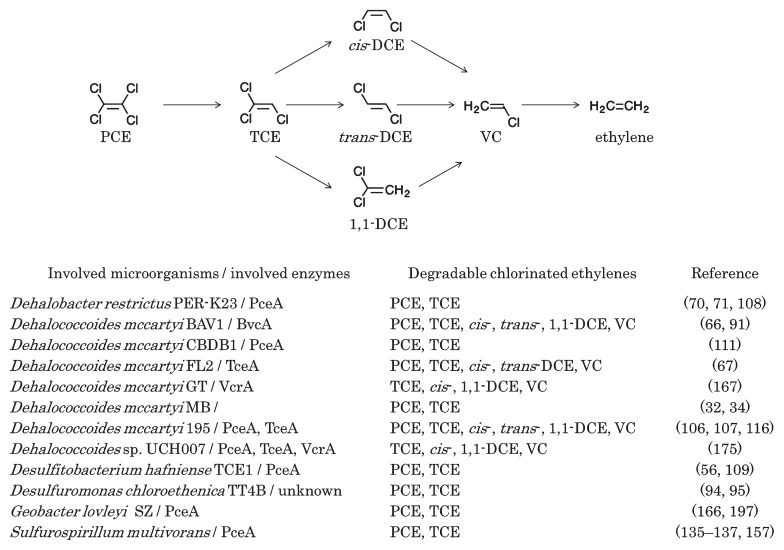
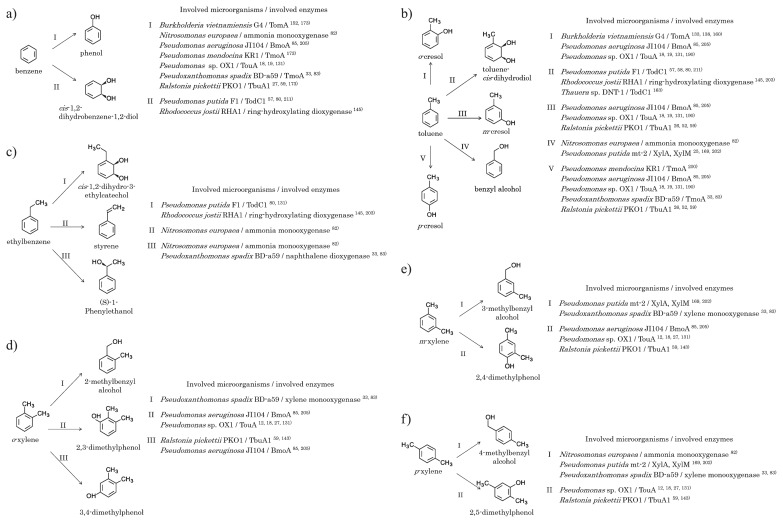
Volatile organic compounds (VOCs) are major pollutants that are found in contaminated sites, particularly in developed countries such as Japan. Various microorganisms that degrade individual VOCs have been reported, and genomic information related to their phylogenetic classification and VOC-degrading enzymes is available. However, the biodegradation of multiple VOCs remains a challenging issue. Practical sites, such as chemical factories, research facilities, and illegal dumping sites, are often contaminated with multiple VOCs. In order to investigate the potential of biodegrading multiple VOCs, we initially reviewed the biodegradation of individual VOCs. VOCs include chlorinated ethenes (tetrachloroethene, trichloroethene, dichloroethene, and vinyl chloride), BTEX (benzene, toluene, ethylbenzene, and xylene), and chlorinated methanes (carbon tetrachloride, chloroform, and dichloromethane). We also summarized essential information on the biodegradation of each kind of VOC under aerobic and anaerobic conditions, together with the microorganisms that are involved in VOC-degrading pathways. Interactions among multiple VOCs were then discussed based on concrete examples. Under conditions in which multiple VOCs co-exist, the biodegradation of a VOC may be constrained, enhanced, and/or unaffected by other compounds. Co-metabolism may enhance the degradation of other VOCs. In contrast, constraints are imposed by the toxicity of co-existing VOCs and their by-products, catabolite repression, or competition between VOC-degrading enzymes. This review provides fundamental, but systematic information for designing strategies for the bioremediation of multiple VOCs, as well as information on the role of key microorganisms that degrade VOCs.
挥发性有机化合物(VOCs)是在污染场地中发现的主要污染物,尤其是在日本等发达国家。已经报道了各种降解单个VOCs的微生物,并且有与其系统发育分类和VOC降解酶相关的基因组信息。然而,多种VOCs的生物降解仍然是一个具有挑战性的问题。实际场地,如化工厂、研究设施和非法倾倒场,常常受到多种VOCs的污染。为了研究生物降解多种VOCs的潜力,我们首先回顾了单个VOCs的生物降解情况。VOCs包括氯代乙烯(四氯乙烯、三氯乙烯、二氯乙烯和氯乙烯)、BTEX(苯、甲苯、乙苯和二甲苯)以及氯代甲烷(四氯化碳、氯仿和二氯甲烷)。我们还总结了在需氧和厌氧条件下每种VOC生物降解的基本信息,以及参与VOC降解途径的微生物。然后基于具体实例讨论了多种VOCs之间的相互作用。在多种VOCs共存的条件下,一种VOC的生物降解可能会受到其他化合物的抑制、促进和/或不受影响。共代谢可能会促进其他VOCs的降解。相反,共存VOCs及其副产物的毒性、分解代谢物阻遏或VOC降解酶之间的竞争会产生限制作用。本综述为设计多种VOCs生物修复策略提供了基础但系统的信息,以及关于降解VOCs的关键微生物作用的信息。