Nourmohammadi Mahdieh, Moghadam Omid Moradi, Lahiji Mohammad Niakan, Hatamian Sevak, Shariatpanahi Zahra Vahdat
National Nutrition and Food Technology Research Institute, Faculty of Nutrition and Food Technology, Shahid Beheshti University of Medical Sciences, Tehran, Iran.
Department of Anesthesiology and Critical Care, Rasoul Akram Hospital, Iran University of Medical Sciences, Tehran, Iran.
Indian J Crit Care Med. 2017 Aug;21(8):500-505. doi: 10.4103/ijccm.IJCCM_118_17.
The aim of this study was to evaluate the preventive effects of high-fat enteral feeding on glycemic control and clinical outcomes in critically ill patients: a randomized clinical trial.
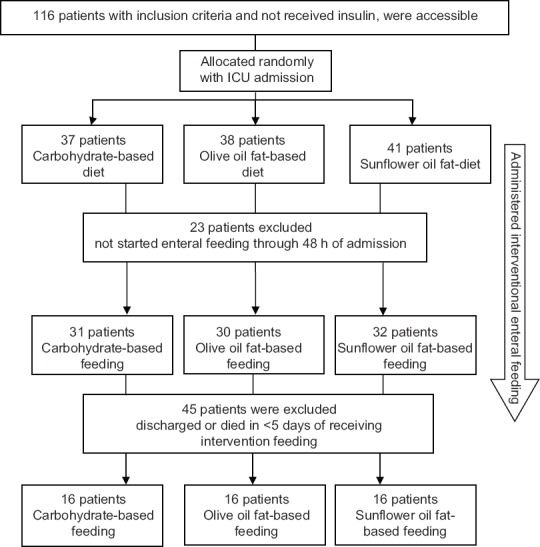
This study was done on 42 normoglycemic patients admitted to Intensive Care Unit (ICU). Patients were randomly classified into three groups of 14 each. Control group (A) received carbohydrate-based diet (protein: 20%, fat: 30%, and carbohydrate: 50%), study groups received two types of high-fat diet; Group B (protein: 20%, fat: 45% including half of olive oil and half sunflower oil, and carbohydrate: 35%); and Group C (protein: 20%, fat: 45% including sunflower oil, and carbohydrate: 35%) in the first 48 h of admission.
Basal characteristics of participants were the same. After the feeding trial, there was no difference between the groups in mean plasma and capillary glucose levels and insulin requirements. Serum high density lipoprotein (HDL)-cholesterol level was increased significantly in Group B on day 10 compared to admission level (40.75 ± 5.58 vs. 43.56 ± 2.25, = 0.05). We did not find any difference in organ failure involvement and mortality rate between groups. The number of ICU free days was significantly more in Group B compared to the control group ( = 0.04).
High-fat diets have no preventive effect on stress hyperglycemia. High monounsaturated fat diet may increase serum HDL-cholesterol level and decrease the length of stay in ICU.
本研究旨在评估高脂肠内营养对危重症患者血糖控制及临床结局的预防作用:一项随机临床试验。
本研究纳入了42例入住重症监护病房(ICU)的血糖正常患者。患者被随机分为三组,每组14例。对照组(A组)接受以碳水化合物为主的饮食(蛋白质:20%,脂肪:30%,碳水化合物:50%),研究组接受两种高脂饮食;B组(蛋白质:20%,脂肪:45%,其中一半为橄榄油,一半为葵花籽油,碳水化合物:35%);C组(蛋白质:20%,脂肪:45%,包括葵花籽油,碳水化合物:35%),在入院后的前48小时内给予。
参与者的基础特征相同。喂养试验后,各组间平均血浆和毛细血管血糖水平及胰岛素需求量无差异。与入院时相比,B组在第10天时血清高密度脂蛋白(HDL)胆固醇水平显著升高(40.75±5.58 vs. 43.56±2.25,P = 0.05)。我们未发现各组间器官功能衰竭发生率和死亡率有任何差异。B组的无ICU天数显著多于对照组(P = 0.04)。
高脂饮食对应激性高血糖无预防作用。高单不饱和脂肪饮食可能会增加血清HDL胆固醇水平,并缩短ICU住院时间。