Ghanbari Atefeh, Hasandoost Fateme, Lyili Ehsan Kazemnezhad, Khomeiran Rasoul Tabari, Momeni Maryam
Associate Professor, Social Determinant of Health Research Center, Guilan University of Medical Sciences, Rasht, Iran.
Department of Nursing and Midwifery, Qazvin University of Medical Sciences, Qazvin, Iran.
Iran J Nurs Midwifery Res. 2017 Jul-Aug;22(4):280-286. doi: 10.4103/1735-9066.212990.
Nursing as a clinical discipline is developing in the emergency wards. Health care systems should continuously assess and prioritize indicators of clinical competency in these wards. The lack of clear standards of clinical competency indicators challenges evaluation. The purpose of this study was to determine clinical competency indicators and its priority based on nurses' views in educational and therapeutic centers in Guilan.
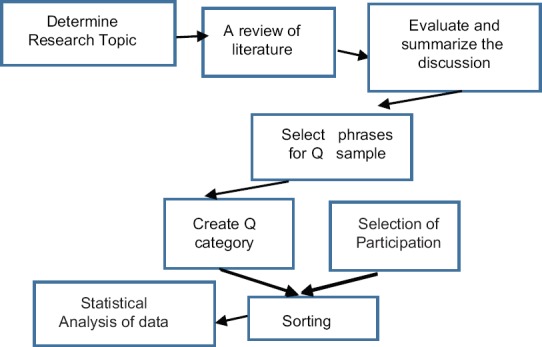
The Q methodology was conducted in three phases, that is, phase I (determining the clinical competency indicators), phase II (classifying clinical competency indicators by an expert panel), and phase III (prioritizing clinical competency indicators). The subjects were selected by convenience sampling among nurses working in the emergency wards of teaching hospitals affiliated to Guilan in 2013. Finally, clinical competency indicators were prioritized using exploratory factor analysis.
In the prioritizing phase, data were collected from 710 nurses over two months. Five factors with 30 general competencies were found in three domains: communication, professional maturity, and personality characteristics. Six factors with 37 specific competencies were also found in two domains: scientific and technical capabilities and basic clinical skills that can provide a structured instrument for assessing clinical competence in emergency nurses.
Achieved competencies can be used as a reference for nursing education and practice in emergency. Further research on health care system is needed in order to achieve a reliable and valid instrument.
护理作为一门临床学科正在急诊病房中不断发展。医疗保健系统应持续评估这些病房中临床能力的指标并确定其优先级。缺乏明确的临床能力指标标准给评估带来了挑战。本研究的目的是根据吉兰省教育和治疗中心护士的观点确定临床能力指标及其优先级。
采用Q方法分三个阶段进行,即第一阶段(确定临床能力指标)、第二阶段(由专家小组对临床能力指标进行分类)和第三阶段(对临床能力指标进行优先级排序)。研究对象通过便利抽样从2013年吉兰省附属医院急诊病房工作的护士中选取。最后,使用探索性因素分析对临床能力指标进行优先级排序。
在优先级排序阶段,在两个月内从710名护士中收集了数据。在沟通、专业成熟度和个性特征三个领域中发现了包含30项一般能力的五个因素。在科学技术能力和基本临床技能两个领域中还发现了包含37项特定能力的六个因素,这些因素可为评估急诊护士的临床能力提供一个结构化工具。
所获得的能力可作为急诊护理教育和实践的参考。为了获得一个可靠有效的工具,还需要对医疗保健系统进行进一步研究。