Arhant Christine, Beetz Andrea Martina, Troxler Josef
Department for Farm Animals and Veterinary Public Health, Institute of Animal Husbandry and Animal Welfare, University of Veterinary Medicine, Vienna, Austria.
Department for Special Education, University of Rostock, Rostock, Germany.
Front Vet Sci. 2017 Aug 30;4:130. doi: 10.3389/fvets.2017.00130. eCollection 2017.
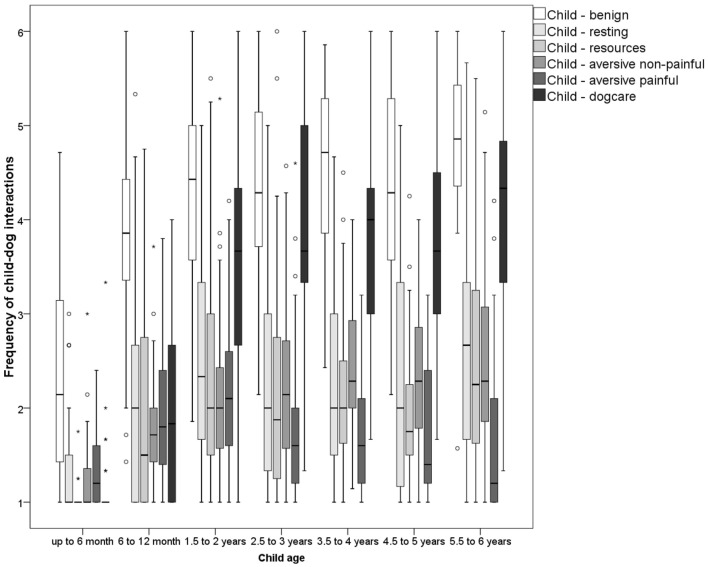
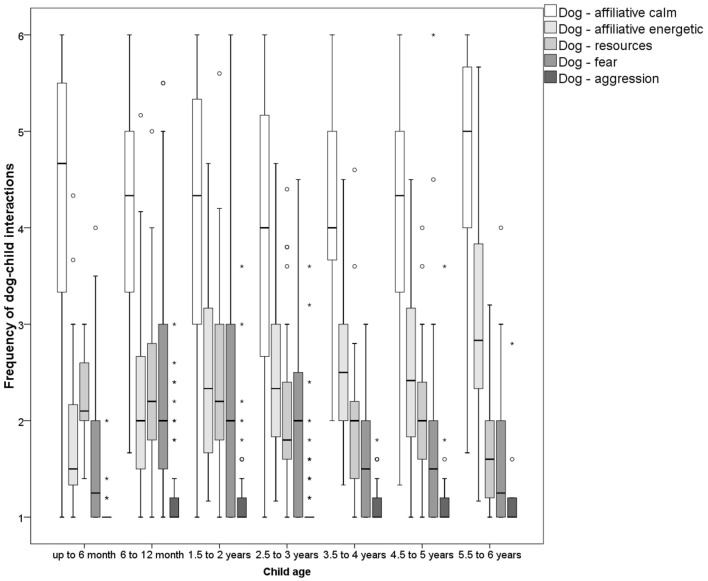
In children up to 6 years, interactions such as interfering with the dog's resources and also benign behaviors (e.g., petting) commonly precede a bite incident with the family dog. Therefore, the aim of the present study was to explore the development of everyday interactions between children up to 6 years and their family dogs and whether parents' attitudes to supervision are related to those interactions. Additionally, we investigated whether behavior of dogs that had lived in the family for longer than the child differed from those that grew up with children. A self-selected sample of caregivers living with a child up to 6 years and a family dog was surveyed an online questionnaire ( = 402). Frequency of observed child behaviors directed toward the dog and dog behaviors directed toward the child were scored on a six-point scale (1-never and 6-very often). Data on characteristics of the caregiver, the child, and the dog were collected, and a section surveying attitudes to supervision of child-dog interactions was included. Additionally, we asked whether the dog already injured the child. Benign child behaviors toward dogs were most frequently reported (mean ± SD: 4.1 ± 1.2), increased with child age ( = 0.38, < 0.001), and reached high levels from 6 months on. Overall, resource-related interactions were relatively infrequent (2.1 ± 1.1). Most common was the dog allowing the child to take objects from its mouth (4.1 ± 1.7). This behavior was more common with older children ( = 0.37, < 0.001). Reported injuries during resource-related interactions occurred while feeding treats or taking objects from the dog during fetch play. Dogs that had lived in the family for longer than the child showed less affiliative behaviors toward the child (e.g., energetic affiliative: = -7.171, < 0.001) and more fear-related behaviors ( = -3.581, < 0.001). Finally, the caregivers' attitudes to supervision were related to all child behaviors (e.g., allow unsafe behaviors-benign child behavior: = 0.47, < 0.001). The results of this study underline the need for a dog bite prevention approach directed toward the caregivers very early in the child-dog relationship, taking into account the child's age and individual needs of the dog.
在6岁及以下的儿童中,诸如干扰狗狗资源以及一些良性行为(例如抚摸)等互动通常先于与家庭宠物狗发生咬伤事件。因此,本研究的目的是探讨6岁及以下儿童与其家庭宠物狗之间日常互动的发展情况,以及父母对监督的态度是否与这些互动相关。此外,我们还调查了在家庭中生活时间比孩子长的狗狗的行为是否与和孩子一起长大的狗狗不同。通过在线问卷(n = 402)对一个自行选择的样本进行了调查,该样本为与6岁及以下儿童和家庭宠物狗一起生活的照顾者。针对孩子对狗狗的行为以及狗狗对孩子的行为,观察到的频率按照六点量表进行评分(1 - 从不,6 - 非常频繁)。收集了关于照顾者、孩子和狗狗特征的数据,并纳入了一个调查对儿童与狗狗互动监督态度的部分。此外,我们询问了狗狗是否曾伤害过孩子。报告中儿童对狗狗的良性行为最为常见(均值±标准差:4.1±1.2),且随孩子年龄增长而增加(r = 0.38,p < 0.001),从6个月起就达到了较高水平。总体而言,与资源相关的互动相对较少(2. .1±1.1)。最常见的是狗狗允许孩子从它嘴里拿东西(4.1±1.7)。这种行为在年龄较大的孩子中更常见(r = 0.37,p < 0.001)。报告的与资源相关互动期间的受伤情况发生在喂食零食或在 fetch游戏中从狗狗那里拿东西的时候。在家庭中生活时间比孩子长的狗狗对孩子表现出较少友好行为(例如精力充沛的友好行为:r = -7.171,p < 0.001)和更多恐惧相关行为(r = -3.581,p < 0.001)。最后,照顾者对监督的态度与所有儿童行为相关(例如允许不安全行为 - 儿童良性行为:r = 0.47,p < 0.001)。本研究结果强调,在儿童与狗狗的关系建立之初,就需要针对照顾者采取一种预防狗狗咬伤的方法,同时要考虑到孩子的年龄和狗狗的个体需求。