Kim Mi Ae, Shin Seung Woo, Park Jong Sook, Uh Soo Taek, Chang Hun Soo, Bae Da Jeong, Cho You Sook, Park Hae Sim, Yoon Ho Joo, Choi Byoung Whui, Kim Yong Hoon, Park Choon Sik
Department of Pulmonology, Allergy and Critical Care Medicine, CHA Bundang Medical Center, CHA University, Seongnam, Korea.
Genome Research Center for Allergy and Respiratory Diseases, Soonchunhyang University Bucheon Hospital, Bucheon, Korea.
Allergy Asthma Immunol Res. 2017 Nov;9(6):483-490. doi: 10.4168/aair.2017.9.6.483.
Asthma is a heterogeneous disease characterized by various types of airway inflammation and obstruction. Therefore, it is classified into several subphenotypes, such as early-onset atopic, obese non-eosinophilic, benign, and eosinophilic asthma, using cluster analysis. A number of asthmatics frequently experience exacerbation over a long-term follow-up period, but the exacerbation-prone subphenotype has rarely been evaluated by cluster analysis. This prompted us to identify clusters reflecting asthma exacerbation.
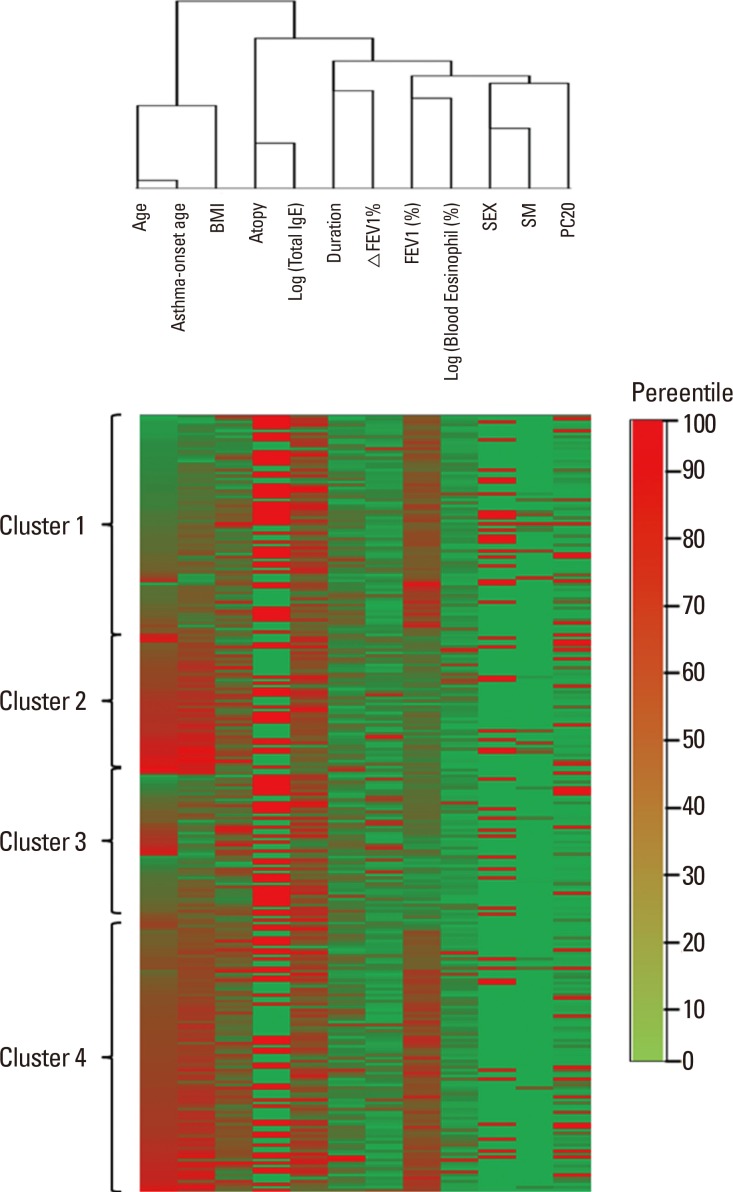
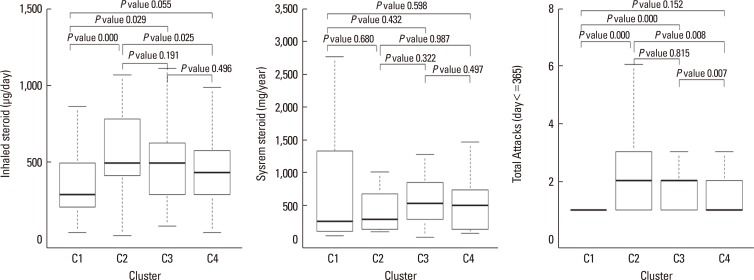
A uniform cluster analysis method was applied to 259 adult asthmatics who were regularly followed-up for over 1 year using 12 variables, selected on the basis of their contribution to asthma phenotypes. After clustering, clinical profiles and exacerbation rates during follow-up were compared among the clusters.
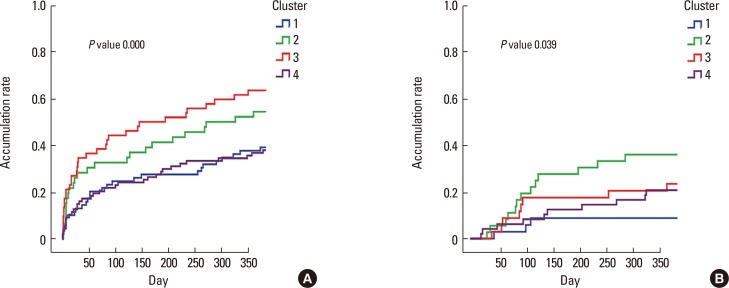
Four subphenotypes were identified: cluster 1 was comprised of patients with early-onset atopic asthma with preserved lung function, cluster 2 late-onset non-atopic asthma with impaired lung function, cluster 3 early-onset atopic asthma with severely impaired lung function, and cluster 4 late-onset non-atopic asthma with well-preserved lung function. The patients in clusters 2 and 3 were identified as exacerbation-prone asthmatics, showing a higher risk of asthma exacerbation.
Two different phenotypes of exacerbation-prone asthma were identified among Korean asthmatics using cluster analysis; both were characterized by impaired lung function, but the age at asthma onset and atopic status were different between the two.
哮喘是一种具有多种类型气道炎症和阻塞特征的异质性疾病。因此,使用聚类分析可将其分为几种亚表型,如早发型特应性、肥胖非嗜酸性粒细胞性、良性和嗜酸性粒细胞性哮喘。许多哮喘患者在长期随访期间经常出现病情加重,但聚类分析很少评估易加重的亚表型。这促使我们识别反映哮喘加重的聚类。
采用统一的聚类分析方法,对259名成年哮喘患者进行分析,这些患者接受了超过1年的定期随访,使用基于对哮喘表型的贡献而选择的12个变量。聚类后,比较各聚类之间的临床特征和随访期间的加重率。
识别出四种亚表型:聚类1由肺功能保留的早发型特应性哮喘患者组成,聚类2为肺功能受损的晚发型非特应性哮喘患者,聚类3是肺功能严重受损的早发型特应性哮喘患者,聚类4为肺功能良好的晚发型非特应性哮喘患者。聚类2和3中的患者被确定为易加重的哮喘患者,显示出更高的哮喘加重风险。
通过聚类分析在韩国哮喘患者中识别出两种不同的易加重哮喘表型;两者均以肺功能受损为特征,但两者之间哮喘发病年龄和特应性状态不同。