Centro de Investigaciones Químicas, Instituto de Investigación en Ciencias Básicas y Aplicadas, Universidad Autónoma del Estado de Morelos, Avenida Universidad 1001, Col. Chamilpa, Cuernavaca, Morelos 62209, Mexico.
Department of Pharmacy and Pharmaceutical Technology, School of Pharmacy, Campus of Cartuja s/n, University of Granada, 18071 Granada, Spain.
Molecules. 2017 Sep 15;22(9):1553. doi: 10.3390/molecules22091553.
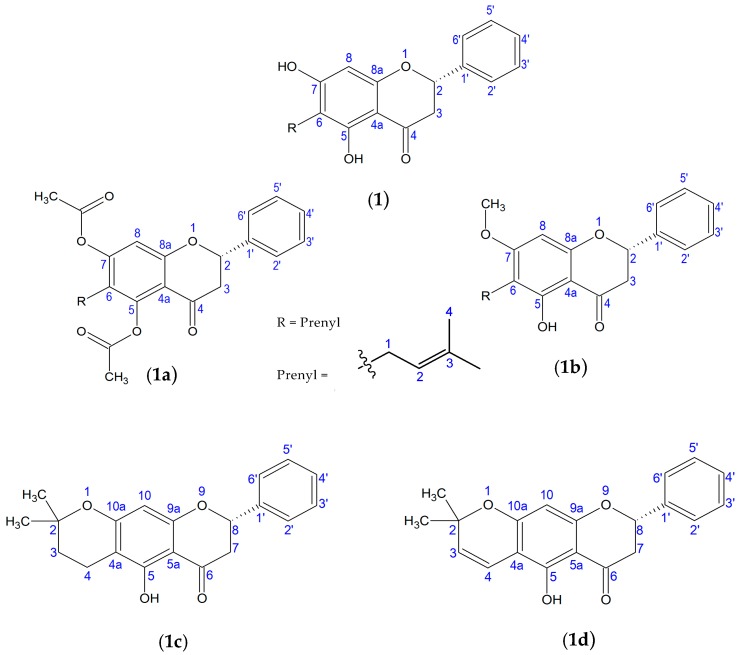
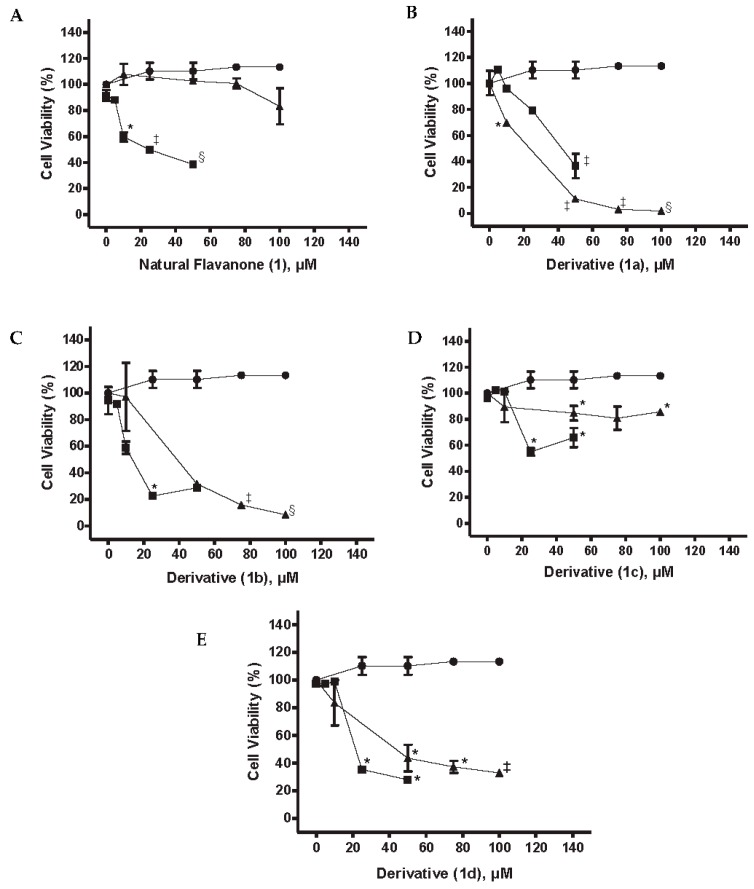
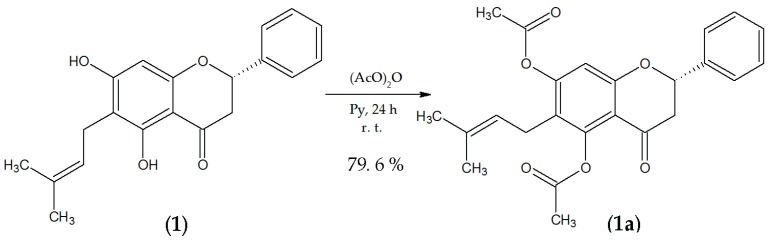
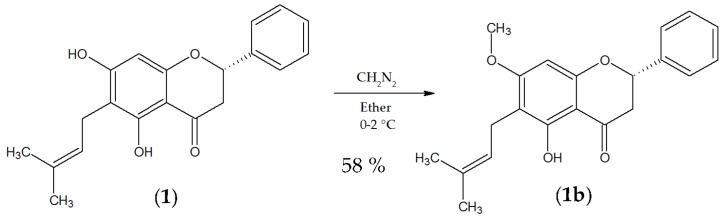
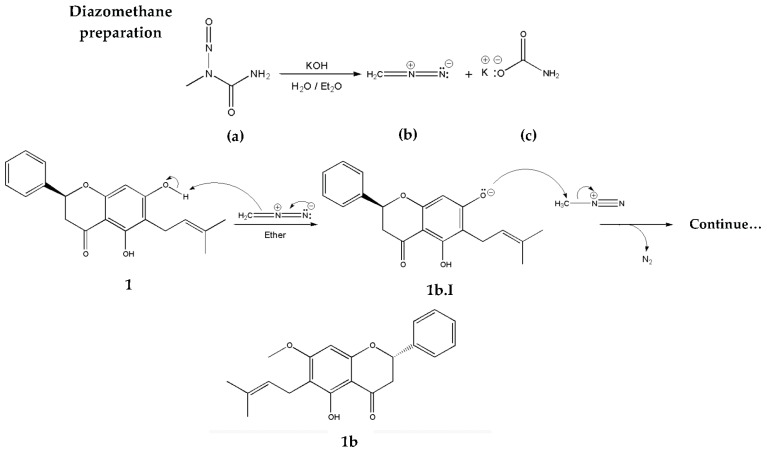
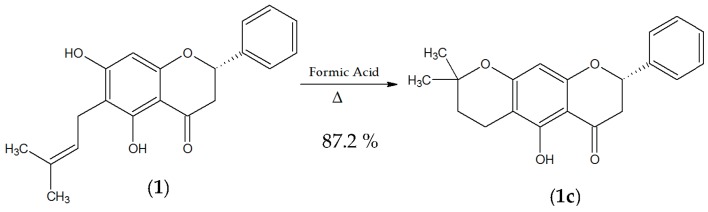
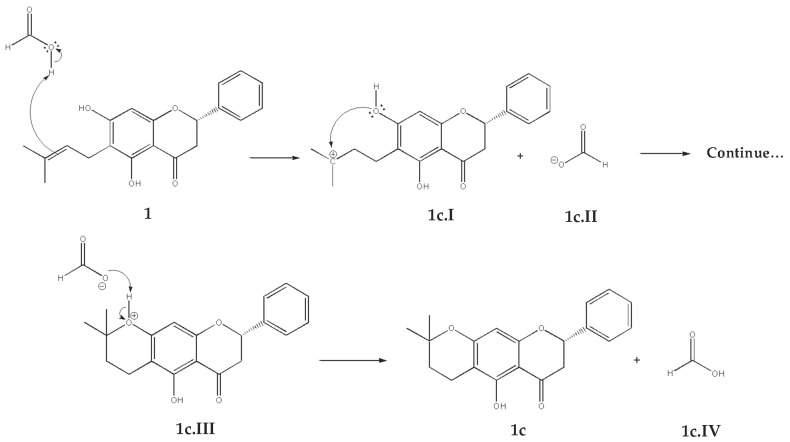
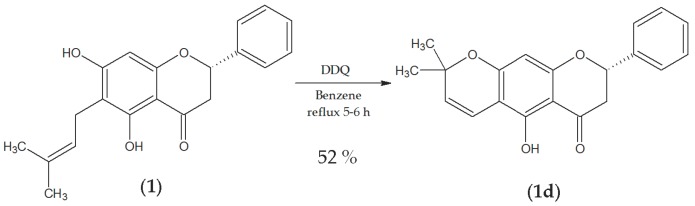
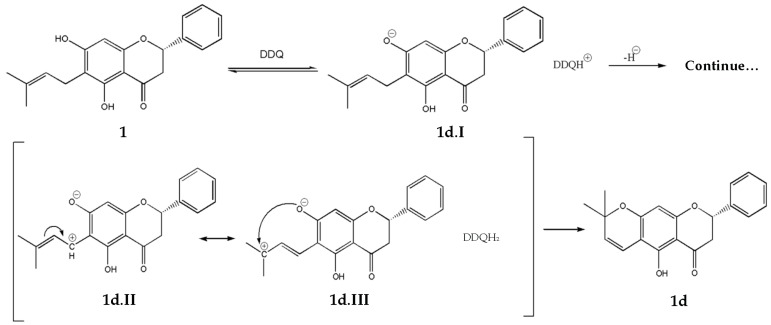
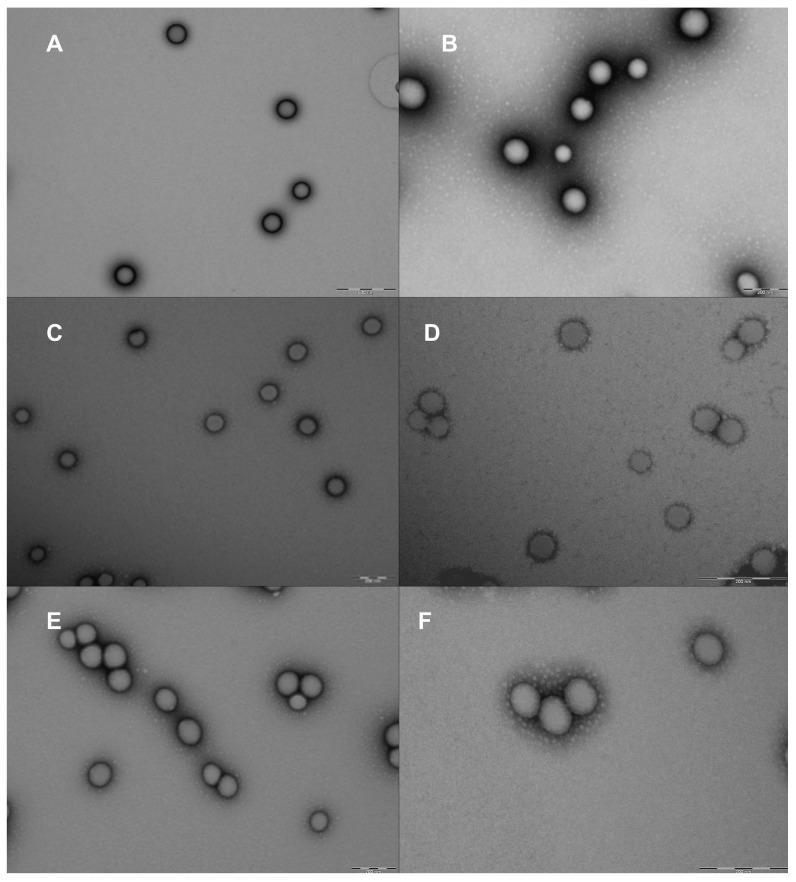
The search for new alternatives for the prevention and treatment of cancer is extremely important to minimize human mortality. Natural products are an alternative to chemical drugs, since they are a source of many potential compounds with anticancer properties. In the present study, the (2)-5,7-dihydroxy-6-prenylflavanone (semi-systematic name), also called (2)-5,7-dihydroxy-6-(3-methyl-2-buten-1-yl)-2-phenyl-2,3-dihydro-4-1-Benzopyran-4-one (CAS Name registered) () was isolated from leaves. This flavanone was considered as the lead compound to generate new cytotoxic derivatives , , and . These compounds , , , , and were then loaded in nanosized drug delivery systems such as polymeric nanoparticles (NPs). Small homogeneous spherical shaped NPs were obtained. Cytotoxic activity of free compounds , , , , and and encapsulated in polymeric NPs (NPs, NPs, NPs, NPs and NPs) were evaluated against the pancreatic cancer cell line MiaPaCa-2. The obtained results demonstrated that NPs and NPs exhibited optimal cytotoxicity, and an even higher improvement of the cytotoxic efficacy was exhibited with the encapsulation of . Based on these results, NPs were proposed as promising anticancer agent candidates.
寻找新的癌症预防和治疗替代方法对于最大限度地降低人类死亡率至关重要。天然产物是化学药物的替代品,因为它们是许多具有抗癌特性的潜在化合物的来源。在本研究中,(2)-5,7-二羟基-6-异戊烯基黄酮(半系统命名),也称为(2)-5,7-二羟基-6-(3-甲基-2-丁烯-1-基)-2-苯基-2,3-二氢-4H-1-苯并吡喃-4-酮(注册的 CAS 名称)()是从 叶子中分离出来的。这种黄烷酮被认为是生成新的细胞毒性衍生物 、 、 和 的先导化合物。然后将这些化合物 、 、 、 和 负载在纳米级药物传递系统中,如聚合物纳米粒子(NPs)。获得了小的均匀球形 NPs。游离化合物 、 、 、 和 以及封装在聚合物 NPs(NPs、NPs、NPs、NPs 和 NPs)中的细胞毒性活性针对胰腺癌细胞系 MiaPaCa-2 进行了评估。得到的结果表明,NPs 和 NPs 表现出最佳的细胞毒性,并且通过封装 甚至可以提高细胞毒性功效。基于这些结果,NPs 被提议作为有前途的抗癌剂候选物。