French Simone A, Rydell Sarah A, Mitchell Nathan R, Michael Oakes J, Elbel Brian, Harnack Lisa
Division of Epidemiology and Community Health, University of Minnesota School of Public Health, 1300 S. 2nd Street, Suite 300, 55454, Minneapolis, MN, USA.
Department of Population Health, School of Medicine, New York University, New York, NY, 10016, USA.
Int J Behav Nutr Phys Act. 2017 Sep 16;14(1):127. doi: 10.1186/s12966-017-0585-9.
This research evaluated the effects of financial incentives and purchase restrictions on food purchasing in a food benefit program for low income people.
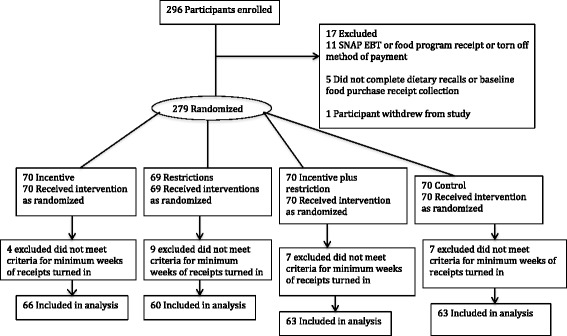
Participants (n=279) were randomized to groups: 1) Incentive- 30% financial incentive for fruits and vegetables purchased with food benefits; 2) Restriction- no purchase of sugar-sweetened beverages, sweet baked goods, or candies with food benefits; 3) Incentive plus Restriction; or 4) Control- no incentive or restrictions. Participants received a study-specific debit card where funds were added monthly for 12-weeks. Food purchase receipts were collected over 16 weeks. Total dollars spent on grocery purchases and by targeted food categories were computed from receipts. Group differences were examined using general linear models.
Weekly purchases of fruit significantly increased in the Incentive plus Restriction ($4.8) compared to the Restriction ($1.7) and Control ($2.1) groups (p <.01). Sugar-sweetened beverage purchases significantly decreased in the Incentive plus Restriction (-$0.8 per week) and Restriction ($-1.4 per week) groups compared to the Control group (+$1.5; p< .0001). Sweet baked goods purchases significantly decreased in the Restriction (-$0.70 per week) compared to the Control group (+$0.82 per week; p < .01).
Paired financial incentives and restrictions on foods and beverages purchased with food program funds may support more healthful food purchases compared to no incentives or restrictions.
Clinicaltrials.gov Identifier: NCT02643576 .
本研究评估了经济激励措施和购买限制对一项针对低收入人群的食品福利计划中食品购买行为的影响。
参与者(n = 279)被随机分为几组:1)激励组——使用食品福利购买水果和蔬菜可获得30%的经济激励;2)限制组——禁止使用食品福利购买含糖饮料、甜烘焙食品或糖果;3)激励加限制组;或4)对照组——无激励或限制措施。参与者收到一张特定研究的借记卡,每月向卡中充值,为期12周。在16周内收集食品购买收据。根据收据计算购买食品杂货和特定食品类别的总支出金额。使用一般线性模型检验组间差异。
与限制组(每周1.7美元)和对照组(每周2.1美元)相比,激励加限制组(每周4.8美元)的水果每周购买量显著增加(p <.01)。与对照组(每周1.5美元)相比,激励加限制组(每周 - 0.8美元)和限制组(每周 - 1.4美元)的含糖饮料购买量显著减少(p <.0001)。与对照组(每周0.82美元)相比,限制组(每周 - 0.70美元)的甜烘焙食品购买量显著减少(p <.01)。
与无激励或限制措施相比,对使用食品计划资金购买的食品和饮料同时实施经济激励和限制措施,可能有助于促进更健康的食品购买。
Clinicaltrials.gov标识符:NCT02643576 。