Sun Xiaonan, Luo Leiming, Zhao Xiaoqian, Ye Ping
Department of Geriatric Cardiolog, Chinese People's Liberation Army General Hospital, Beijing, China.
Department of Cardiology, Chinese People's Liberation Army 305 Hospital, Beijing, China.
BMJ Open. 2017 Sep 18;7(9):e015649. doi: 10.1136/bmjopen-2016-015649.
The aim of this study was to elucidate the impact of nutritional status on survival per Controlling Nutritional Status (CONUT) score and Geriatric Nutritional Risk Index (GNRI) in patients with hypertension over 80 years of age.
Prospective follow-up study.
A total of 336 hypertensive patients over 80 years old were included in this study.
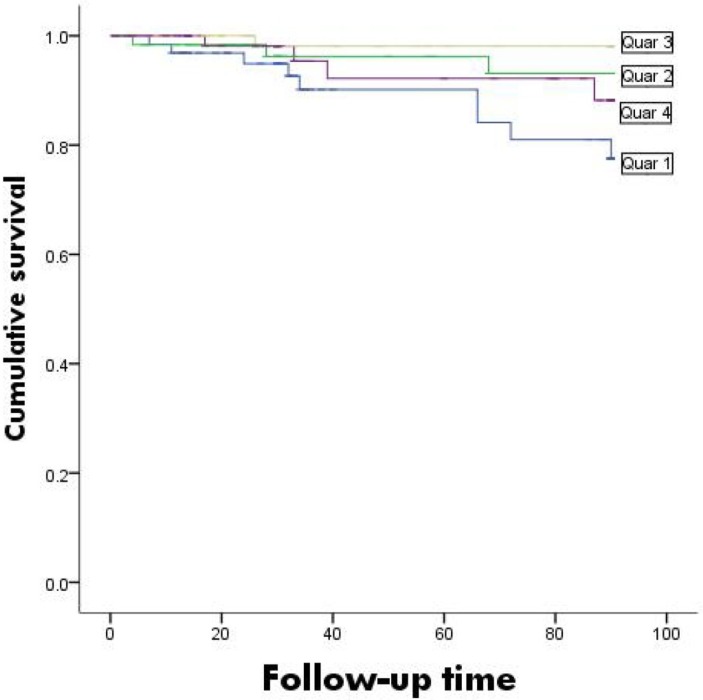
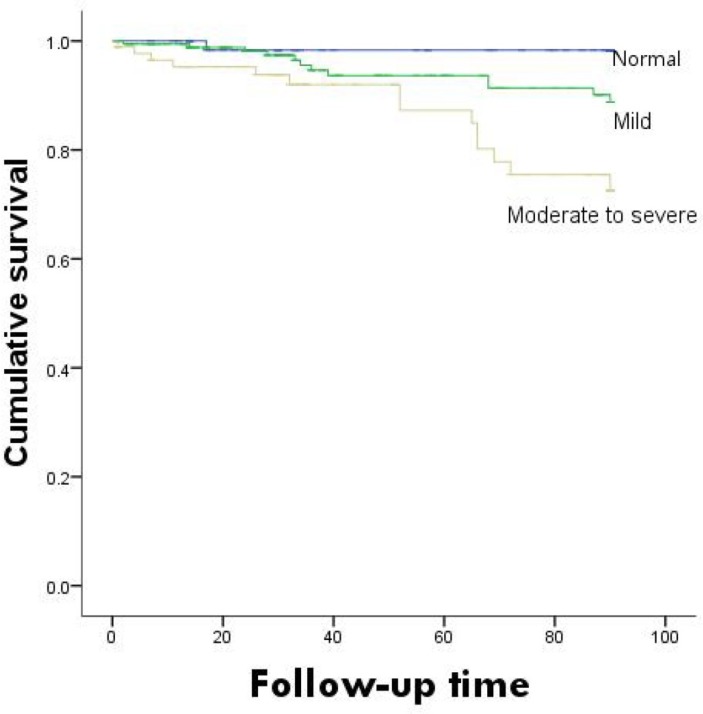
All-cause deaths were recorded as Kaplan-Meier curves to evaluate the association between CONUT and all-cause mortality at follow-up. Cox regression models were used to investigate the prognostic value of CONUT and GNRI for all-cause mortality in the 90-day period after admission.
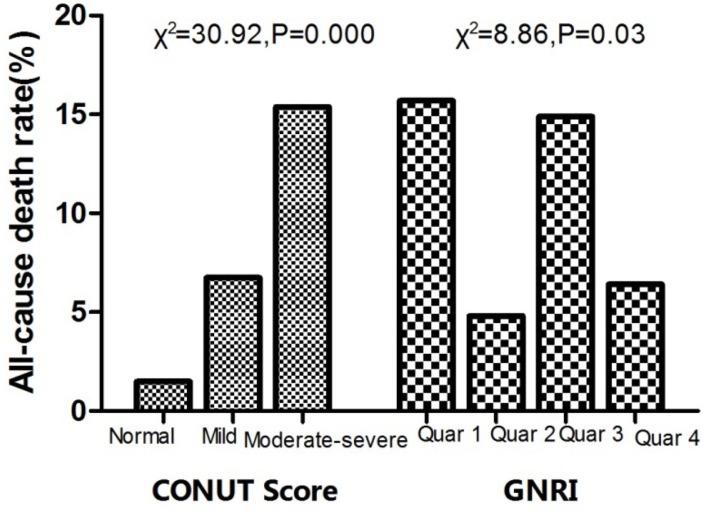
Hypertensive patients with higher CONUT scores exhibited higher mortality within 90 days after admission (1.49%, 6.74%, 15.38%, respectively, χ=30.92, p=0.000). Surviving patients had higher body mass index (24.25±3.05 vs 24.25±3.05, p=0.012), haemoglobin (123.78±17.05 vs 115.07±20.42, p=0.040) and albumin levels, as well as lower fasting blood glucose (6.90±2.48 vs 8.24±3.51, p=0.010). Higher GRNI score (99.42±6.55 vs 95.69±7.77, p=0.002) and lower CONUT (3.13±1.98 vs 5.14±2.32) both indicated better nutritional status. Kaplan-Meier curves indicated that survival rates were significantly worse in the high-CONUT group compared with the low-CONUT group (χ =13.372, p=0.001). Cox regression indicated an increase in HR with increasing CONUT risk (from normal to moderate to severe). HRs (95% CI) for 3-month mortality was 1.458 (95% CI 1.102 to 1.911). In both respiratory tract infection and 'other reason' groups, only CONUT was a sufficiently predictor for all-cause mortality (HR=1.284, 95% CI 1.013 to 1.740, p=0.020 and HR=1.841, 95% CI 1.117 to 4.518, p=0.011). Receiver operating characteristic showed that CONUT higher than 3.0 was found to predict all-cause mortality with a sensitivity of 77.8% and a specificity of 64.7% (area under the curve=0.778, p<0.001).
Nutritional status assessed via CONUT is an accurate predictor of all-cause mortality 90 days postadmission. Evaluation of nutritional status may provide additional prognostic information in hypertensive patients.
本研究旨在阐明营养状况对80岁以上高血压患者基于控制营养状况(CONUT)评分和老年营养风险指数(GNRI)的生存情况的影响。
前瞻性随访研究。
本研究共纳入336例80岁以上的高血压患者。
全因死亡情况以Kaplan-Meier曲线记录,以评估随访时CONUT与全因死亡率之间的关联。采用Cox回归模型研究CONUT和GNRI对入院后90天内全因死亡率的预后价值。
CONUT评分较高的高血压患者入院后90天内死亡率较高(分别为1.49%、6.74%、15.38%,χ=30.92,p=0.000)。存活患者的体重指数较高(24.25±3.05对24.25±3.05,p=0.012)、血红蛋白水平较高(123.78±17.05对115.07±20.42,p=0.040)、白蛋白水平较高,且空腹血糖较低(6.90±2.48对8.24±3.51,p=0.010)。较高的GRNI评分(99.42±6.55对95.69±7.77,p=0.002)和较低的CONUT评分(3.13±1.98对5.14±2.32)均表明营养状况较好。Kaplan-Meier曲线表明,高CONUT组的生存率明显低于低CONUT组(χ =13.372,p=0.001)。Cox回归表明,随着CONUT风险增加(从正常到中度再到重度),风险比(HR)升高。3个月死亡率的HR(95%CI)为1.458(95%CI 1.102至1.911)。在呼吸道感染组和“其他原因”组中,只有CONUT是全因死亡率的充分预测指标(HR=1.284,95%CI 1.013至1.740,p=0.020;HR=1.841,95%CI 1.117至4.518,p=0.011)。受试者工作特征曲线显示,CONUT高于3.0时预测全因死亡率的灵敏度为77.8%,特异度为64.7%(曲线下面积=0.778,p<0.001)。
通过CONUT评估的营养状况是入院后90天全因死亡率的准确预测指标。评估营养状况可为高血压患者提供额外的预后信息。