Lionetti Elena, Pulvirenti Alfredo, Vallorani Martina, Catassi Giulia, Verma Anil K, Gatti Simona, Catassi Carlo
Department of Pediatrics, Università Politecnica delle MarcheAncona, Italy.
Department of Clinical and Molecular Biomedicine, Università Politecnica delle MarcheAncona, Italy.
Front Physiol. 2017 Sep 5;8:621. doi: 10.3389/fphys.2017.00621. eCollection 2017.
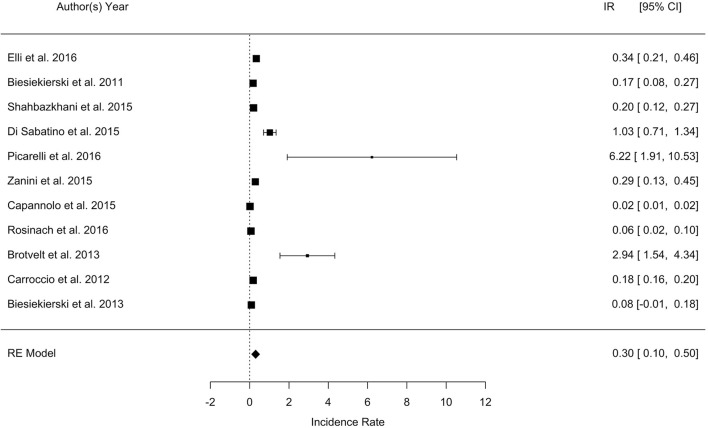
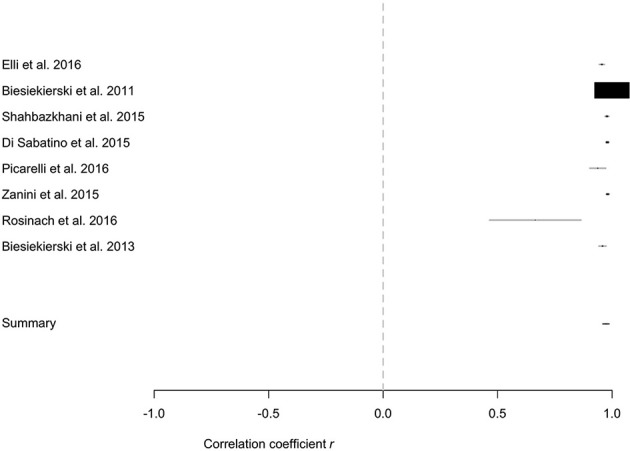
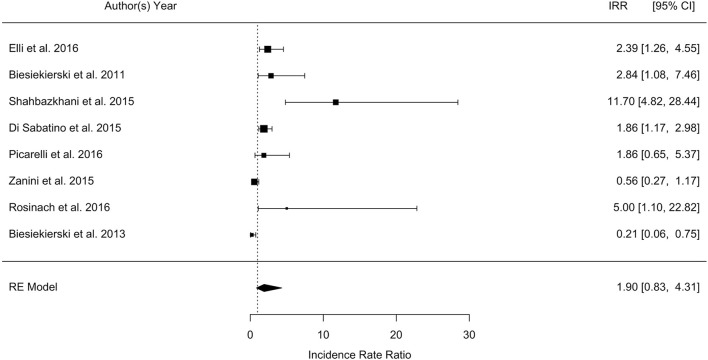
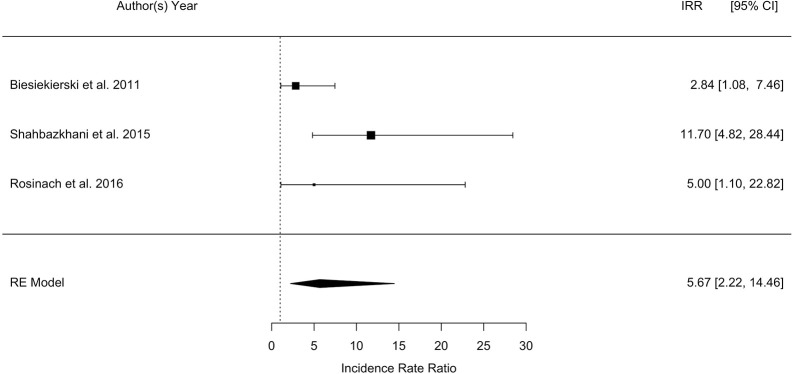
Non-celiac gluten sensitivity (NCGS) is a clinical entity characterized by intestinal and/or extra-intestinal symptoms related to the ingestion of gluten in individuals that are not affected by either celiac disease (CD) or wheat allergy (WA). Since we do not have specific biomarkers for NCGS, the diagnosis is based on the evidence of a clear relationship between the ingestion of gluten (re-challenge) and clinical symptoms, after a remission during the gluten-free diet (GFD). Several re-challenge studies have been published so far to evaluate the real prevalence of NCGS, reporting conflicting results. In the present article, we provide a systematic review with meta-analysis of the existing literature on re-challenge studies to evaluate prevalence figures of NCGS after re-challenge procedures. All clinical trials performing a gluten re-challenge with or without a placebo control in patients with a suspected diagnosis of NCGS were included. Search results were limited to studies published in English language. No publication date or publication status restrictions were imposed. Eleven studies were included in the meta-analysis. There was a considerable heterogeneity related to different sample size, type, and amount of gluten administered, duration of challenge and different type of placebo. The overall pooled percentage of patients with a diagnosis of NCGS relapsing after a gluten challenge was 30%, ranging between 7 and 77%. The meta-analysis showed a not significant relative risk (RR) of relapse after gluten challenge as compared to placebo (RR = 0.4; 95% CI = -0.15-0.9; = 0.16). The overall pooled percentage of patients with a diagnosis of NCGS relapsing after a gluten challenge performed according to the recent Salerno criteria was significantly higher as compared to the percentage of patients relapsing after placebo (40 vs. 24%; = 0.003), with a significant RR of relapse after gluten challenge as compared to placebo (RR = 2.8; 95% CI = 1.5-5.5; = 0.002). The prevalence of NCGS after gluten re-challenge is low, and the percentage of relapse after a gluten or a placebo challenge is similar. However, a higher number of patients will be correctly classified with NCGS if applying the recent Salerno criteria.
非乳糜泻麸质敏感(NCGS)是一种临床病症,其特征为在既未患乳糜泻(CD)也未患小麦过敏(WA)的个体中,出现与摄入麸质相关的肠道和/或肠道外症状。由于我们没有针对NCGS的特异性生物标志物,诊断基于在无麸质饮食(GFD)期间缓解后,摄入麸质(重新激发)与临床症状之间存在明确关联的证据。到目前为止,已经发表了几项重新激发研究以评估NCGS的实际患病率,但结果相互矛盾。在本文中,我们对现有文献中关于重新激发研究进行了系统评价和荟萃分析,以评估重新激发程序后NCGS的患病率数据。纳入了所有对疑似NCGS患者进行有或无安慰剂对照的麸质重新激发的临床试验。检索结果仅限于以英文发表的研究。未施加出版日期或出版状态限制。荟萃分析纳入了11项研究。与不同的样本量、麸质给药的类型和量、激发持续时间以及不同类型的安慰剂存在相当大的异质性。麸质激发后被诊断为复发的NCGS患者的总体合并百分比为30%,范围在7%至77%之间。荟萃分析显示,与安慰剂相比,麸质激发后复发的相对风险(RR)不显著(RR = 0.4;95%置信区间 = -0.15 - 0.9;P = 0.16)。根据最近的萨勒诺标准进行麸质激发后被诊断为复发的NCGS患者的总体合并百分比,与安慰剂激发后复发的患者百分比相比显著更高(40%对24%;P = 0.003),与安慰剂相比,麸质激发后复发的RR显著(RR = 2.8;95%置信区间 = 1.5 - 5.5;P = 0.002)。麸质重新激发后NCGS的患病率较低,麸质或安慰剂激发后复发的百分比相似。然而,如果应用最近的萨勒诺标准,将有更多患者被正确归类为NCGS。