Patrice Thierry, Rozec Bertrand, Sidoroff Alexis, Blanloeil Yvonnick, Despins Philippe, Perrigaud Christian
Anesthesiology and Intensive Care, Laënnec Hospital, 44093 Nantes, France.
Department of Dermatology and Venereology, Medical University of Innsbruck, Innsbruck, A-6020, Austria.
Diseases. 2016 Jul 14;4(3):25. doi: 10.3390/diseases4030025.
Singlet oxygen (¹O₂) oxidizes targets through the production of secondary reactive oxygen species (SOS). Cancers induce oxidative stress changing with progression, the resulting antioxidant status differing from one patient to the other. The aim of this study was to determine the oxidative status of patients with resectable Non-Small cell lung cancers (NSCLC) and the potential influence of antioxidants, compared to sera from healthy donors.
Serum samples from 10 women and 28 men, 19 adenocarcinomas (ADK), 15 patients N1 or M1 were submitted to a photoreaction producing ¹O₂. Then, samples were supplemented with vitamins (Vit C, Vit E), or glutathione (GSH).
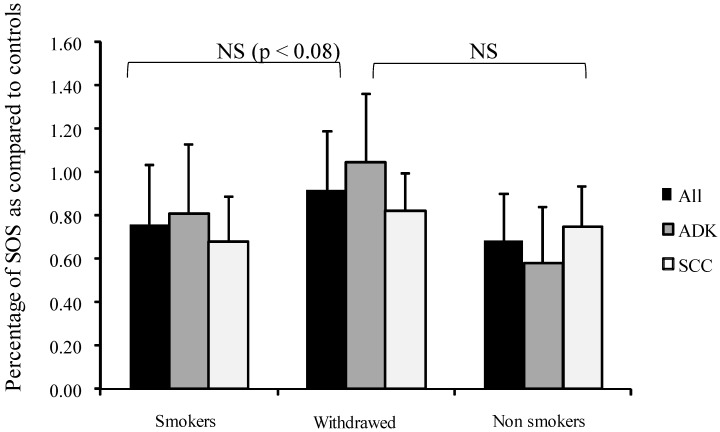
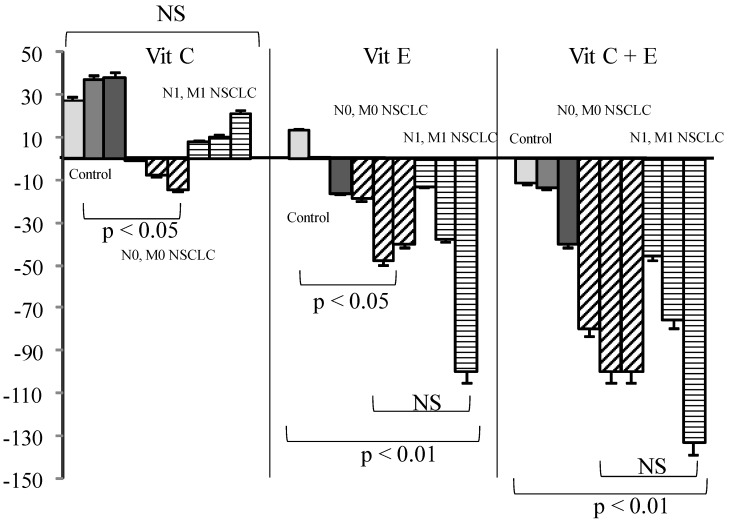
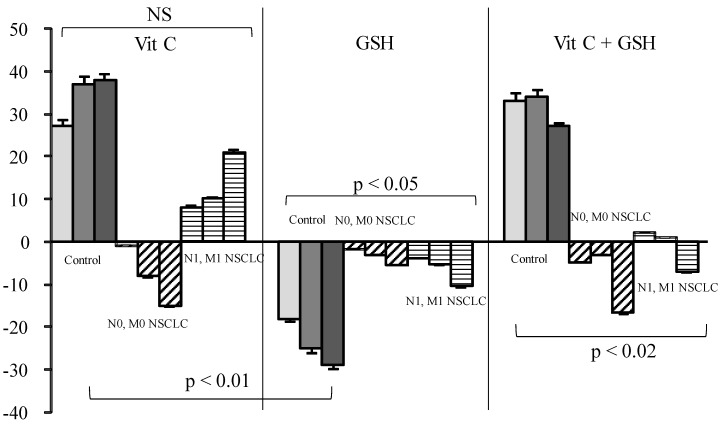
Squamous cell carcinomas (SCC) and metastatic SCCs induced a lower SOS rate. While Vit C increased SOS in controls as in patients with metastases, Vit E or the combination of Vit E and C strongly reduced SOS. GSH alone lightly decreased SOS in controls but had no effect in patients either alone or combined with Vit C.
In "early" lung cancers, SOS are comparable or lower than for healthy persons. The role of Vitamins varies with gender, cancer type, and metastases. This suggests that an eventual supplementation should be performed on a per-patient basis to evidence any effect.
单线态氧(¹O₂)通过产生次级活性氧物种(SOS)来氧化靶标。癌症会引发随病情进展而变化的氧化应激,不同患者的抗氧化状态也存在差异。本研究的目的是确定可切除的非小细胞肺癌(NSCLC)患者的氧化状态以及抗氧化剂的潜在影响,并与健康供体的血清进行比较。
采集了10名女性和28名男性的血清样本,其中包括19例腺癌(ADK)患者以及15例N1或M1期患者,将这些样本进行光反应以产生¹O₂。随后,样本中添加了维生素(维生素C、维生素E)或谷胱甘肽(GSH)。
鳞状细胞癌(SCC)和转移性SCC诱导的SOS率较低。维生素C在对照组和有转移的患者中均增加了SOS,而维生素E或维生素E与C的组合则强烈降低了SOS。单独使用GSH在对照组中轻微降低了SOS,但单独使用或与维生素C联合使用时对患者均无影响。
在“早期”肺癌中,SOS与健康人相当或更低。维生素的作用因性别、癌症类型和转移情况而异。这表明最终的补充应根据个体情况进行,以证明其任何效果。