Perciani Catia T, Jaoko Walter, Walmsley Sharon, Farah Bashir, Mahmud Salaheddin M, Ostrowski Mario, Anzala Omu, Team Kavi-Icr, MacDonald Kelly S
Department of Immunology, University of Toronto, Toronto, Ontario, Canada.
Kenyan AIDS Vaccine Initiative-Institute of Clinical Research (KAVI-ICR), Nairobi, Kenya.
BMJ Open. 2017 Sep 21;7(9):e017391. doi: 10.1136/bmjopen-2017-017391.
A protective HIV vaccine would be expected to induce durable effector immune responses at the mucosa, restricting HIV infection at its portal of entry. We hypothesise that use of varicella-zoster virus (VZV) as an HIV delivery vector could generate sustained and robust tissue-based immunity against HIV antigens to provide long-term protection against HIV. Given that HIV uniquely targets immune-activated T cells, the development of human vaccines against HIV must also involve a specific examination of the safety of the vector. Thus, we aim to evaluate the effects of VZV vaccination on the recipients' immune activation state, and on VZV-specific circulating humoral and cellular responses in addition to those at the cervical and rectal mucosa.
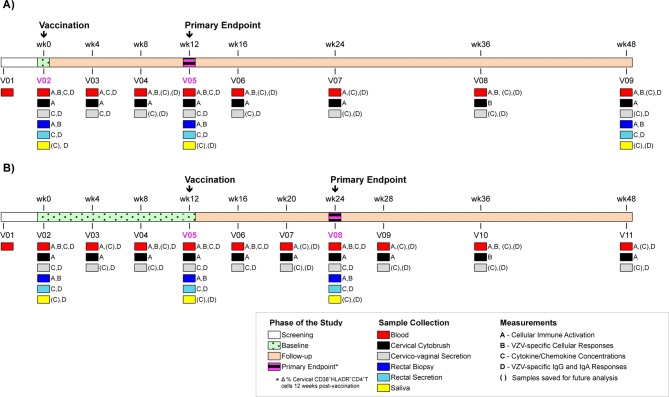
This open-label, randomised, longitudinal crossover study includes healthy Kenyan VZV-seropositive women at low risk for HIV infection. Participants receive a single dose of a commercial live-attenuated VZV vaccine at either week 0 (n=22) or at week 12 (n=22) of the study and are followed for 48 and 36 weeks postvaccination, respectively. The primary outcome is the change on cervical CD4 T-cell immune activation measured by the coexpression of CD38 and HLA-DR 12 weeks postvaccination compared with the baseline (prevaccination). Secondary analyses include postvaccination changes in VZV-specific mucosal and systemic humoral and cellular immune responses, changes in cytokine and chemokine measures, study acceptability and feasibility of mucosal sampling and a longitudinal assessment of the bacterial community composition of the mucosa.
The study has ethical approval from Kenyatta National Hospital/University of Nairobi Ethics and Research Committee, the University of Toronto Research Ethics Board and by Kenyan Pharmacy and Poisons Board. Results will be presented at conferences, disseminated to participants and stakeholders as well as published in peer-reviewed journals.
NCT02514018. Pre-results.
一种具有保护作用的HIV疫苗有望在黏膜处诱导持久的效应免疫反应,在HIV进入门户限制其感染。我们假设使用水痘-带状疱疹病毒(VZV)作为HIV递送载体可产生针对HIV抗原的持续且强大的基于组织的免疫,从而提供针对HIV的长期保护。鉴于HIV独特地靶向免疫激活的T细胞,开发针对HIV的人类疫苗还必须特别检查载体的安全性。因此,我们旨在评估VZV疫苗接种对接受者免疫激活状态的影响,以及对VZV特异性循环体液和细胞反应以及宫颈和直肠黏膜处反应的影响。
这项开放标签、随机、纵向交叉研究纳入了HIV感染低风险的肯尼亚健康VZV血清阳性女性。参与者在研究的第0周(n = 22)或第12周(n = 22)接受一剂市售减毒活VZV疫苗,并分别在接种疫苗后随访48周和36周。主要结局是接种疫苗12周后通过CD38和HLA-DR共表达测量的宫颈CD4 T细胞免疫激活相对于基线(接种疫苗前)的变化。次要分析包括接种疫苗后VZV特异性黏膜和全身体液及细胞免疫反应的变化、细胞因子和趋化因子测量的变化、研究的可接受性和黏膜采样的可行性以及黏膜细菌群落组成的纵向评估。
该研究已获得肯雅塔国家医院/内罗毕大学伦理与研究委员会、多伦多大学研究伦理委员会以及肯尼亚药房和毒药委员会的伦理批准。结果将在会议上展示,分发给参与者和利益相关者,并发表在同行评审期刊上。
NCT02514018。预结果。