Centre for Big Data Research in Health, UNSW Sydney, Sydney, NSW, Australia.
MRC/CSO Social and Public Health Sciences Unit, University of Glasgow, Glasgow, UK.
Health Serv Res. 2018 Aug;53 Suppl 1(Suppl Suppl 1):3148-3169. doi: 10.1111/1475-6773.12777. Epub 2017 Sep 22.
To demonstrate the use of multiple-membership multilevel models, which analytically structure patients in a weighted network of hospitals, for exploring between-hospital variation in preventable hospitalizations.
Cohort of 267,014 people aged over 45 in NSW, Australia.
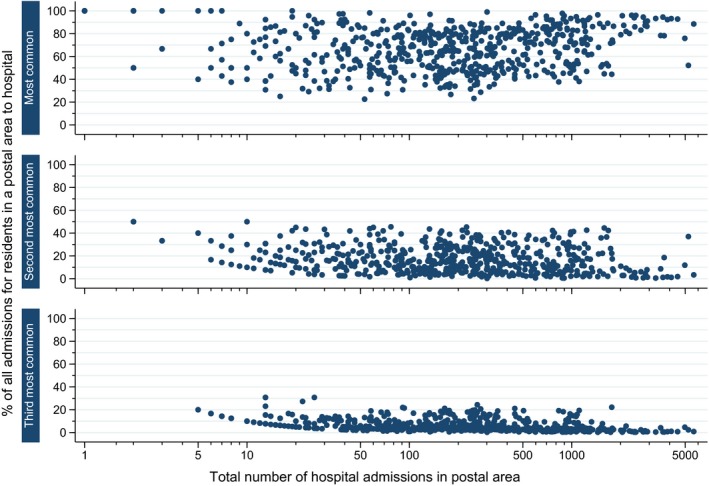
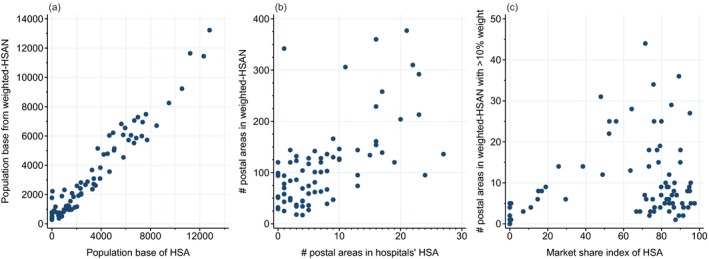
Patterns of patient flow were used to create weighted hospital service area networks (weighted-HSANs) to 79 large public hospitals of admission. Multiple-membership multilevel models on rates of preventable hospitalization, modeling participants structured within weighted-HSANs, were contrasted with models clustering on 72 hospital service areas (HSAs) that assigned participants to a discrete geographic region.
DATA COLLECTION/EXTRACTION METHODS: Linked survey and hospital admission data.
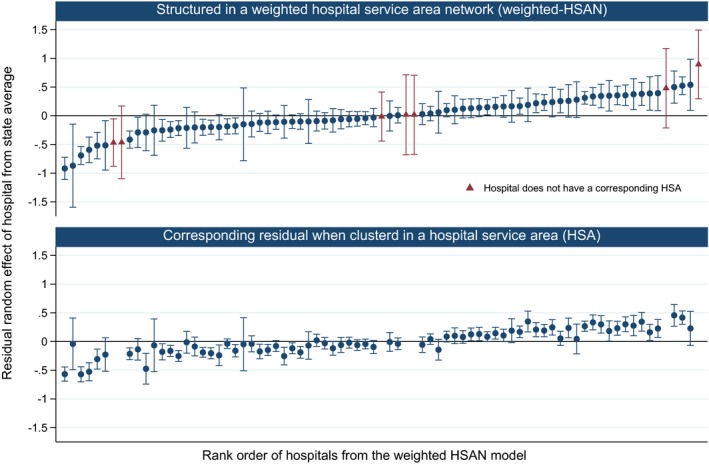
Between-hospital variation in rates of preventable hospitalization was more than two times greater when modeled using weighted-HSANs rather than HSAs. Use of weighted-HSANs permitted identification of small hospitals with particularly high rates of admission and influenced performance ranking of hospitals, particularly those with a broadly distributed patient base. There was no significant association with hospital bed occupancy.
Multiple-membership multilevel models can analytically capture information lost on patient attribution when creating discrete health care catchments. Weighted-HSANs have broad potential application in health services research and can be used across methods for creating patient catchments.
展示如何使用多成员多层次模型,该模型对医院加权网络中的患者进行分析,以探索可预防住院的医院间差异。
澳大利亚新南威尔士州 267014 名 45 岁以上人群的队列。
利用患者流动模式创建加权医院服务区网络(加权-HSAN),将其用于 79 家大型公立医院的入院。使用多成员多层次模型对可预防住院率进行建模,将参与者在加权-HSAN 内进行结构化建模,与对 72 个医院服务区(HSAs)进行聚类的模型进行对比,这些服务区将参与者分配到离散的地理区域。
数据收集/提取方法:链接调查和住院数据。
当使用加权-HSAN 而不是 HSAs 进行建模时,可预防住院率的医院间差异增加了两倍多。使用加权-HSAN 可以识别出具有特别高入院率的小医院,并影响医院的绩效排名,尤其是那些患者分布广泛的医院。与医院床位占用率没有显著关联。
多成员多层次模型可以在创建离散医疗服务范围时分析性地捕捉到患者归因时丢失的信息。加权-HSAN 在卫生服务研究中有广泛的应用潜力,并且可以在创建患者服务范围的各种方法中使用。