Pergam Steven A, Woodfield Maresa C, Lee Christine M, Cheng Guang-Shing, Baker Kelsey K, Marquis Sara R, Fann Jesse R
Vaccine and Infectious Disease Division, Fred Hutchinson Cancer Research Center, Seattle, Washington.
Clinical Research Division, Fred Hutchinson Cancer Research Center, Seattle, Washington.
Cancer. 2017 Nov 15;123(22):4488-4497. doi: 10.1002/cncr.30879. Epub 2017 Sep 25.
Cannabis is purported to alleviate symptoms related to cancer treatment, although the patterns of use among cancer patients are not well known. This study was designed to determine the prevalence and methods of use among cancer patients, the perceived benefits, and the sources of information in a state with legalized cannabis.
A cross-sectional, anonymous survey of adult cancer patients was performed at a National Cancer Institute-designated cancer center in Washington State. Random urine samples for tetrahydrocannabinol provided survey validation.
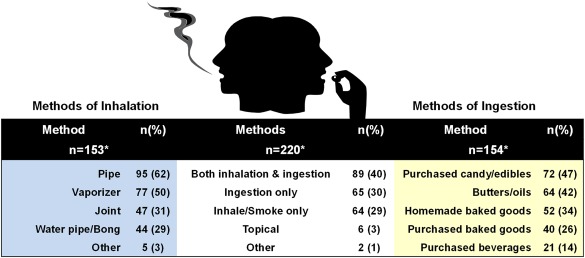
Nine hundred twenty-six of 2737 eligible patients (34%) completed the survey, and the median age was 58 years (interquartile range [IQR], 46-66 years). Most had a strong interest in learning about cannabis during treatment (6 on a 1-10 scale; IQR, 3-10) and wanted information from cancer providers (677 of 911 [74%]). Previous use was common (607 of 926 [66%]); 24% (222 of 926) used cannabis in the last year, and 21% (192 of 926) used cannabis in the last month. Random urine samples found similar percentages of users who reported weekly use (27 of 193 [14%] vs 164 of 926 [18%]). Active users inhaled (153 of 220 [70%]) or consumed edibles (154 of 220 [70%]); 89 (40%) used both modalities. Cannabis was used primarily for physical (165 of 219 [75%]) and neuropsychiatric symptoms (139 of 219 [63%]). Legalization significantly increased the likelihood of use in more than half of the respondents.
This study of cancer patients in a state with legalized cannabis found high rates of active use across broad subgroups, and legalization was reported to be important in patients' decision to use. Cancer patients desire but are not receiving information about cannabis use during their treatment from oncology providers. Cancer 2017;123:4488-97. © 2017 The Authors. Cancer published by Wiley Periodicals, Inc. on behalf of American Cancer Society. This is an open access article under the terms of the Creative Commons Attribution-NonCommercial-NoDerivs License, which permits use and distribution in any medium, provided the original work is properly cited, the use is non-commercial and no modifications or adaptations are made.
大麻据称可缓解与癌症治疗相关的症状,尽管癌症患者的使用模式尚不为人所知。本研究旨在确定大麻合法化州的癌症患者中的使用流行率和使用方法、感知到的益处以及信息来源。
在华盛顿州一家美国国立癌症研究所指定的癌症中心,对成年癌症患者进行了一项横断面匿名调查。采集随机尿样检测四氢大麻酚以验证调查结果。
2737名符合条件的患者中有926名(34%)完成了调查,中位年龄为58岁(四分位间距[IQR],46 - 66岁)。大多数患者在治疗期间对了解大麻有浓厚兴趣(1 - 10分制中为6分;IQR,3 - 10),并希望从癌症医疗服务提供者处获取信息(911名患者中的677名[74%])。既往使用情况很常见(926名患者中的607名[66%]);24%(926名患者中的222名)在过去一年使用过大麻,21%(926名患者中的192名)在过去一个月使用过大麻。随机尿样检测发现,报告每周使用大麻的使用者比例相似(193名中的27名[14%]对比926名中的164名[18%])。现用者采用吸入方式(220名中的153名[70%])或食用大麻制品(220名中的154名[70%]);89名(40%)两种方式都用。大麻主要用于缓解身体症状(219名中的165名[75%])和神经精神症状(219名中的139名[63%])。大麻合法化使超过半数的受访者使用大麻的可能性显著增加。
这项对大麻合法化州癌症患者的研究发现,广泛亚组中的现用率很高,且据报告合法化对患者的使用决策很重要。癌症患者渴望但未从肿瘤学医疗服务提供者处获得关于其治疗期间使用大麻的信息。《癌症》2017年;123:4488 - 97。© 2017作者。《癌症》由威利期刊公司代表美国癌症协会出版。这是一篇根据知识共享署名 - 非商业性使用 - 禁止演绎许可条款的开放获取文章,允许在任何媒介中使用和传播,前提是正确引用原始作品,使用是非商业性的,且不进行修改或改编。