Hamidullah Shahnaza, Thorpe Hayley H A, Frie Jude A, Mccurdy Richard D, Khokhar Jibran Y
Department of Biomedical Sciences, University of Guelph, Guelph, ON, Canada.
Front Hum Neurosci. 2020 Aug 4;14:298. doi: 10.3389/fnhum.2020.00298. eCollection 2020.
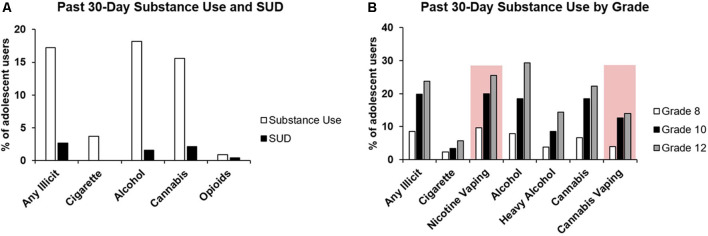
Adolescence is an important ontogenetic period that is characterized by behaviors such as enhanced novelty-seeking, impulsivity, and reward preference, which can give rise to an increased risk for substance use. While substance use rates in adolescence are generally on a decline, the current rates combined with emerging trends, such as increases in e-cigarette use, remain a significant public health concern. In this review, we focus on the neurobiological divergences associated with adolescent substance use, derived from a cross-sectional, retrospective, and longitudinal studies, and highlight how the use of these substances during adolescence may relate to behavioral and neuroimaging-based outcomes. Identifying and understanding the associations between adolescent substance use and changes in cognition, mental health, and future substance use risk may assist our understanding of the consequences of drug exposure during this critical window.
青春期是一个重要的个体发育时期,其特征表现为寻求新奇、冲动和奖励偏好等行为,这些行为会增加物质使用的风险。虽然青春期的物质使用率总体呈下降趋势,但当前的使用率加上电子烟使用增加等新趋势,仍然是一个重大的公共卫生问题。在这篇综述中,我们关注来自横断面、回顾性和纵向研究的与青少年物质使用相关的神经生物学差异,并强调青春期使用这些物质可能如何与基于行为和神经影像学的结果相关。识别和理解青少年物质使用与认知、心理健康变化以及未来物质使用风险之间的关联,可能有助于我们理解在这个关键时期药物暴露的后果。