Youth League Committee, the Tumor Hospital Affiliated of Harbin Medical University, Harbin, China.
Department of Traditional Chinese Medicine, School of Basic Medicine, Heilongjiang University of Chinese Medicine, Harbin, China.
Nurs Open. 2021 Jul;8(4):1981-1989. doi: 10.1002/nop2.876. Epub 2021 May 3.
To explore the correlations among social isolation and symptoms of anxiety and depression among patients with breast cancer in China and to further verify the mediating role of social support in social isolation and symptoms of depression or anxiety.
A cross-sectional survey.
The cluster sampling method was conducted for 456 female inpatients diagnosed with breast cancer at the Tumor Hospital Affiliated of Harbin Medical University from April 2019-September 2019.
Pearson correlation analysis was used for identifying correlations among all the variables. Mediation effect analysis was used to examine the role of social support in social isolation and symptoms of depression or anxiety.
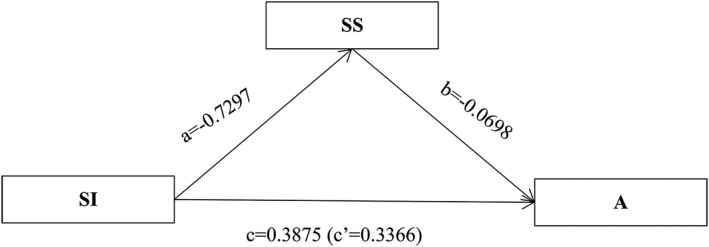
The results showed a prevalence of 73.26% and 70.44% for anxiety and depression symptoms in patients with breast cancer, respectively. Anxiety was significantly negatively correlated with social support (r = -.334, p < .01) and significantly positively correlated with social isolation (r = .369, p < .01). Similarly, depression was significantly negatively correlated with social support (r = -.289, p < .01) and significantly positively correlated with social isolation (r = .466, p < .01). Social support played a mediating role in social isolation and f symptoms of anxiety or depression among these patients.
Social isolation was positively correlated with symptoms of anxiety and depression in patients with breast cancer, respectively. Social support for patients with breast cancer has a mediating effect on the patients' social isolation and symptoms of anxiety and depression. Therefore, the support of family, friends, hospitals, and organizations plays a positive role in reducing social isolation as well as symptoms of depression and anxiety in these patients.
探讨中国乳腺癌患者社会隔离与焦虑、抑郁症状的相关性,并进一步验证社会支持在社会隔离与抑郁或焦虑症状之间的中介作用。
横断面调查。
采用整群抽样方法,于 2019 年 4 月至 9 月选取哈尔滨医科大学附属肿瘤医院 456 例女性乳腺癌住院患者。
采用 Pearson 相关分析识别各变量之间的相关性,采用中介效应分析检验社会支持在社会隔离与抑郁或焦虑症状之间的作用。
结果显示,乳腺癌患者的焦虑症状发生率为 73.26%,抑郁症状发生率为 70.44%。焦虑与社会支持呈显著负相关(r=-.334,p<0.01),与社会隔离呈显著正相关(r=-.369,p<0.01);抑郁与社会支持呈显著负相关(r=-.289,p<0.01),与社会隔离呈显著正相关(r=-.466,p<0.01)。社会支持在社会隔离与焦虑或抑郁症状之间起部分中介作用。
社会隔离与乳腺癌患者的焦虑和抑郁症状分别呈正相关。社会支持对乳腺癌患者的社会隔离及焦虑、抑郁症状具有中介作用。因此,家庭、朋友、医院和组织的支持对减少这些患者的社会隔离以及抑郁和焦虑症状具有积极作用。