Jull J, Whitehead M, Petticrew M, Kristjansson E, Gough D, Petkovic J, Volmink J, Weijer C, Taljaard M, Edwards S, Mbuagbaw L, Cookson R, McGowan J, Lyddiatt A, Boyer Y, Cuervo L G, Armstrong R, White H, Yoganathan M, Pantoja T, Shea B, Pottie K, Norheim O, Baird S, Robberstad B, Sommerfelt H, Asada Y, Wells G, Tugwell P, Welch V
Ottawa Hospital Research Institute, University of Ottawa, Ottawa, Ontario, Canada.
Department of Public Health and Policy, University of Liverpool, Liverpool, UK.
BMJ Open. 2017 Sep 25;7(9):e015815. doi: 10.1136/bmjopen-2016-015815.
Randomised controlled trials can provide evidence relevant to assessing the equity impact of an intervention, but such information is often poorly reported. We describe a conceptual framework to identify health equity-relevant randomised trials with the aim of improving the design and reporting of such trials.
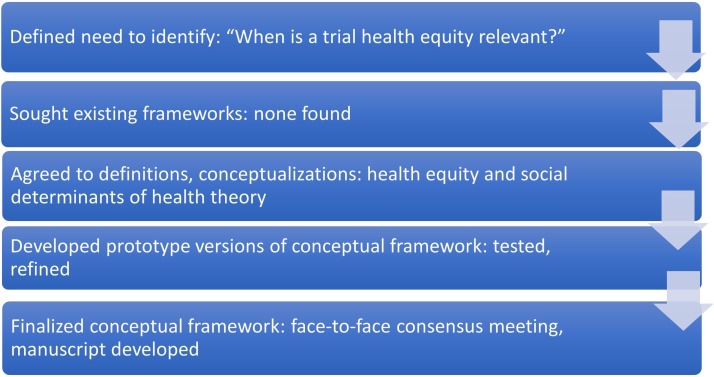
An interdisciplinary and international research team engaged in an iterative consensus building process to develop and refine the conceptual framework via face-to-face meetings, teleconferences and email correspondence, including findings from a validation exercise whereby two independent reviewers used the emerging framework to classify a sample of randomised trials.
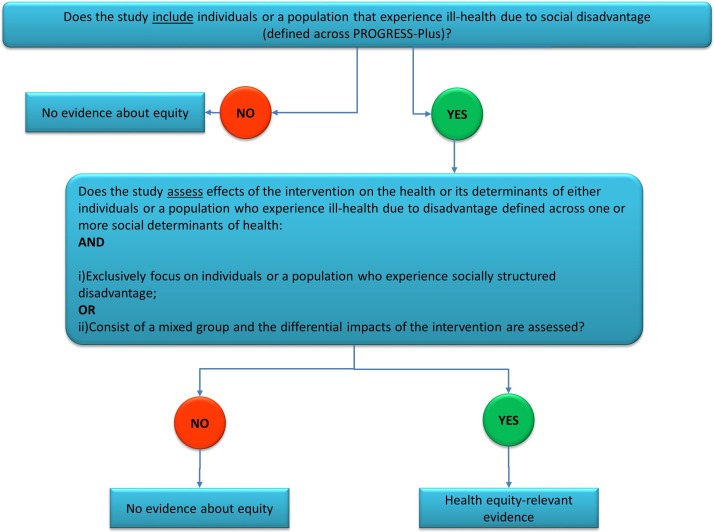
A randomised trial can usefully be classified as 'health equity relevant' if it assesses the effects of an intervention on the health or its determinants of either individuals or a population who experience ill health due to disadvantage defined across one or more social determinants of health. Health equity-relevant randomised trials can either exclusively focus on a single population or collect data potentially useful for assessing differential effects of the intervention across multiple populations experiencing different levels or types of social disadvantage. Trials that are not classified as 'health equity relevant' may nevertheless provide information that is indirectly relevant to assessing equity impact, including information about individual level variation unrelated to social disadvantage and potentially useful in secondary modelling studies.
The conceptual framework may be used to design and report randomised trials. The framework could also be used for other study designs to contribute to the evidence base for improved health equity.
随机对照试验能够提供与评估一项干预措施的公平性影响相关的证据,但此类信息的报告往往不尽人意。我们描述了一个概念框架,以识别与健康公平相关的随机试验,旨在改进此类试验的设计和报告。
一个跨学科的国际研究团队通过面对面会议、电话会议和电子邮件通信,参与了一个反复的共识建立过程,以开发和完善该概念框架,包括一项验证活动的结果,其中两名独立评审员使用该新兴框架对随机试验样本进行分类。
如果一项随机试验评估了一项干预措施对因一个或多个健康社会决定因素所定义的不利状况而健康不佳的个人或人群的健康或其健康决定因素的影响,那么该试验可被有效地归类为“与健康公平相关”。与健康公平相关的随机试验既可以专门关注单一人群,也可以收集可能有助于评估该干预措施在经历不同程度或类型社会不利状况的多个人群中的差异影响的数据。未被归类为“与健康公平相关”的试验尽管如此仍可能提供与评估公平性影响间接相关的信息,包括与社会不利状况无关的个体层面差异信息,这些信息在二次建模研究中可能有用。
该概念框架可用于设计和报告随机试验。该框架也可用于其他研究设计,以为改善健康公平的证据基础做出贡献。