Bruyere Research Institute, University of Ottawa, Ottawa, ON, Canada.
School of Rehabilitation Therapy, Queen's University, Kingston, ON, Canada.
Trials. 2020 Apr 3;21(1):308. doi: 10.1186/s13063-020-4223-5.
The randomized controlled trial (RCT) is considered the gold standard study design to inform decisions about the effectiveness of interventions. However, a common limitation is inadequate reporting of the applicability of the intervention and trial results for people who are "socially disadvantaged" and this can affect policy-makers' decisions. We previously developed a framework for identifying health-equity-relevant trials, along with a reporting guideline for transparent reporting. In this study, we provide a descriptive assessment of health-equity considerations in 200 randomly sampled equity-relevant trials.
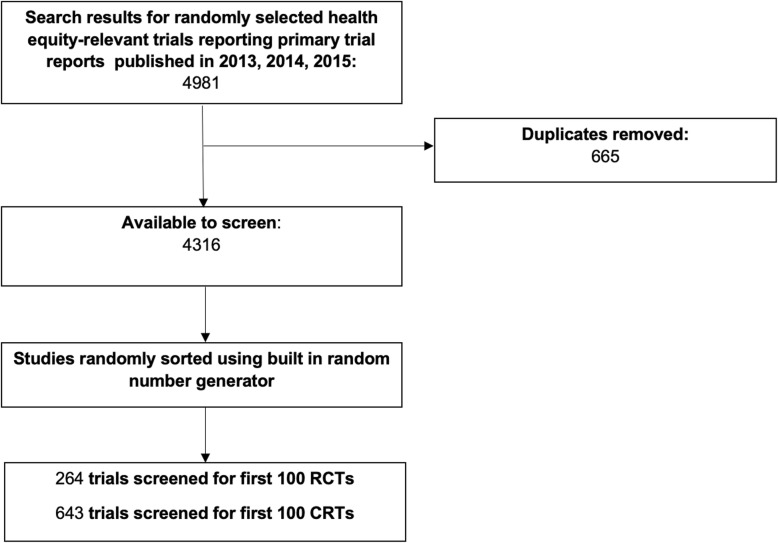
We developed a search strategy to identify health-equity-relevant trials published between 2013 and 2015. We randomly sorted the 4316 records identified by the search and screened studies until 100 individually randomized (RCTs) and 100 cluster randomized controlled trials (CRTs) were identified. We developed and pilot-tested a data extraction form based on our initial work, to inform the development of our reporting guideline for equity-relevant randomized trials.
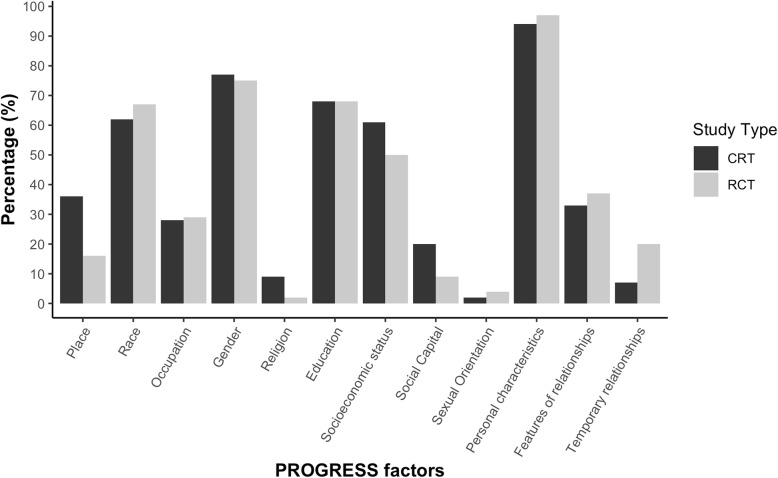
In total, 39 trials (20%) were conducted in a low- and middle-income country and 157 trials (79%) in a high-income country focused on socially disadvantaged populations (78% CRTs, 79% RCTs). Seventy-four trials (37%) reported a subgroup analysis across a population characteristic associated with disadvantage (25% CRT, 49% RCTs), with 19% of included studies reporting subgroup analyses across sex, 9% across race/ethnicity/culture, and 4% across socioeconomic status. No subgroup analyses were reported for place of residence, occupation, religion, education, or social capital. One hundred and forty-one trials (71%) discussed the applicability of their results to one or more socially disadvantaged populations (68% of CRT, 73% of RCT).
In this set of trials, selected for their relevance to health equity, data that were disaggregated for socially disadvantaged populations were rarely reported. We found that even when the data are available, opportunities to analyze health-equity considerations are frequently missed. The recently published equity extension of the Consolidated Reporting Standards for Randomized Trials (CONSORT-Equity) may help improve delineation of hypotheses related to socially disadvantaged populations, and transparency and completeness of reporting of health-equity considerations in RCTs. This study can serve as a baseline assessment of the reporting of equity considerations.
随机对照试验(RCT)被认为是提供干预措施有效性决策信息的黄金标准研究设计。然而,一个常见的局限性是对干预措施和试验结果在“社会弱势群体”中的适用性的报告不足,这可能会影响决策者的决策。我们之前开发了一个用于确定健康公平相关试验的框架,并为透明报告制定了一个报告指南。在这项研究中,我们对 200 项随机抽样的公平相关试验中的健康公平考虑因素进行了描述性评估。
我们制定了一个搜索策略,以确定 2013 年至 2015 年期间发表的健康公平相关试验。我们随机排列了搜索中确定的 4316 条记录,并筛选了研究,直到确定了 100 项个体随机(RCT)和 100 项群组随机对照试验(CRT)。我们根据我们的初步工作开发并试点了一个数据提取表格,以告知我们为公平相关随机试验制定报告指南。
共有 39 项试验(20%)在中低收入国家进行,157 项试验(79%)在高收入国家进行,针对社会弱势群体(78%的 CRT,79%的 RCT)。74 项试验(37%)报告了一项与弱势群体相关的人口特征的亚组分析(25%的 CRT,49%的 RCT),其中 19%的纳入研究报告了性别亚组分析,9%的种族/民族/文化亚组分析,4%的社会经济地位亚组分析。没有报告关于居住地、职业、宗教、教育或社会资本的亚组分析。141 项试验(71%)讨论了其结果对一个或多个社会弱势群体的适用性(68%的 CRT,73%的 RCT)。
在这组为健康公平而选择的试验中,很少报告针对社会弱势群体进行了分类的数据。我们发现,即使数据可用,分析健康公平考虑因素的机会也经常被错过。最近发布的 CONSORT-Equity(Consolidated Reporting Standards for Randomized Trials 的权益扩展)可能有助于改善与社会弱势群体相关的假设的阐述,以及 RCT 中健康公平考虑因素的透明度和完整性。这项研究可以作为对权益考虑因素报告的基线评估。