Albert Nikolai, Melau Marianne, Jensen Heidi, Hastrup Lene Halling, Hjorthøj Carsten, Nordentoft Merete
Copenhagen Mental Health Centre, Capital Region, Copenhagen, Denmark.
University of Copenhagen, Copenhagen, Denmark.
NPJ Schizophr. 2017 Sep 26;3(1):34. doi: 10.1038/s41537-017-0034-4.
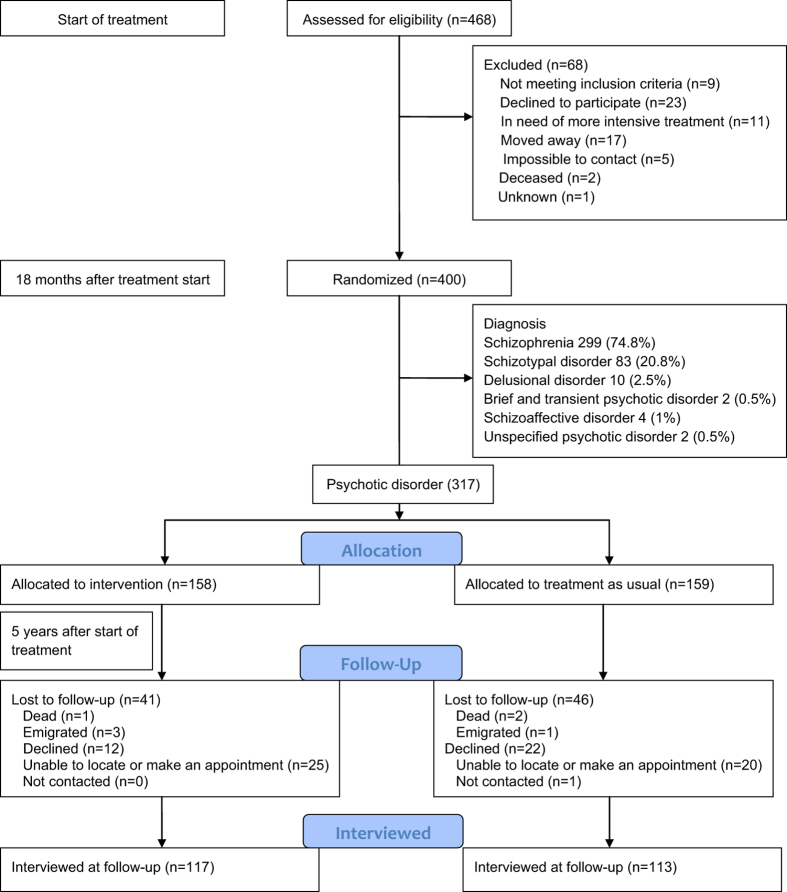
The duration of untreated psychosis (DUP) has been shown to have an effect on outcome after first-episode psychosis. The premise of specialized early intervention (SEI) services is that intervention in the early years of illness can affect long-term outcomes. In this study, we investigate whether DUP affects treatment response after 5 years of SEI treatment compared to 2 years of SEI treatment. As part of a randomized controlled trial testing the effect of prolonged SEI treatment 400 participants diagnosed within the schizophrenia spectrum were recruited. For this specific study participants were dichotomized based on DUP, treatment delay, and time from first symptom until start of SEI treatment. The groups were analyzed with regard to treatment response on psychopathology, level of functioning, and cognitive functioning. The participants with a short DUP had a tendency to respond better to the prolonged treatment with regards to disorganized and negative dimension. For participants with short duration from first symptom until start of SEI treatment there was a significant difference on the negative dimension favoring the prolonged OPUS treatment. The finding of an effect of prolonged treatment for participants with a short total treatment delay could mean that prolonged SEI treatment is more beneficial than treatment as usual (TAU) so long as it is provided in the early years of illness and not just in the early years after diagnosis.
THE EARLIER THE BETTER: The duration of untreated psychosis influences the long-term outcomes of treatment. Nikolai Albert, at the Copenhagen Mental Health Centre, and a team of Danish researchers have investigated the effects of a specialized early intervention program (OPUS) in 400 patients diagnosed with schizophrenia spectrum disorders and compared the effects of OPUS after two and five years. Their findings suggest that five years of specialized early intervention was most beneficial when the total duration from symptom start to treatment was shorter than 6 months. The treatment was particularly effective at improving patients' disorganized behavior and negative symptoms such as blunted emotions and lack of motivation. These findings support previous studies suggesting that patients are more responsive to treatment in the early years of illness and highlight the importance of avoiding delays within the mental health service provision.
未治疗精神病持续时间(DUP)已被证明对首发精神病后的结局有影响。专门早期干预(SEI)服务的前提是在疾病早期进行干预可影响长期结局。在本研究中,我们调查与2年SEI治疗相比,DUP对5年SEI治疗后的治疗反应是否有影响。作为一项测试延长SEI治疗效果的随机对照试验的一部分,招募了400名精神分裂症谱系内诊断的参与者。对于这项特定研究,参与者根据DUP、治疗延迟以及从首次出现症状到开始SEI治疗的时间进行二分法分类。对这些组在精神病理学、功能水平和认知功能方面的治疗反应进行了分析。DUP短的参与者在紊乱和阴性维度方面对延长治疗的反应有更好的趋势。对于从首次出现症状到开始SEI治疗时间短的参与者,在阴性维度上延长OPUS治疗有显著差异。对于总治疗延迟短的参与者延长治疗有效果这一发现可能意味着,只要在疾病早期而非仅在诊断后的早期提供延长的SEI治疗,其比常规治疗(TAU)更有益。
越早越好:未治疗精神病的持续时间会影响治疗的长期结局。哥本哈根心理健康中心的尼古拉·阿尔伯特和一组丹麦研究人员调查了一项专门的早期干预项目(OPUS)对400名诊断为精神分裂症谱系障碍患者的影响,并比较了OPUS在两年和五年后的效果。他们的研究结果表明,当从症状开始到治疗的总持续时间短于6个月时,五年的专门早期干预最为有益。该治疗在改善患者的紊乱行为和阴性症状(如情感迟钝和缺乏动机)方面特别有效。这些发现支持了先前的研究,表明患者在疾病早期对治疗反应更好,并强调了避免精神卫生服务提供过程中出现延误的重要性。