Zhang Shaohong, He Xiuying, Zhao Junliang, Cheng Yongsheng, Xie Zhimei, Chen Yuehan, Yang Tifeng, Dong Jingfang, Wang Xiaofei, Liu Qing, Liu Wei, Mao Xingxue, Fu Hua, Chen Zhaoming, Liao Yaoping, Liu Bin
Rice Research Institute, Guangdong Academy of Agricultural Sciences, Guangzhou, 510640, China.
Guangdong Key Laboratory of New Technology in Rice Breeding, Guangzhou, 510640, China.
Rice (N Y). 2017 Sep 26;10(1):44. doi: 10.1186/s12284-017-0183-0.
Harvest index (HI) in rice is defined as the ratio of grain yield (GY) to biomass (BM). Although it has been demonstrated that HI is significantly related to yield and is considered as one of the most important traits in high-yielding rice breeding, HI-based high-yielding rice breeding is difficult due to its polygenic nature and insufficient knowledge on the genetic basis of HI. Therefore, searching for rice varieties with high HI and mapping genes associated with high HI can facilitate marker-assisted breeding for high HI in rice.
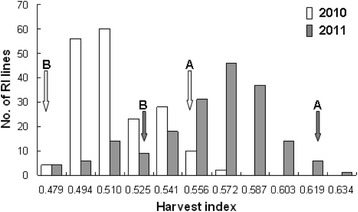
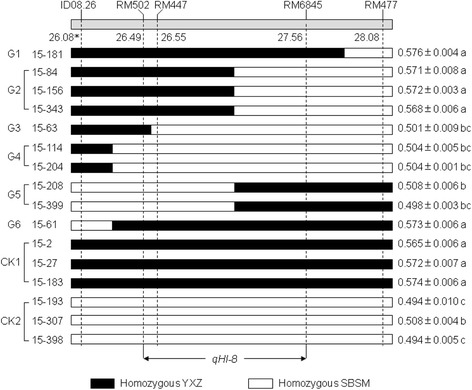
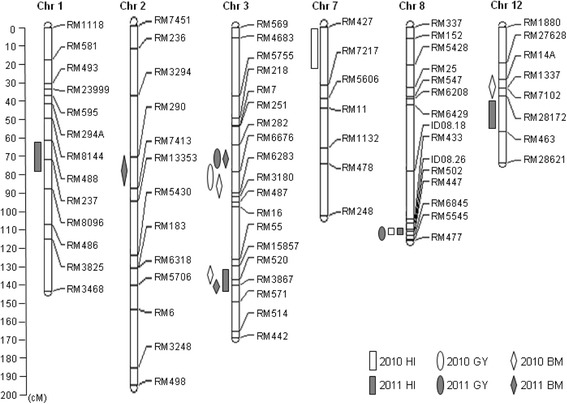
Yuexiangzhan, a popular indica cultivar with good reputation of high HI was crossed with Shengbasimiao, an indica cultivar with lower HI to develop a recombinant inbred line population, and QTL mapping for HI and its component traits was conducted. In total, five QTLs for HI, three QTLs for GY, and six QTLs for BM were detected in two-year experiments. Among the three GY QTLs, one co-located with the HI QTL on chromosome 8, while the other two co-located with the two tightly-linked BM QTLs on chromosome 3. The co-located QTLs in each of the chromosomal regions produced additive effects in the same direction. Particularly, the HI QTL on chromosome 8, qHI-8, could be detected across two years and explained 42.8% and 44.5% of the phenotypic variation, respectively. The existence of qHI-8 was confirmed by the evaluation of the near isogenic lines derived from a residual heterozygous line, and this QTL was delimitated to a 1070 kb interval by substitution mapping.
In the present study, the detected GY QTLs overlapped with both HI QTL and BM QTL, suggesting a positive relationship between GY and HI or BM, respectively. With an understanding of the genetic basis for grain yield, harvest index and biomass, it is possible to achieve higher yield through enhancing HI and BM by pyramiding the favorable alleles for the two traits via marker-assisted selection (MAS). As qHI-8 has a large phenotypic effect on HI and expresses stably in different environments, it provides a promising target for further genetic characterization of HI and MAS of high HI in rice breeding.
水稻的收获指数(HI)定义为籽粒产量(GY)与生物量(BM)之比。尽管已经证明HI与产量显著相关,并且被认为是高产水稻育种中最重要的性状之一,但由于其多基因性质以及对HI遗传基础的了解不足,基于HI的高产水稻育种很困难。因此,寻找具有高HI的水稻品种并定位与高HI相关的基因可以促进水稻中高HI的分子标记辅助育种。
将具有高HI良好声誉的流行籼稻品种粤香占与HI较低的籼稻品种胜巴丝苗杂交,构建了一个重组自交系群体,并对HI及其组成性状进行了QTL定位。在两年的实验中,共检测到5个HI的QTL、3个GY的QTL和6个BM的QTL。在3个GY的QTL中,1个与第8染色体上的HI QTL共定位,另外2个与第3染色体上紧密连锁的2个BM QTL共定位。每个染色体区域中共定位的QTL产生相同方向的加性效应。特别是,第8染色体上的HI QTL,qHI - 8,在两年中均能检测到,分别解释了42.8%和44.5%的表型变异。通过对源自剩余杂合系的近等基因系的评估证实了qHI - 8的存在,并通过代换作图将该QTL定位到一个1070 kb的区间。
在本研究中,检测到的GY QTL与HI QTL和BM QTL重叠,分别表明GY与HI或BM之间存在正相关关系。了解籽粒产量、收获指数和生物量的遗传基础后,通过分子标记辅助选择(MAS)将两个性状中的有利等位基因聚合,有可能通过提高HI和BM来实现更高的产量。由于qHI - 8对HI具有较大的表型效应,并且在不同环境中稳定表达,它为水稻育种中HI的进一步遗传特性分析和高HI的MAS提供了一个有前景的目标。