Wu Yan, He Jie, Sun Xue, Zhao Yi-Ming, Lou Han-Yu, Ji Xiao-Li, Pang Xiao-Hong, Shan Li-Zhen, Kang Ying-Xiu, Xu Jun, Zhang Song-Zhao, Wang Yong-Jian, Ren Yue-Zhong, Shan Peng-Fei
Department of Endocrinology and Metabolism, the Second Affiliated Hospital ZheJiang University College of Medicine Department of Endocrinology and Metabolism, Zhejiang Greentown Cardiovascular Hospital Department of Ultrasound Department of Clinical Laboratory, the Second Affiliated Hospital ZheJiang University College of Medicine, Hangzhou, Zhejiang, P.R. China.
Medicine (Baltimore). 2017 Sep;96(39):e8151. doi: 10.1097/MD.0000000000008151.
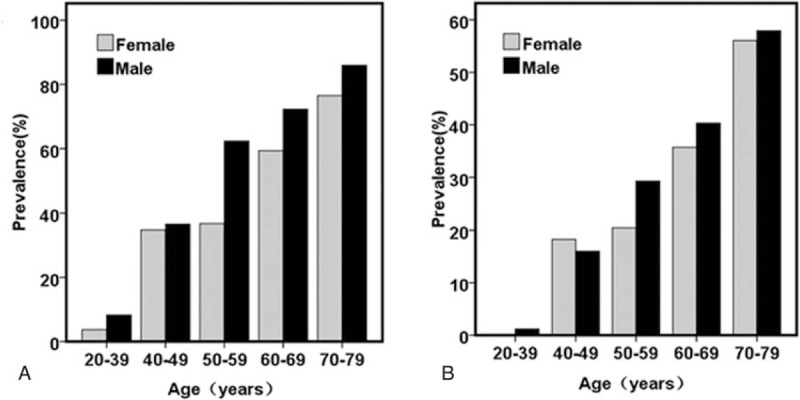
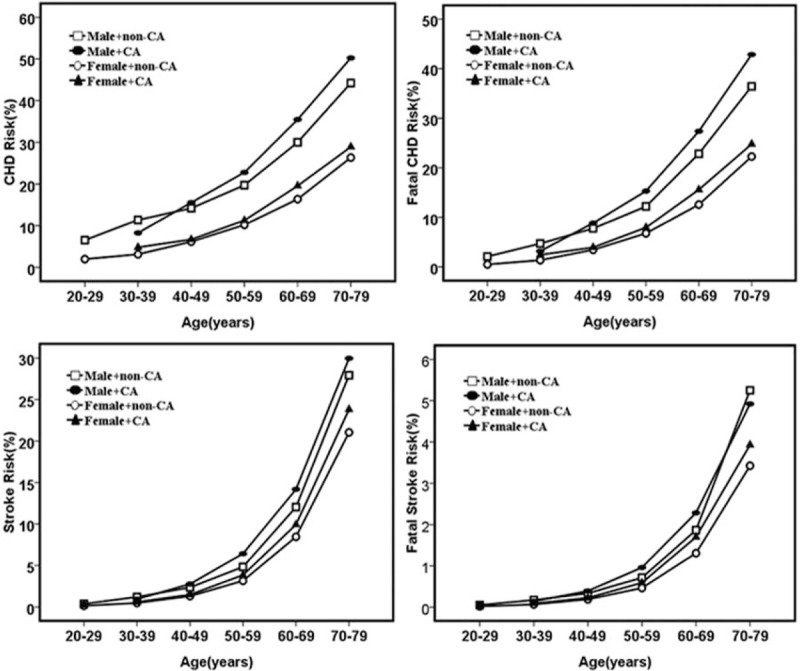
Carotid atherosclerosis (CA) and carotid plaque (CP) are highly correlated with cardiovascular disease. We aimed to determine the prevalence of CA and CP and their relationship with 10-year risks of stroke and coronary heart disease (CHD) in type 2 diabetes mellitus (T2DM).We studied 1584 T2DM patients aged 20 years and older. CA and CP were detected using ultrasonography. Ten-year stroke and CHD risk were determined using the United Kingdom Prospective Diabetes Study (UKPDS) risk engine.The prevalence of CA and CP increased gradually with age. Men had a higher prevalence of CA than women (CA: 58.18% vs 51.54%, P < .01). The 10-year CHD risk (27.9% vs 15.4%, P < .001) and stroke risk (15.2% vs 5.70%, P < .001) were higher in patients with CA than that of those without CA. Compared with patients without CA, the odds ratios (ORs) of CHD in CA and CP group were 4.47 and 10.78 for men, and 4.19 and 5.20 for women, respectively; in the case of stroke, the OR in CA and CP group were 8.83 and 12.07 for men, and 4.35 and 4.90 for women, respectively (P < .001 for all). Multivariate binary logistic regression analysis showed that CA was an independent risk factor for CHD [OR = 2.66, 95% confidence interval (95% CI), 2.05-3.46, P < .001] and stroke (OR = 3.11, 95% CI, 2.38-4.07, P < .001).CA and CP were prevalent in patients with T2DM and positively correlated with 10-year CHD and stroke risk. CA was an independent risk factor for 10-year CHD risk.
颈动脉粥样硬化(CA)和颈动脉斑块(CP)与心血管疾病高度相关。我们旨在确定2型糖尿病(T2DM)患者中CA和CP的患病率及其与10年中风和冠心病(CHD)风险的关系。我们研究了1584名年龄在20岁及以上的T2DM患者。使用超声检查检测CA和CP。使用英国前瞻性糖尿病研究(UKPDS)风险引擎确定10年中风和CHD风险。CA和CP的患病率随年龄逐渐增加。男性CA的患病率高于女性(CA:58.18%对51.54%,P<0.01)。有CA的患者10年CHD风险(27.9%对15.4%,P<0.001)和中风风险(15.2%对5.70%,P<0.001)高于无CA的患者。与无CA的患者相比,CA和CP组男性CHD的比值比(OR)分别为4.47和10.78,女性分别为4.19和5.20;在中风方面,CA和CP组男性的OR分别为8.83和12.07,女性分别为4.35和4.90(所有P<0.001)。多变量二元逻辑回归分析表明,CA是CHD的独立危险因素[OR=2.66,95%置信区间(95%CI),2.05-3.46,P<0.001]和中风(OR=3.11,95%CI,2.38-4.07,P<0.001)。CA和CP在T2DM患者中普遍存在,且与10年CHD和中风风险呈正相关。CA是10年CHD风险的独立危险因素。