Falardeau Justin, Johnson Roger P, Pagotto Franco, Wang Siyun
Department of Food, Nutrition, and Health, The University of British Columbia, Vancouver, British Columbia, Canada.
Public Health Agency of Canada, Guelph, Ontario, Canada.
PLoS One. 2017 Sep 27;12(9):e0185437. doi: 10.1371/journal.pone.0185437. eCollection 2017.
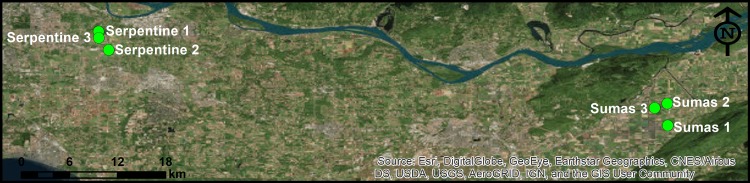
Produce has become a major source of foodborne illness, and may become contaminated through surface water irrigation. The objectives of this study were to (i) determine the frequency of verotoxigenic E. coli (VTEC), Listeria monocytogenes, and Salmonella in surface waters used for irrigation in the Lower Mainland of British Columbia, (ii) assess the suitability of fecal coliforms and generic E. coli as hygiene indicators, and (iii) investigate the correlations of environmental factors with pathogen occurrence. Water samples were collected semi-monthly for 18 months from seven irrigation ditches across the Serpentine and Sumas watersheds. VTEC colonies on water filters were detected using a verotoxin colony immunoblot, and the presence of virulence genes vt1 and vt2 was ascertained via multiplex PCR. Detection of L. monocytogenes and Salmonella was completed using standard, Health Canada Compendium of Analytical Methods. Fecal coliforms and generic E. coli were enumerated by 3M™ Petrifilm™ and filtration methods, and meteorological and geographic data were collected from government records. VTEC, L. monocytogenes, and Salmonella were detected in 4.93%, 10.3%, and 2.69% of 223 samples, respectively. L. monocytogenes occurrence was greatest in the Serpentine watershed (χ2; p < 0.05), and was most common during the winter and fall (Fisher exact test; p < 0.05). Site dependence of VTEC and Salmonella occurrence was observed within watersheds (Fisher's exact test; p < 0.10). Pathogen occurrence correlated with fecal coliform counts (r = 0.448), while VTEC occurrence also correlated with precipitation over the five days before sampling (r = 0.239). The density of upstream livestock correlated with VTEC (rs = 0.812), and L. monocytogenes (rs = 0.841) detection. These data show that foodborne pathogens are present in the waters used for irrigation in the Lower Mainland of British Columbia, but their frequency may depend on spatial and temporal factors.
农产品已成为食源性疾病的主要来源,并且可能通过地表水灌溉而受到污染。本研究的目的是:(i)确定不列颠哥伦比亚省低陆平原用于灌溉的地表水中产志贺毒素大肠杆菌(VTEC)、单核细胞增生李斯特菌和沙门氏菌的检出频率;(ii)评估粪大肠菌群和大肠埃希氏菌作为卫生指标的适用性;(iii)调查环境因素与病原体出现之间的相关性。在18个月的时间里,每半月从蛇纹石和苏马斯流域的7条灌溉沟渠采集水样。使用志贺毒素菌落免疫印迹法检测滤膜上的VTEC菌落,并通过多重聚合酶链反应确定毒力基因vt1和vt2的存在。单核细胞增生李斯特菌和沙门氏菌的检测按照加拿大卫生部《分析方法汇编》的标准方法完成。通过3M™ Petrifilm™和过滤法对粪大肠菌群和大肠埃希氏菌进行计数,并从政府记录中收集气象和地理数据。在223个样本中,VTEC、单核细胞增生李斯特菌和沙门氏菌的检出率分别为4.93%、10.3%和2.69%。单核细胞增生李斯特菌在蛇纹石流域的检出率最高(χ2检验;p < 0.05),在冬季和秋季最为常见(Fisher精确检验;p < 0.05)。在流域内观察到VTEC和沙门氏菌出现的地点依赖性(Fisher精确检验;p < 0.10)。病原体的出现与粪大肠菌群计数相关(r = 0.448),而VTEC的出现也与采样前五天的降水量相关(r = 0.239)。上游牲畜的密度与VTEC(rs = 0.812)和单核细胞增生李斯特菌(rs = 0.841)的检测相关。这些数据表明,不列颠哥伦比亚省低陆平原用于灌溉的水体中存在食源性病原体,但其频率可能取决于空间和时间因素。