Center for Integrative Brain Research, Seattle Children's Research Institute, Seattle, Washington.
Department of Biology and Graduate Program in Neuroscience, University of Washington, Seattle, Washington.
J Biol Rhythms. 2017 Oct;32(5):444-455. doi: 10.1177/0748730417730169. Epub 2017 Sep 27.
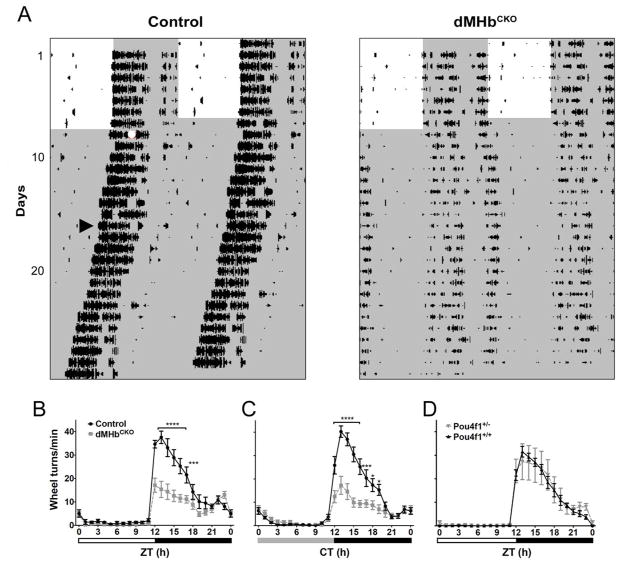
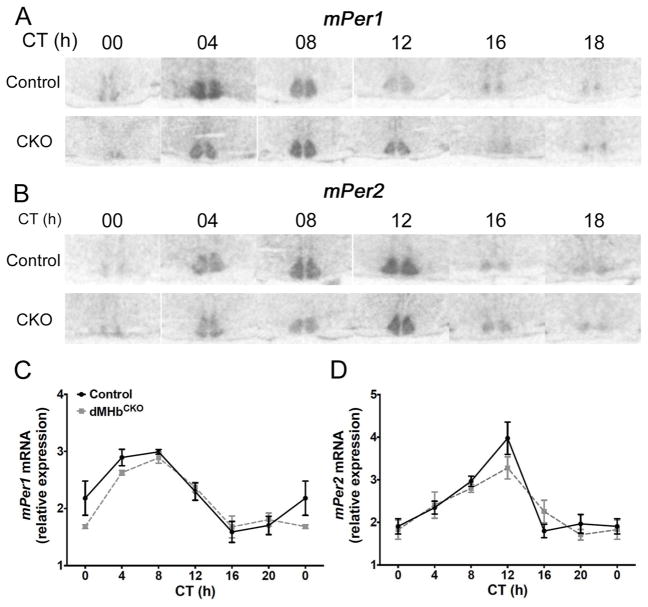
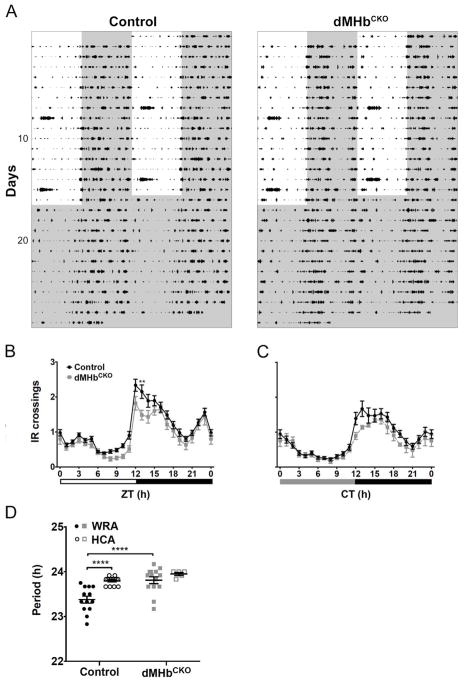
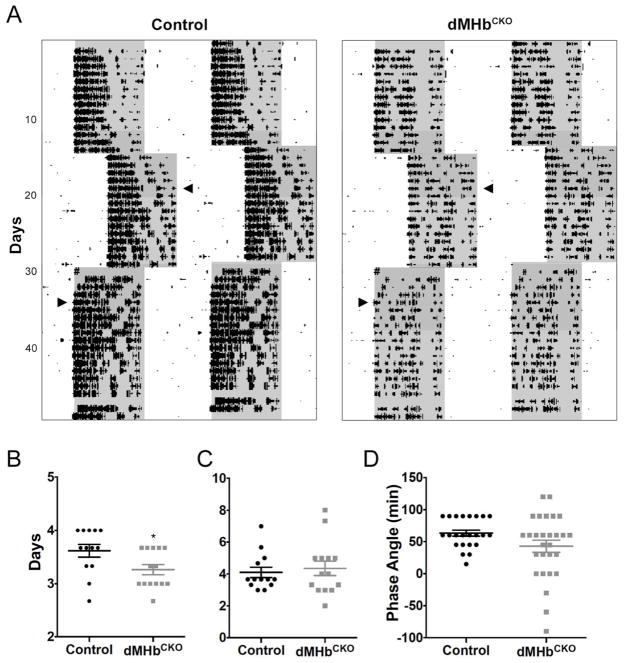
In nocturnal rodents, voluntary wheel-running activity (WRA) represents a self-reinforcing behavior. We have previously demonstrated that WRA is markedly reduced in mice with a region-specific deletion of the transcription factor Pou4f1 (Brn3a), which leads to an ablation of the dorsal medial habenula (dMHb). The decrease in WRA in these dMHb-lesioned (dMHb) mice suggests that the dMHb constitutes a critical center for conveying reinforcement by exercise. However, WRA also represents a prominent output of the circadian system, and the possibility remains that the dMHb is a source of input to the master circadian pacemaker located in the suprachiasmatic nucleus (SCN) of the hypothalamus. To test this hypothesis, we assessed the integrity of the circadian system in dMHb mice. Here we show that the developmental lesion of the dMHb reduces WRA under both a light-dark cycle and constant darkness, increases the circadian period of WRA, but has no effect on the circadian amplitude or period of home cage activity or the daily amplitude of sleep stages, suggesting that the lengthening of period is a result of the decreased WRA in the mutant mice. Polysomnographic sleep recordings show that dMHb mice have an overall unaltered daily amplitude of sleep stages but have fragmented sleep and an overall increase in total rapid eye movement (REM) sleep. Photoresponsiveness is intact in dMHb mice, but compared with control animals, they reentrain faster to a 6-h abrupt phase delay protocol. Circadian changes in WRA of dMHb mice do not appear to emerge within the central pacemaker, as circadian expression of the clock genes Per1 and Per2 within the SCN is normal. We do find some evidence for fragmented sleep and an overall increase in total REM sleep, supporting a model in which the dMHb is part of the neural circuitry encoding motivation and involved in the manifestation of some of the symptoms of depression.
在夜间活动的啮齿动物中,自愿转轮活动(WRA)代表一种自我强化的行为。我们之前的研究表明,在转录因子 Pou4f1(Brn3a)特异性缺失的小鼠中,WRA 明显减少,这导致背内侧缰核(dMHb)的消融。这些 dMHb 损伤(dMHb)小鼠中 WRA 的减少表明 dMHb 构成了通过运动传递强化的关键中心。然而,WRA 也代表了昼夜节律系统的一个突出输出,并且仍然存在 dMHb 是位于下丘脑视交叉上核(SCN)的主昼夜节律起搏器的输入源的可能性。为了验证这一假设,我们评估了 dMHb 小鼠的昼夜节律系统的完整性。在这里,我们表明 dMHb 的发育性损伤减少了在光-暗周期和持续黑暗下的 WRA,增加了 WRA 的昼夜节律周期,但对家笼活动的昼夜节律幅度或周期或睡眠阶段的每日幅度没有影响,这表明突变小鼠中周期的延长是由于 WRA 减少的结果。多导睡眠记录显示,dMHb 小鼠的睡眠阶段每日幅度总体上没有改变,但睡眠碎片化,总快速眼动(REM)睡眠总体增加。dMHb 小鼠的光反应性完好,但与对照动物相比,它们对 6 小时突然相位延迟方案的重新同步更快。dMHb 小鼠的 WRA 昼夜节律变化似乎不会出现在中央起搏器内,因为 SCN 内时钟基因 Per1 和 Per2 的昼夜节律表达正常。我们确实发现一些睡眠碎片化和总 REM 睡眠总体增加的证据,支持 dMHb 是编码动机的神经回路的一部分并参与一些抑郁症症状表现的模型。