Hollanders Jonneke J, van der Voorn Bibian, Kieviet Noera, Dolman Koert M, de Rijke Yolanda B, van den Akker Erica L T, Rotteveel Joost, Honig Adriaan, Finken Martijn J J
Department of Pediatric EndocrinologyVU University Medical Center, Amsterdam, The Netherlands
Department of Pediatric EndocrinologyVU University Medical Center, Amsterdam, The Netherlands.
Endocr Connect. 2017 Nov;6(8):692-699. doi: 10.1530/EC-17-0179. Epub 2017 Sep 27.
Glucocorticoids (GCs) measured in neonatal hair might reflect intrauterine as well as postpartum GC regulation. We aimed to identify factors associated with neonatal hair GC levels in early life, and their correlation with maternal hair GCs.
In a single-center observational study, mother-infant pairs ( = 107) admitted for >72 h at the maternity ward of a general hospital were included. At birth and an outpatient visit (OPV, = 72, 44 ± 11 days postpartum), maternal and neonatal hair was analyzed for cortisol and cortisone levels by LC-MS/MS. Data were analyzed regarding: (1) neonatal GC levels postpartum and at the OPV, (2) associations of neonatal GC levels with maternal GC levels and (3) with other perinatal factors.
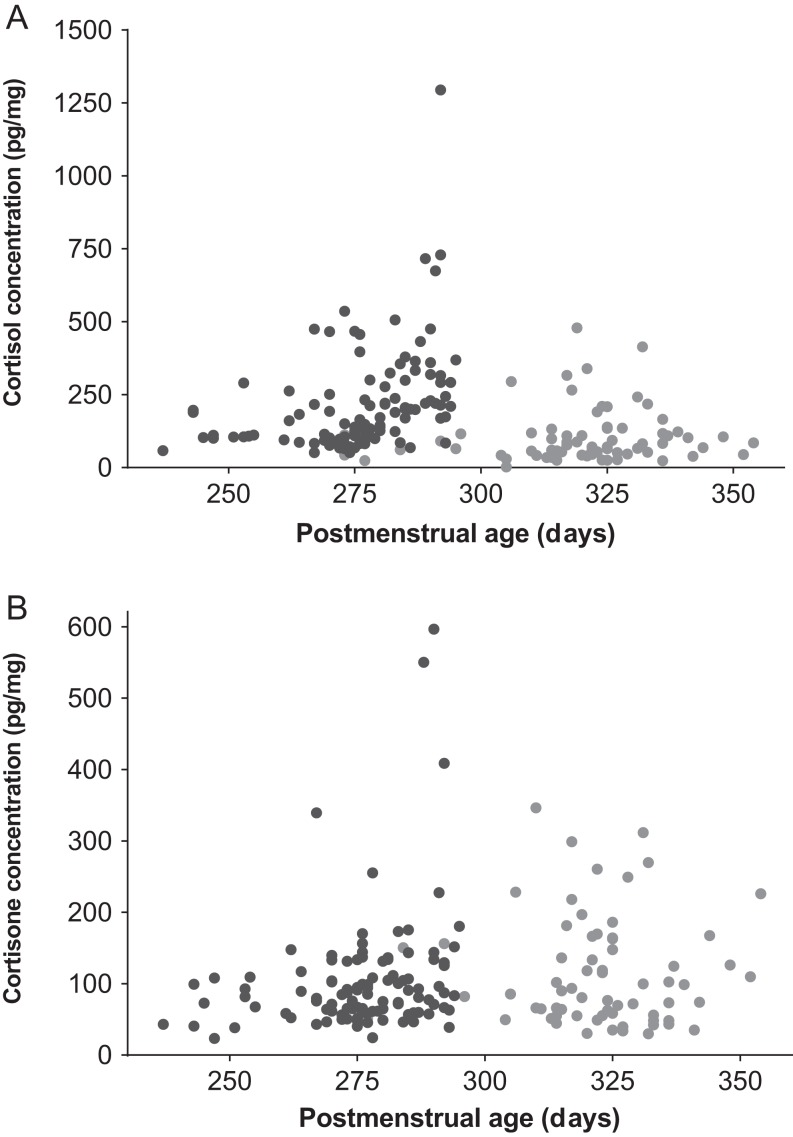
(1) Neonatal GC levels were >5 times higher than maternal levels, with a decrease in ±50% between birth and the OPV for cortisol. (2) Maternal and neonatal cortisol, but not cortisone, levels were correlated both at postpartum and at the OPV. (3) Gestational age was associated with neonatal GC postpartum (log-transformed (95% CI): cortisol 0.07 (0.04-0.10); cortisone 0.04 (0.01-0.06)) and at the OPV (cortisol 0.08 (0.04-0.12); cortisone 0.00 (-0.04 to 0.04)), while weaker associations were found between neonatal GCs and other perinatal and maternal factors.
Neonatal hair GCs mainly reflect the third trimester increase in cortisol, which might be caused by the positive feedback loop, a placenta-driven phenomenon, represented by the positive association with GA. Between birth and 1.5 months postpartum, neonatal hair cortisol concentrations decrease sharply, but still appear to reflect both intra- and extrauterine periods.
新生儿毛发中检测到的糖皮质激素(GCs)可能反映宫内以及产后的GC调节情况。我们旨在确定生命早期与新生儿毛发GC水平相关的因素,以及它们与母亲毛发GCs的相关性。
在一项单中心观察性研究中,纳入了在一家综合医院产科病房住院超过72小时的母婴对(n = 107)。在出生时和门诊就诊时(OPV,n = 72,产后44±11天),通过液相色谱-串联质谱法(LC-MS/MS)分析母亲和新生儿毛发中的皮质醇和可的松水平。对数据进行了以下分析:(1)产后和OPV时的新生儿GC水平,(2)新生儿GC水平与母亲GC水平的关联,以及(3)与其他围产期因素的关联。
(1)新生儿GC水平比母亲水平高5倍以上,皮质醇在出生时和OPV之间下降了±50%。(2)母亲和新生儿的皮质醇水平,而非可的松水平,在产后和OPV时均具有相关性。(3)胎龄与产后新生儿GC相关(对数转换后β(95%CI):皮质醇0.07(0.04 - 0.10);可的松0.04(0.01 - 0.06)),在OPV时也相关(皮质醇0.08(0.04 - 0.12);可的松0.00(-0.04至0.04)),而新生儿GCs与其他围产期和母亲因素之间的关联较弱。
新生儿毛发GCs主要反映孕晚期皮质醇的增加,这可能是由正反馈回路引起的,正反馈回路是一种由胎盘驱动的现象,表现为与胎龄呈正相关。在出生至产后1.5个月之间,新生儿毛发皮质醇浓度急剧下降,但似乎仍能反映宫内和宫外时期。