Bournemouth University, Faculty of Health and Social Sciences, Bournemouth, Dorset, UK.
Poole Hospital NHS Foundation Trust, Dorset Multiple Sclerosis Service, Poole, Dorset, UK.
BMJ Open. 2017 Sep 27;7(9):e016966. doi: 10.1136/bmjopen-2017-016966.
While the health and well-being benefits of physical activity are recognised, people with multiple sclerosis (MS) often face greater barriers than the general population. The Nintendo Wii potentially offers a fun, convenient way of overcoming some of these. The aim was to test the feasibility of conducting a definitive trial of the effectiveness and cost-effectiveness of Mii-vitaliSe; a home-based, physiotherapist-supported Nintendo Wii intervention.
A single-centre wait-list randomised controlled study.
MS service in secondary care.
Ambulatory, relatively inactive people with clinically confirmed MS.
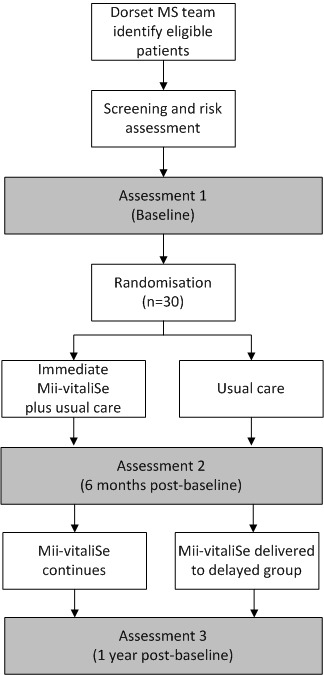
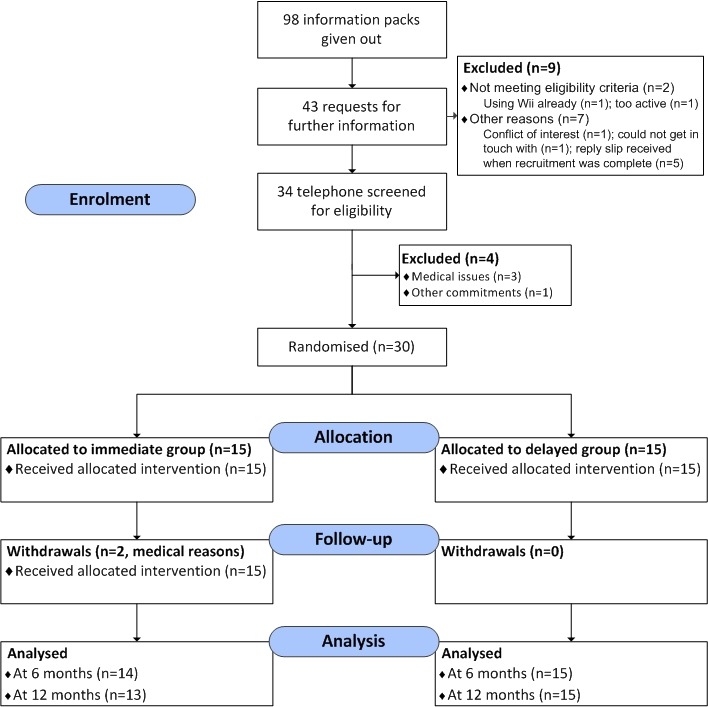
Thirty participants were randomised to receive Mii-vitaliSe either immediately (for 12 months) or after a 6-month wait (for 6 months). Mii-vitaliSe consisted of two supervised Nintendo Wii familiarisation sessions in the hospital followed by home use (Wii Sports, Sports Resort and Fit Plus software) with physiotherapist support and personalised resources.
Included self-reported physical activity levels, quality of life, mood, self-efficacy, fatigue and assessments of balance, gait, mobility and hand dexterity at baseline, 6 and 12 months. Interviews (n=25) explored participants' experiences and, at study end, the two Mii-vitaliSe facilitators' experiences of intervention delivery (main qualitative findings reported separately).
Mean (SD) age was 49.3 (8.7) years, 90% female, with 47% diagnosed with MS <6 years ago and 60% new to active gaming. The recruitment rate was 31% (95% CI 20% to 44%). Outcome data were available for 29 (97%) at 6 months and 28 (93%) at 12 months. No serious adverse events were reported during the study. Qualitative data indicated that Mii-vitaliSe was well-received. Mean Wii use across both groups over the initial 6-month intervention period was twice a week for 27 min/day. Mean cost of delivering Mii-vitaliSe was £684 per person.
Mii-vitaliSe appears acceptable and a future trial feasible and warranted. These findings will inform its design.
ISRCTN49286846.
虽然人们已经认识到体育活动对健康和幸福的益处,但多发性硬化症(MS)患者往往面临比一般人群更大的障碍。任天堂 Wii 游戏机可能提供了一种有趣、方便的方式来克服其中的一些障碍。本研究旨在测试一种基于家庭、由物理治疗师支持的任天堂 Wii 干预措施 Mii-vitaliSe 的有效性和成本效益的确定性试验的可行性。
单中心候补随机对照研究。
二级保健中的 MS 服务。
临床确诊的 MS 患者,活动量较少且能走动。
30 名参与者被随机分配接受 Mii-vitaliSe 治疗,一组立即接受治疗(12 个月),另一组接受 6 个月的候补治疗(6 个月)。Mii-vitaliSe 包括在医院进行两次监督的任天堂 Wii 熟悉课程,然后在家中使用(Wii Sports、Sports Resort 和 Fit Plus 软件),由物理治疗师提供支持和个性化资源。
在基线、6 个月和 12 个月时,使用自我报告的身体活动水平、生活质量、情绪、自我效能、疲劳以及平衡、步态、移动性和手部灵巧性评估。(主要定性发现单独报告)。在研究结束时,还采访了 25 名参与者,以了解他们的体验,以及两名 Mii-vitaliSe 促进者的干预经验。
参与者的平均(SD)年龄为 49.3(8.7)岁,90%为女性,47%的人在 6 年前被诊断为 MS,60%的人是新的积极游戏者。招募率为 31%(95%CI 20%至 44%)。在 6 个月时有 29 名(97%)和 28 名(93%)参与者可获得完整的结果数据。研究期间未报告任何严重不良事件。定性数据表明 Mii-vitaliSe 受到了很好的欢迎。两组在最初的 6 个月干预期间,平均每周使用 Wii 两次,每次 27 分钟。Mii-vitaliSe 的人均交付成本为 684 英镑。
Mii-vitaliSe 似乎是可以接受的,未来的试验是可行和值得的。这些发现将为其设计提供信息。
ISRCTN49286846。