Jauk Emanuel, Weigle Elena, Lehmann Konrad, Benedek Mathias, Neubauer Aljoscha C
Department of Psychology, University of GrazGraz, Austria.
Front Psychol. 2017 Sep 13;8:1600. doi: 10.3389/fpsyg.2017.01600. eCollection 2017.
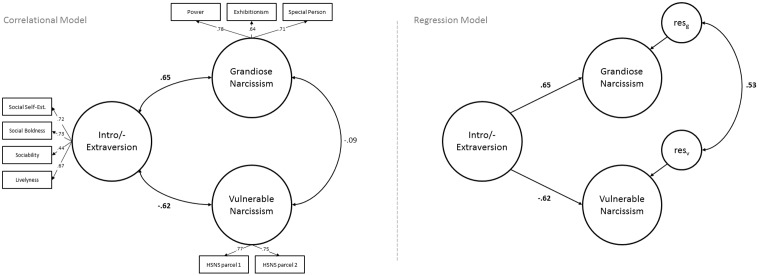
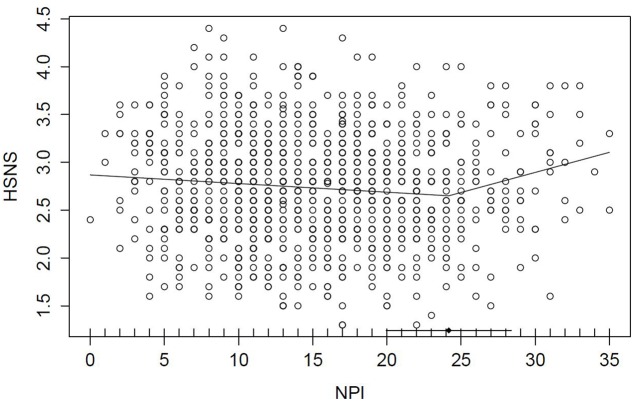
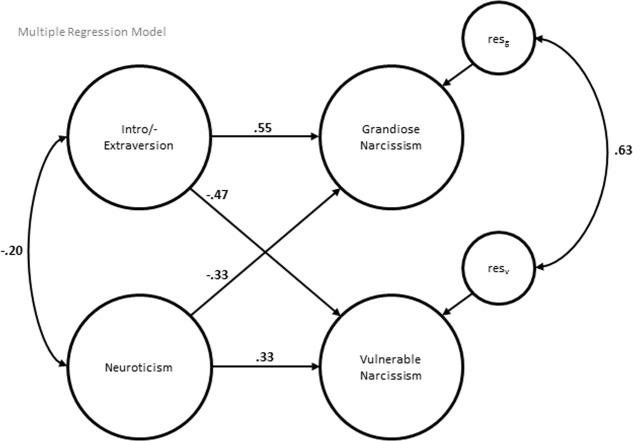
Narcissistic grandiosity is characterized by overt expressions of feelings of superiority and entitlement, while narcissistic vulnerability reflects hypersensitivity and introversive self-absorbedness. Clinical evidence suggests that grandiosity is accompanied by vulnerable aspects, pointing to a common foundation. Subclinical personality research, however, views grandiose and vulnerable narcissism as independent traits. Grandiose narcissism displays substantial correlation with extraversion, while vulnerable narcissism correlates highly with introversion. We investigated if (1) controlling for intro-/extraversion might reveal a "common core" of grandiose and vulnerable narcissism, and if (2) the correlation between both aspects might be higher at higher levels of narcissism. Latent variable structural equation modeling and segmented regression analysis confirmed these hypotheses in a large non-clinical sample ( = 1,006). Interindividual differences in intro-/extraversion mask the common core of grandiose and vulnerable narcissism. The association between both aspects increases at high levels (upper 10%) of grandiose narcissism, which suggests a possible transition to clinically relevant (pathological) narcissism.
自恋型夸大表现为公开表达优越感和特权感,而自恋型脆弱则反映出过度敏感和内向的自我专注。临床证据表明,夸大伴随着脆弱的方面,指向一个共同的基础。然而,亚临床人格研究将夸大型和脆弱型自恋视为独立的特质。夸大型自恋与外向性有显著相关性,而脆弱型自恋与内向性高度相关。我们研究了:(1)控制内向/外向性是否可能揭示夸大型和脆弱型自恋的“共同核心”,以及(2)在自恋程度较高时,这两个方面之间的相关性是否可能更高。潜变量结构方程建模和分段回归分析在一个大型非临床样本(N = 1,006)中证实了这些假设。内向/外向性的个体差异掩盖了夸大型和脆弱型自恋的共同核心。在夸大型自恋程度较高(前10%)时,这两个方面之间的关联会增加,这表明可能向临床相关(病理性)自恋转变。