Akkuş Birol, Postmes Tom, Stroebe Katherine
Faculty of Behavioural and Social Sciences, University of Groningen, Groningen, Netherlands.
Academy for Social Work, Saxion University of Applied Sciences, Enschede, Netherlands.
PLoS One. 2017 Sep 28;12(9):e0185725. doi: 10.1371/journal.pone.0185725. eCollection 2017.
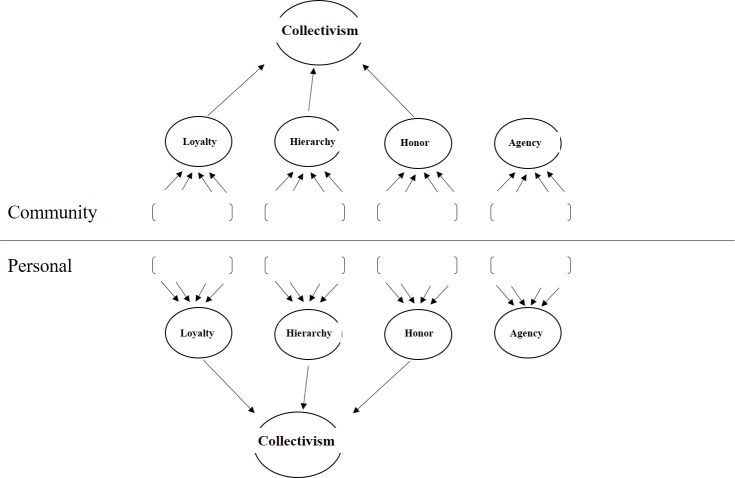
Culture shapes individuals, but the measurement of cultural differences has proven a challenge. Traditional measures of cultural values focus on individual perceptions. We suggest that values are established and maintained within social communities of proximate others, such as the family and its social environment. Within such communities, values serve to maintain collective harmony whilst preserving individual agency. From a social-dynamic analysis of communities, we infer that community values of loyalty regulate individual commitment, values of honor regulate norm compliance, and values of group hierarchy maintain a division of labor. In addition, communities may regulate the ways in which individuals have independent agency. A new scale to measure these values was validated in four studies (N = 398, 112, 465 and 111) among Dutch (religious and non-religious), Turkish-Dutch, Surinamese and Turkish groups. Values and practices were measured at the level of the individual ('What do you value?') and at the level of the perceived community ('What does your community value?'). Results show that, unlike individual-level measures of individualism/collectivism, this scale has excellent reliability, differentiates between cultural groups, and has predictive validity for future (voting) behavior. This approach provides a new way of conceptualizing culture, a new measure of collectivism and new insights into the role of proximate others in shaping culture.
文化塑造个体,但事实证明,衡量文化差异是一项挑战。传统的文化价值观衡量方法侧重于个体认知。我们认为,价值观是在诸如家庭及其社会环境等亲近他人的社会群体中确立和维持的。在这样的群体中,价值观有助于维持集体和谐,同时保留个体能动性。通过对群体进行社会动态分析,我们推断,忠诚的群体价值观调节个体承诺,荣誉价值观调节规范遵守,群体等级价值观维持劳动分工。此外,群体可能会规范个体拥有独立能动性的方式。在四项研究(样本量分别为N = 398、112、465和111)中,对荷兰人(包括信教和不信教的)、土耳其裔荷兰人、苏里南人和土耳其群体验证了一种衡量这些价值观的新量表。价值观和行为在个体层面(“你重视什么?”)和感知到的群体层面(“你的群体重视什么?”)进行衡量。结果表明,与个人主义/集体主义的个体层面衡量方法不同,该量表具有出色的信度,能够区分不同文化群体,并且对未来(投票)行为具有预测效度。这种方法提供了一种新的文化概念化方式、一种新的集体主义衡量方法,以及对亲近他人在塑造文化中的作用的新见解。