Kroehne Volker, Tsata Vasiliki, Marrone Lara, Froeb Claudia, Reinhardt Susanne, Gompf Anne, Dahl Andreas, Sterneckert Jared, Reimer Michell M
DFG-Center for Regenerative Therapies Dresden, Cluster of Excellence, Technische Universität DresdenDresden, Germany.
Deep Sequencing Group, Center for Molecular and Cellular Bioengineering (CMCB), Biotechnologisches Zentrum (BIOTEC), Technische Universität DresdenDresden, Germany.
Front Cell Neurosci. 2017 Sep 14;11:284. doi: 10.3389/fncel.2017.00284. eCollection 2017.
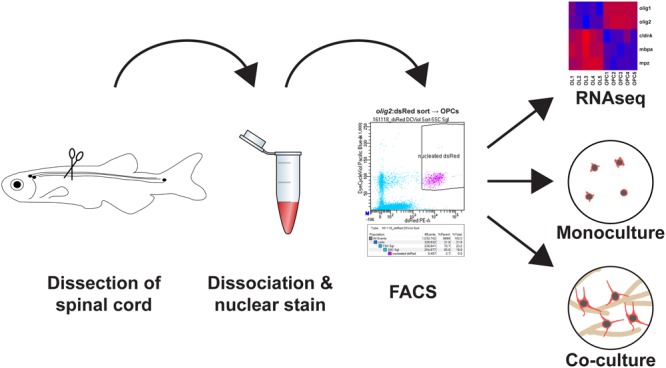
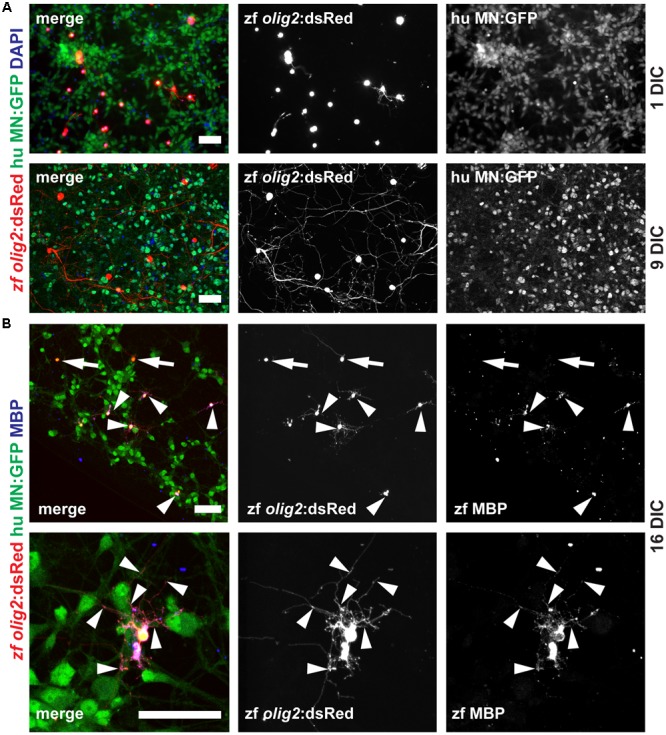
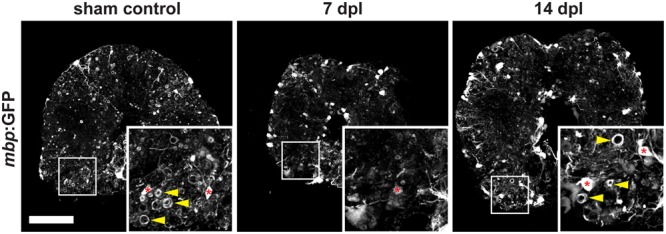
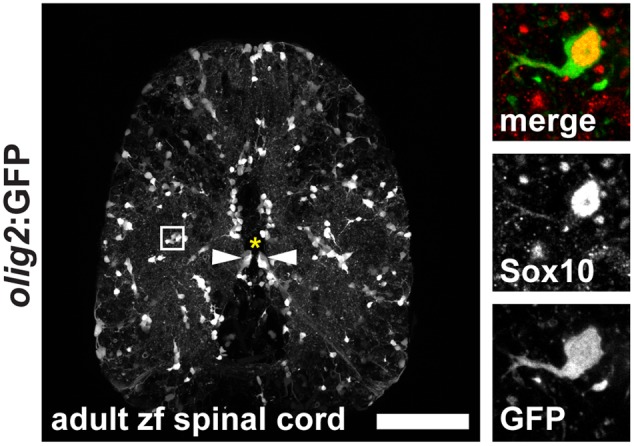
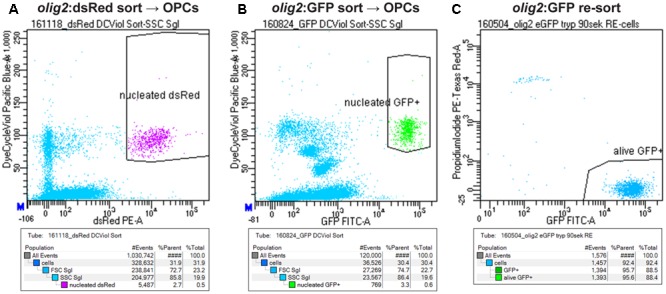
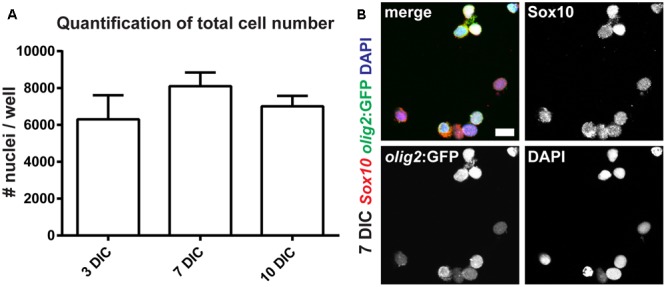
Endogenous oligodendrocyte progenitor cells (OPCs) are a promising target to improve functional recovery after spinal cord injury (SCI) by remyelinating denuded, and therefore vulnerable, axons. Demyelination is the result of a primary insult and secondary injury, leading to conduction blocks and long-term degeneration of the axons, which subsequently can lead to the loss of their neurons. In response to SCI, dormant OPCs can be activated and subsequently start to proliferate and differentiate into mature myelinating oligodendrocytes (OLs). Therefore, researchers strive to control OPC responses, and utilize small molecule screening approaches in order to identify mechanisms of OPC activation, proliferation, migration and differentiation. In zebrafish, OPCs remyelinate axons of the optic tract after lysophosphatidylcholine (LPC)-induced demyelination back to full thickness myelin sheaths. In contrast to zebrafish, mammalian OPCs are highly vulnerable to excitotoxic stress, a cause of secondary injury, and remyelination remains insufficient. Generally, injury induced remyelination leads to shorter internodes and thinner myelin sheaths in mammals. In this study, we show that myelin sheaths are lost early after a complete spinal transection injury, but are re-established within 14 days after lesion. We introduce a novel, easy-to-use, inexpensive and highly reproducible OPC culture system based on dormant spinal OPCs from adult zebrafish that enables analysis. Zebrafish OPCs are robust, can easily be purified with high viability and taken into cell culture. This method enables to examine why zebrafish OPCs remyelinate better than their mammalian counterparts, identify cell intrinsic responses, which could lead to pro-proliferating or pro-differentiating strategies, and to test small molecule approaches. In this methodology paper, we show efficient isolation of OPCs from adult zebrafish spinal cord and describe culture conditions that enable analysis up to 10 days . Finally, we demonstrate that zebrafish OPCs differentiate into Myelin Basic Protein (MBP)-expressing OLs when co-cultured with human motor neurons differentiated from induced pluripotent stem cells (iPSCs). This shows that the basic mechanisms of oligodendrocyte differentiation are conserved across species and that understanding the regulation of zebrafish OPCs can contribute to the development of new treatments to human diseases.
内源性少突胶质前体细胞(OPCs)是通过对裸露且因此易受损的轴突进行髓鞘再生来改善脊髓损伤(SCI)后功能恢复的一个有前景的靶点。脱髓鞘是原发性损伤和继发性损伤的结果,导致传导阻滞和轴突的长期退化,随后可能导致其神经元的丧失。对SCI的反应中,静止的OPCs可被激活,随后开始增殖并分化为成熟的髓鞘形成少突胶质细胞(OLs)。因此,研究人员努力控制OPCs的反应,并利用小分子筛选方法来确定OPCs激活、增殖、迁移和分化的机制。在斑马鱼中,溶血磷脂酰胆碱(LPC)诱导脱髓鞘后,OPCs可使视束轴突重新髓鞘化,恢复到全厚度髓鞘。与斑马鱼不同,哺乳动物的OPCs对兴奋性毒性应激高度敏感,这是继发性损伤的一个原因,且髓鞘再生仍然不足。一般来说,损伤诱导的髓鞘再生导致哺乳动物的节间较短且髓鞘较薄。在本研究中,我们表明在完全脊髓横断损伤后髓鞘早期丢失,但在损伤后14天内重新建立。我们基于成年斑马鱼的静止脊髓OPCs引入了一种新颖、易用、廉价且高度可重复的OPC培养系统,用于分析。斑马鱼OPCs很强健,可轻松以高活力纯化并用于细胞培养。该方法能够研究为什么斑马鱼OPCs比其哺乳动物对应物髓鞘再生更好,确定可能导致促增殖或促分化策略的细胞内在反应,并测试小分子方法。在这篇方法学论文中,我们展示了从成年斑马鱼脊髓中高效分离OPCs,并描述了能够进行长达10天分析的培养条件。最后,我们证明当与从诱导多能干细胞(iPSCs)分化而来的人类运动神经元共培养时,斑马鱼OPCs可分化为表达髓鞘碱性蛋白(MBP)的OLs。这表明少突胶质细胞分化的基本机制在物种间是保守的,并且了解斑马鱼OPCs的调控有助于开发针对人类疾病的新疗法。